

Sabarimala women entry: SC’s 9-judge bench to begin hearing 2 days before Kerala goes to polls
Mail This Article


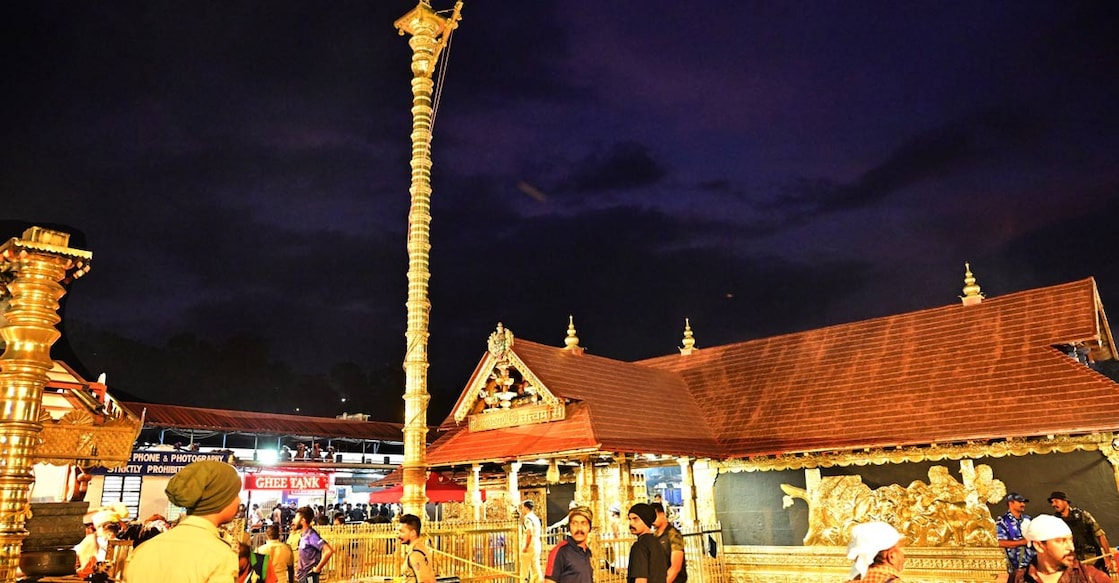
As Kerala heads into Assembly elections on April 9, the Supreme Court is set to commence hearings on the Sabarimala reference matter from April 7, placing the politically sensitive issue back in focus just days before voting. The counting of votes is scheduled for May 4.
The timing is significant, with the ruling LDF government, led by Pinarayi Vijayan, aiming for a historic third consecutive term, even as the Opposition UDF has accused it of softening its stand on women’s entry into the Sabarimala temple ahead of the polls. The state has also recently told the Supreme Court that any decision to alter the long-standing practice at the temple should come only after extensive consultation with religious scholars and social reformers within the Hindu community.
The newly constituted nine-judge Constitution Bench will be led by Chief Justice of India Surya Kant. The Bench also includes Justices B V Nagarathna, M M Sundresh, Ahsanuddin Amanullah, Aravind Kumar, Augustine George Masih, Prasanna B Varale, R Mahadevan and Joymalya Bagchi. The reference goes beyond the Sabarimala dispute, examining key constitutional questions such as the balance between the right to freedom of religion and fundamental rights like equality and dignity, as well as the scope of judicial review in matters of essential religious practices.
The first Pinarayi Vijayan government had welcomed the 2018 verdict, calling it a reflection of Kerala’s renaissance values, despite strong opposition from the Congress, BJP and various religious groups. However, it is alleged that the government later moderated its stance amid growing anti-incumbency sentiment. Meanwhile, Kerala Devaswom Minister V N Vasavan recently reiterated that the State’s position remains consistent with the affidavit it filed in 2007. He maintained that the government stands with devotees and would abide by the Supreme Court’s final decision.
The 2018 verdict, delivered by a 4:1 majority, allowed women of all age groups to enter the Sabarimala temple, stating that “devotion cannot be subjected to gender discrimination.” The majority judgment was authored by then Chief Justice Dipak Misra, along with Justices R F Nariman, A M Khanwilkar and D Y Chandrachud. Justice Indu Malhotra dissented. The Court also ruled that devotees of Lord Ayyappa do not constitute a separate religious denomination and struck down Rule 3(b) of the Kerala Hindu Places of Public Worship (Authorisation of Entry) Rules, 1965, which barred women’s entry.
Subsequent review petitions led to a 2019 ruling by a five-judge Bench headed by then CJI Ranjan Gogoi. By a 3:2 majority, the Court referred larger constitutional questions to a nine-judge Bench, noting overlaps with issues in other cases, including women’s entry into mosques, the practice of female genital mutilation in the Dawoodi Bohra community, and the rights of Parsi women married outside their community.
In 2020, the Supreme Court formally constituted the nine-judge Bench to examine these broader questions. It framed seven key issues:
1. What is the scope and ambit of the right to freedom of religion under Article 25 of the Constitution of India?
2. What is the interplay between the rights of persons under Article 25 of the Constitution of India and the rights of religious denominations under Article 26 of the Constitution of India?
3. Whether the rights of a religious denomination under Article 26 of the Constitution of India are subject to other provisions of Part III of the Constitution of India apart from public order, morality and health?
4. What is the scope and extent of the word 'morality' under Articles 25 and 26 of the Constitution of India, and whether it is meant to include Constitutional morality?
5. What is the scope and extent of judicial review with regard to a religious practice as referred to in Article 25 of the Constitution of India?
6. What is the meaning of the expression "Sections of Hindus" occurring in Article 25 (2) (b) of the Constitution of India?
7. Whether a person not belonging to a religious denomination or religious group can question a practice of that religious denomination or religious group by filing a PIL?
The proceedings have also drawn interventions from bodies such as the All India Muslim Personal Law Board and certain Jain organisations, highlighting the wider implications of the case across faiths. More recently, in February 2023, the Court referred the issue of excommunication in the Dawoodi Bohra community to the same nine-judge Bench, further expanding the scope of the proceedings.
(With inputs from LiveLaw)
