

Sabarimala women entry: Some temples also restrict men, Centre tells SC
Mail This Article


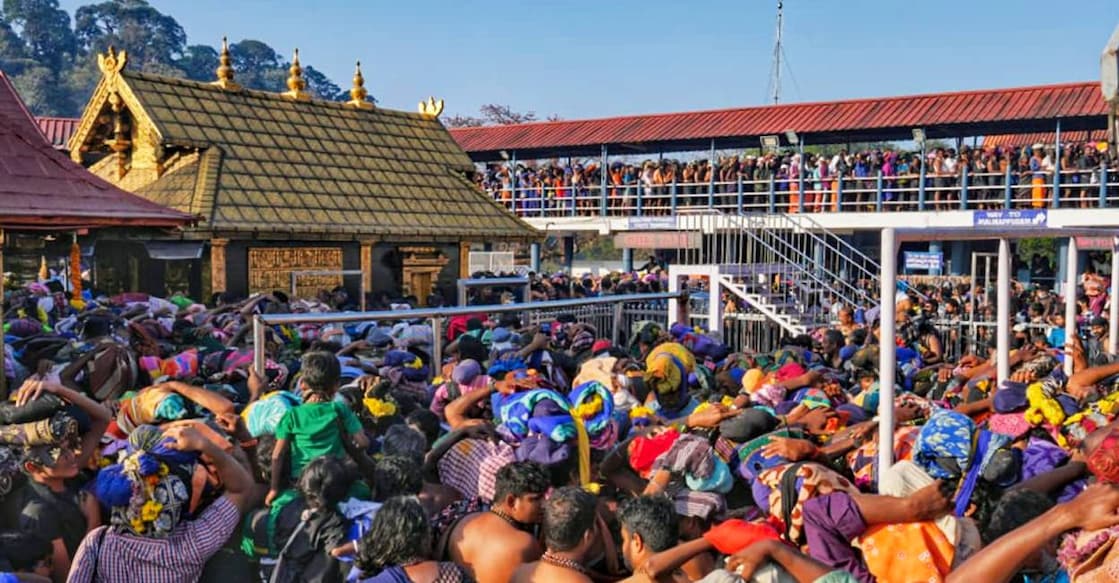
Pathanamthitta/New Delhi: The Centre on Thursday told the Supreme Court that some temples restrict entry for men as well, arguing that the ban at the Sabarimala temple for menstruating women is not solely based on gender. The submission was made before a nine-judge Constitution Bench, which started examining key questions on religious rights and freedoms on Tuesday.
Appearing for the government, Solicitor General Tushar Mehta said the Supreme Court’s 2018 judgment allowing entry of women of all age groups to Sabarimala proceeded on the assumption that men were considered superior and women were on a lower pedestal.
“I have given instances of temples where men are not allowed. Because it is a Devi Bhagwati temple, there are certain faiths and beliefs. There are temples… where male priests are under a religious mandate to wash the feet of female devotees. There are temples like the Pushkar temple… where married men are not allowed. There is also a temple in Kerala where… men will go dressed as women… Only males go there. So it is not a question of male-centric or female-centric religious beliefs. In the present case, it happens to be woman-centric,” Mehta said.
The submission was made before a nine-judge Constitution Bench examining legal questions related to religious rights and freedoms. The Bench is headed by Chief Justice of India Surya Kant and includes Justices B V Nagarathna, M M Sundresh, Ahsanuddin Amanullah, Aravind Kumar, Augustine George Masih, Prasanna B Varale, R Mahadevan and Joymalya Bagchi.
During the hearing, Justice Nagarathna observed that everybody must have access to every temple and matha, clarifying that her remarks were independent of the Sabarimala issue. “If you say: ‘it is my practice… that only my section… must attend my temple and none else’, that is not good for Hinduism,” she said.
Justice Aravind Kumar added that such a stance would divide society.
Senior advocate C S Vaidyanathan said there are temples, including private ones, where outsiders are not allowed. “Denominations also… if they want only for the denominations, they can’t seek funds from the State… Question is whether it is contrary to the Constitutional prohibition?” he said.
He further argued that Hindu temples would be disadvantaged if Article 25(2)(b) — which allows the State to open Hindu religious institutions to all sections — is interpreted to override Article 26(b), which guarantees the right to manage religious affairs.
Justice Nagarathna responded that Article 25(2)(b) exists because of the historical context of Hindu society. The CJI said the argument may not hold. “These arguments probably will not survive… One, what you are arguing is directly in the teeth of the language of Article 25(2)(b)… Article 26 itself is subject to public order, morality and health. Article 17 is on principle of morality,” he said.
Vaidyanathan replied that if a law meets those conditions, he would have nothing further to argue. Justice Nagarathna added, “If we restrict it to a particular denomination, it may itself be contrary to morality under Article 26.”
(With Bar and Bench inputs)
 Add as a preferred source on Google