

Difficult to declare faith of millions wrong: Supreme Court during Sabarimala hearing
Mail This Article


New Delhi: The Supreme Court of India on Wednesday observed that it would be difficult for a court to declare the faith of millions as wrong, during the ongoing hearing in the Sabarimala reference case.
On the fourth day of proceedings before a nine-judge Constitution bench, headed by Chief Justice Surya Kant, senior advocate Abhishek Manu Singhvi appeared for the Travancore Devaswom Board and argued for a stricter threshold in entertaining public interest litigations (PILs) challenging religious practices.
Addressing one of the key issues in the reference, Singhvi submitted that courts should be cautious in admitting PILs filed by persons who do not belong to the concerned religion. He argued that centuries-old practices at temples such as Sabarimala Temple and Guruvayur Temple should not be questioned through third-party petitions.
During the hearing, Justice Joymalya Bagchi posed a hypothetical scenario, asking whether the court could intervene if a religious leader preached mass suicide as a path to salvation. Singhvi described it as an “extreme case” where intervention might be justified, while maintaining that the general rule should be non-interference. The Chief Justice remarked that in such exceptional situations, the court could even act suo motu.
Clarifying that he was not seeking an absolute bar on PILs, Singhvi said the threshold for such petitions in matters of religion should be significantly higher than in other cases. He stressed that courts should not adjudicate the validity of religious practices without hearing the believers, adding that “religion is a faith of millions” and third parties should not be allowed direct access under Article 32 to alter it.
Justice B V Nagarathna said that PILs filed by “interlopers” questioning religious practices could be dismissed on the ground that the aggrieved persons themselves had not approached the court. Justice M M Sundresh also questioned whether the court could decide such matters without hearing the millions who follow the faith.
“The most difficult task is how to declare that the belief of millions is wrong or erroneous,” the Chief Justice observed during the hearing.
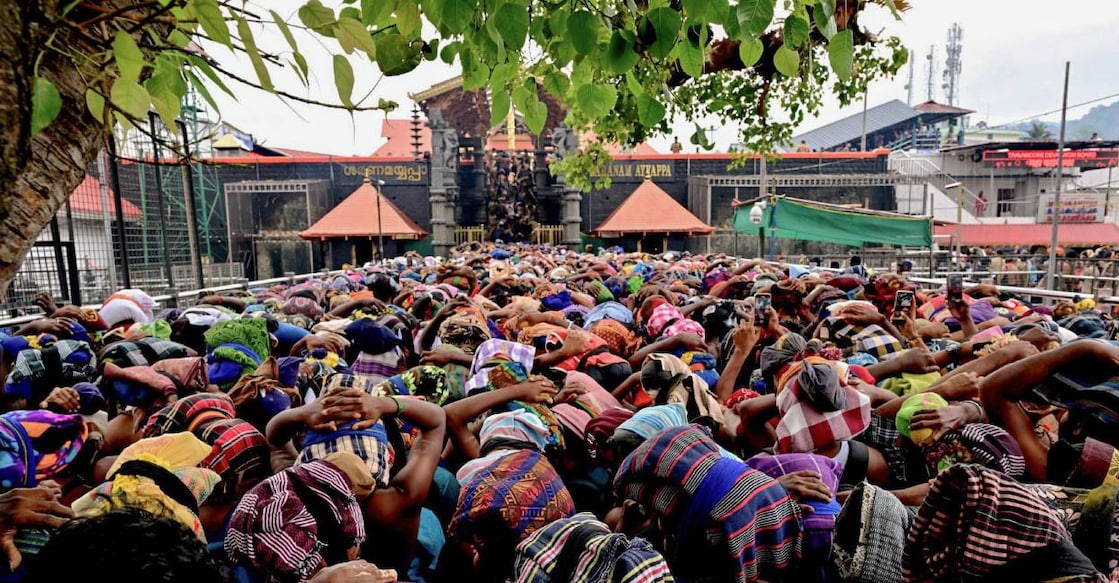
Singhvi further argued that the Sabarimala issue cannot be decided in abstract constitutional terms without considering the unique religious character of the deity. He submitted that Lord Ayyappa is worshipped at Sabarimala in the form of a ‘Naisthika Brahmachari’ (eternal celibate), and that the temple’s rituals, including the 41-day ‘vratam’, are intrinsically linked to this belief.
Responding to concerns of gender discrimination, Singhvi contended that the practice does not amount to a total exclusion of women, as those below 10 years and above 50 years are allowed entry. He argued that the restriction is based on age classification rather than gender, and is aimed at preserving the essential character of the deity.
He also noted that women in the restricted age group are not barred from worshipping Lord Ayyappa altogether, as they can visit other Ayyappa temples.
The Constitution bench hearing the matter comprises the Chief Justice and Justices Nagarathna, Sundresh, Ahsanuddin Amanullah, Aravind Kumar, Augustine George Masih, Prasanna B Varale, R Mahadevan and Justice Bagchi. The hearing in the Sabarimala reference case is currently in its fourth day.
(With LiveLaw inputs.)
