

India's seafood exports hit record high of $8.46 billion in FY 2025-26; shrimp continues to drive growth
Mail This Article


Kochi: Defying challenging global market conditions, India's seafood exports surged to an all-time high in both volume and value during the financial year 2025-26, reaffirming the country's position as one of the world's leading seafood suppliers.
According to the data released by the Marine Products Export Development Authority (MPEDA), which is the agency for the holistic development of the seafood industry in India, India exported 19,72,018 metric tonnes (MT) of seafood worth ₹73,890.46 crore (US $8.46 billion) during the fiscal year, marking the highest-ever export performance achieved by the sector.
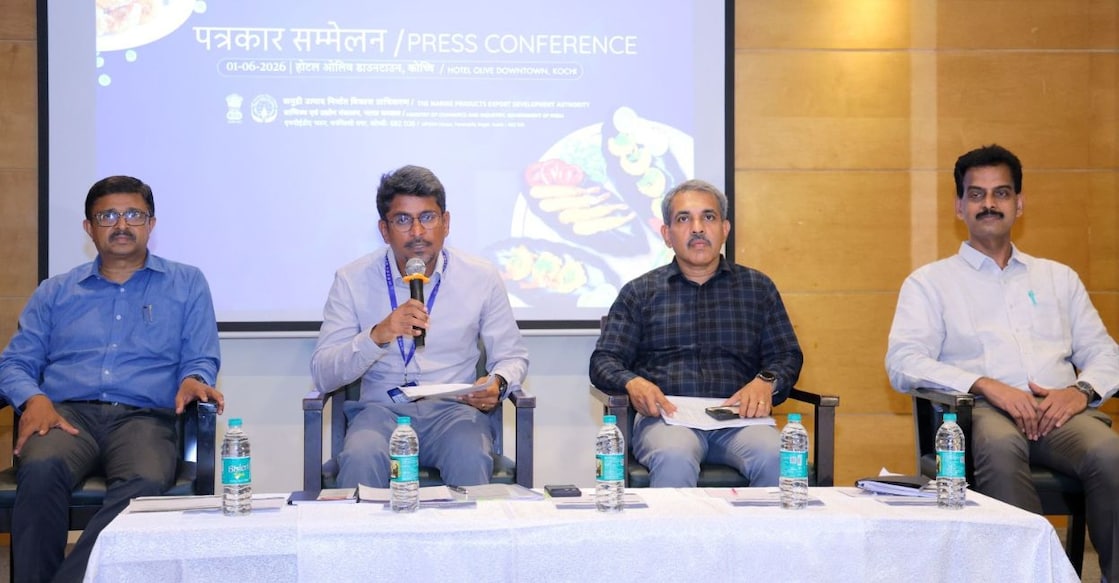
MPEDA chairman P Jawahar said that the United States and China continued to dominate as the largest importers of Indian seafood, while frozen shrimp remained the undisputed star performer, accounting for more than two-thirds of the country's seafood export earnings.
Frozen shrimp exports generated ₹49,037.93 crore (US $5,624.48 million), contributing 40.19% of the total export volume and an impressive 66.52% of India's total seafood export earnings in dollar terms. Shrimp exports registered healthy growth, rising by 13.16% in rupee value and 8.64% in dollar value compared to the previous year.
India exported a total of 7,92,647 MT of frozen shrimp during the year. The United States remained the largest buyer, importing 2,56,128 MT, followed by China (1,69,505 MT), the European Union (1,35,599 MT), South-East Asia (83,810 MT), Japan (40,776 MT) and the Middle East (30,478 MT). Other countries together imported 76,351 MT. Exports of both L. Vannamei Shrimp (Whiteleg Shrimp) and Black Tiger Shrimp recorded growth in volume as well as value.
Beyond shrimp, frozen fish emerged as the second-largest export category, earning ₹5,658.37 crore (US $643.70 million). Dried seafood products secured the third position, generating ₹5,079.09 crore (US $577.44 million) and registering a remarkable 78.05% increase in rupee value, making it one of the fastest-growing segments in the sector.
Exports of frozen squid reached 1,02,060 MT, earning ₹4,493.80 crore (US $513.84 million). Meanwhile, frozen cuttlefish also posted strong growth, with export volumes rising 13.32% and dollar earnings increasing 16.25%. Total cuttlefish exports stood at 67,157 MT, valued at US $331.96 million.
The export of chilled seafood products generated ₹622.31 crore (US $71.27 million), while live seafood exports showed an encouraging 11.46% growth in dollar value, reaching US $62.43 million.
In terms of destination markets, the United States remained India's largest seafood importer by value, purchasing seafood worth ₹20,263.27 crore (US $2,328.74 million) and importing 2,79,193 MT. However, exports to the US witnessed a decline, falling 10.82% in rupee value, 14.22% in dollar value, and 19.51% in volume compared to the previous year. Despite the decline, frozen shrimp dominated India's seafood exports to the US, accounting for 93.55% of export earnings from that market.
China emerged as the largest destination by volume, importing 4,90,369 MT of Indian seafood worth US $1,611.32 million.
The European Union retained its position as the third-largest market in terms of value, importing 2,97,518 MT worth US $1,592.09 million. It was followed by South-East Asia, which imported 4,51,756 MT valued at US $1,348.97 million.
Japan continued as the fifth-largest importer by value, purchasing 1,05,228 MT worth US $452.91 million, while the Middle East ranked sixth with imports of 76,743 MT valued at US $283 million.
On the logistics front, Visakhapatnam (Vizag), Jawaharlal Nehru Port Trust (JNPT), and Kochi emerged as the country's top three ports handling seafood cargo during the year, reflecting their growing importance in India's booming marine exports sector.
Jawahar said that the record-breaking performance underscores the resilience of India's seafood industry and the sustained global demand for its marine products, particularly shrimp, despite uncertainties in international trade and market conditions, especially the Middle East tensions.
