

How Wayanad tunnel project in landslide-prone area finally secured environment clearance
Mail This Article


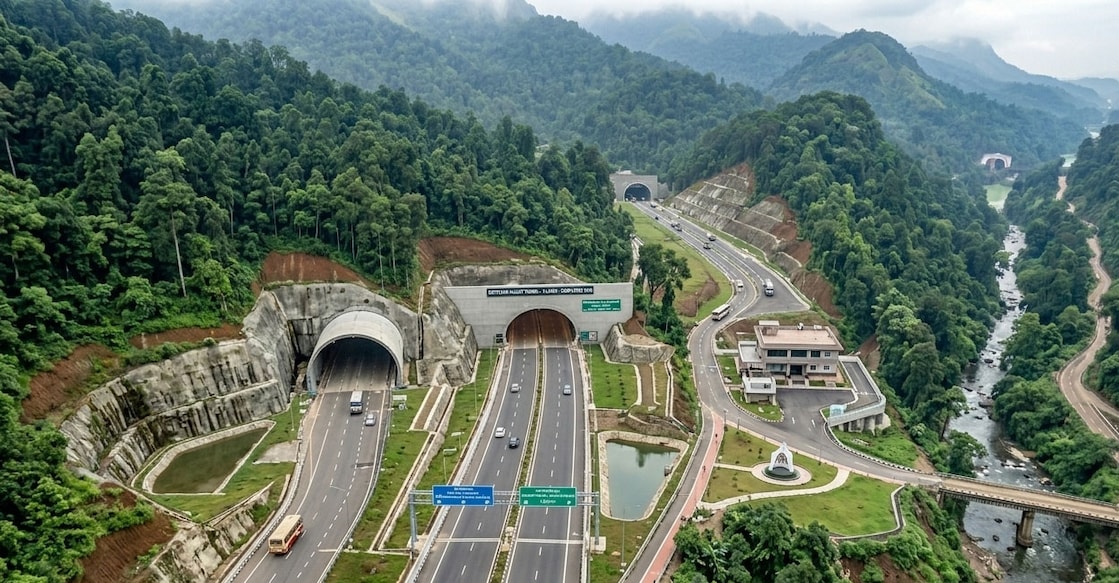
On March 2, 2025, the State-Level Expert Appraisal Committee (SEAC) granted environmental clearance (EC) for the ₹2,043.74-crore 8.753-km tunnel road between Wayanad's Kalladi and Kozhikode's Anakkampoyil.
Even while granting the EC, the SEAC had expressed serious ecological concerns. One, the tunnel alignment passes through highly fragile terrain prone to landslides, where a massive, destructive landslide occurred in 2019 (Puthumala) and 2024 (Mundakkai-Chooralmala).
Two, the project has rich biological diversity. Part of Nilgiri Biosphere Reserve falls within the 10 km radii of the project alignment, and is home to innumerable endangered bird species like Banasura Chilappan and Nilgiri Sholakili.
Three, four tribal colonies are located within the 500 to 1.5 km of the proposed tunnel road in the northern side. A tribal settlement, Aranamala Kattunaikka Colony with 27 families, has been identified as project-affected family (PAF) and is entitled to fair compensation, rehabilitation and resettlement.
Four, the project area falls in the villages categorized as Ecologically Sensitive Area (ESA); Thiruvambady Village in Kozhikode and Vellarimala Village in Wayanad are ESA Villages.
Nearly 80 per cent of the under construction tunnel - 5.76 km - passes through the forest and 17.263 hectares of forest land will be utilised for the project.

The SEAC had to repeatedly make the Public Works Department, the project proponent, rework its reports before it finally granted clearance.
The PWD's first report seeking environment clearance for the tunnel project did not adequately address the potential consequences of a heavy-intensity blast-driven tunnel project in such a hazardous landslide-prone zone. The SEAC asked the PWD to submit 28 additional documents for further appraisal of its application for environmental clearance.
Even these additional documents did not factor in the vibration and 'overpressure impact' of blasting at various distances and also on the nearby built structures. So the PWD was ordered to provide a historical study of landslides in the area by examining in detail the possibility of construction-induced landslide incidents in the area based on detailed evaluation of the causative factors and impacts of the severe landslide experienced in the area over the years.
It was only then that the PWD acknowledged that the proposed project area fell in an environmentally fragile region and a high landslide hazard zone. It then submitted a revised report in which it evaluated in detail the causative factors of the Puthumala, Chooralmala and Mundakkai landslides. The report provided insights into a range of factors like the landslide hazard, debris flow mechanism, the rock characteristics, seismicity of the region, the land use and landscape alteration of the area, drainage characteristics, ground water seepages, landslip in areas above the tunnel, ground vibration from tunnel blasting, overburden characteristics, tunnel stability rate, unanticipated water ingress during the tunnelling process, and ecological impacts, particularly elephant movement and human-wildlife interaction.
The PWD also assured that the tunnelling would be done by a careful drilling and controlled blasting methodology. It also suggested the adoption of New Austrian Tunneling Method (NATM) or Tunnel Boring Machine (TBM).
Based on the PWD report and the exhaustive environment literature it depended on, the SEAC identified two minor fault lineaments (features on the earth's surface that reveal the presence of fracture zones) in the project area. But these were not considered consequential.
However, the funds set apart for mitigating the environmental consequences of the project was a paltry ₹1.02 crore. At the SEAC's insistence, it was increased to ₹15 crore. The SEAC said even this was inadequate as it involved, among other things, the restoration of the Appankappu Elephant Corridor and the rehabilitation of tribal families. However, the SEAC did not take its disappointment further.
Eventually, the EC was granted considering the environmental cost-benefit ratio of 23.7 shown in the Environment Impact Assessment. This means that for every one rupee spent, the society would gain ₹23.7.
The SEAC, while granting the EC, laid down 25 conditions to mitigate the adverse impacts of the project. Here is one: "Construction material of any kind should not be dumped on public roads or pavements or near the existing facilities outside the project site."
 Add as a preferred source on Google