
Retired teacher from Kottayam develops sanctuary of 300 mango varieties
Mail This Article


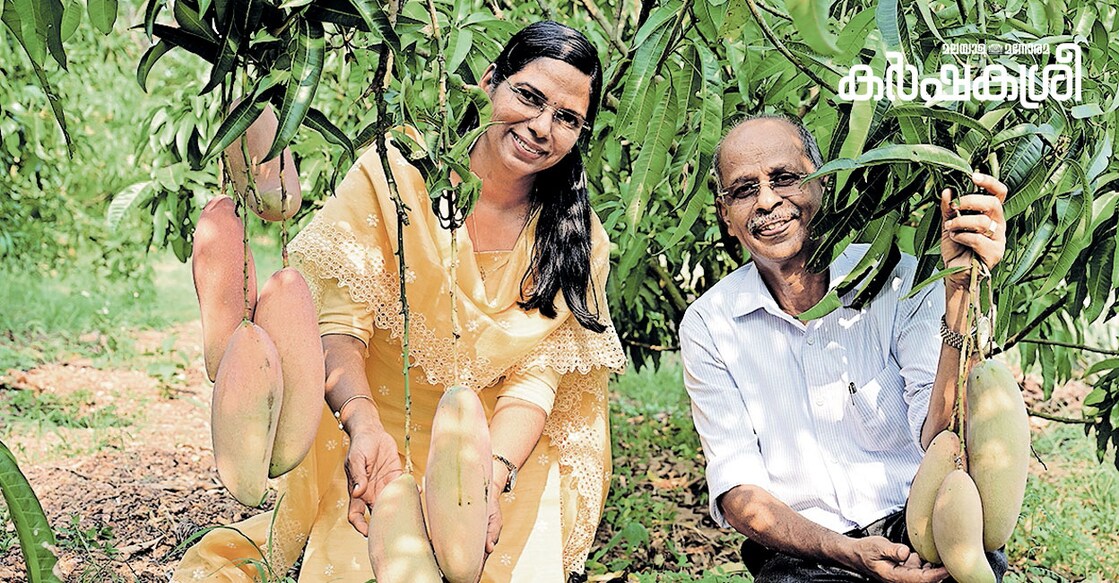
Imagine walking into an orchard where a single tree might bear three or four distinct kinds of mangoes, and the air is heavy with the rich, nostalgic scent of heritage fruits. This is the sensory reality at 'Mango Hives', a farm located in Uppani, near Kaduthuruthy in Kottayam district, Kerala. Lovingly built by Dr Johny Thomas, a retired higher secondary school principal with a doctorate in Botany, this spectacular estate houses 350 mango trees spanning an astonishing 300 varieties.
For generations of Indians who grew up in the countryside, names like Karppoora, Kilichundan, Moovandan, and Vellamkolli evoke sweet childhood memories of throwing stones at loaded branches. Dr Johny was no different. Dismayed by how quickly traditional homestead trees and local varieties were being cleared to make way for modern developments, he decided to dedicate his post-retirement life to their conservation. Two years before completing his service in Lakshadweep, he began sourcing rare saplings, nurturing them in grow bags on his terrace. When he retired six years ago, he returned to his 1.5-acre ancestral plot to plant them in the ground.

An open-air museum of heritage mangoes
Today, his orchard is a thriving live gene bank. Alongside local legends like Kakkothi, Ngettiriyan, Thali, Olour, Chandrakkaran, and Salem, the farm boasts international superstars. Visitors will find Thailand's famous Nam Dok Mai, the evergreen Catimon, and even the Florida-bred Orange Sherbet. Dr Johny systematically documents the history of every variety, tagging each tree with its name and geographical origin.
Rescuing varieties from the brink of extinction
Dr Johny's passion goes far beyond a leisure hobby; it is a vital botanical rescue mission. He points to the famous 'Jailer' mango—a heritage variety once common in Kerala that was on the verge of disappearing forever. When the last known tree of its kind was cut down, a dedicated network of native plant enthusiasts managed to secure its scions. Dr Johny sourced a grafted sapling from them, successfully preserving its lineage. Though he sells some produce to local buyers to offset the cost of protective orchard maintenance, commercial profit is never the goal. For him, the true rewards are health and peace of mind. He and his family spend hours in the orchard every day weeding, manuring, and pruning, transforming farm work into an ideal fitness routine.
Scientific high-density farming techniques
The estate's layout is a lesson in smart agriculture. Originally a steep rubber plantation, the land was excavated to a depth of one metre using heavy machinery, and the pits were enriched with organic fertilisers like neem cake, bone meal, and cow dung. The trees are planted just ten feet apart using a high-density system. By carefully pruning and training the branches, Dr Johny keeps the trees at a manageable height of 8 to 10 feet. This compact stature makes it easy to bag the developing fruits in protective sleeves, safeguarding them from fruit flies and ensuring clean, premium, export-quality produce.
The recipe for a perfect mango
Having sampled hundreds of varieties, Dr Johny remains a staunch champion of native Indian cultivars, with 'Priyoor' being his absolute favourite. He explains that while foreign varieties are often selectively bred for uniform size and bright colour, they rarely match the complex flavour profiles of traditional Indian fruits. According to him, a truly perfect mango requires a precise balance of intense sweetness, distinct aroma, and a subtle, refreshing touch of acidity. For home gardeners with limited space, he recommends varieties like Kalapady, Kulambu, Sindooram, and Moovandan.
The urban solution: multi-grafting
For urban fruit lovers facing space constraints, Dr Johny strongly advocates multi-grafting—the art of growing multiple varieties on a single rootstock. By planting a hardy rootstock like Kulambu or Moovandan in a cut plastic drum or a large paint bucket, home gardeners can graft up to four different premium varieties onto a single trunk.
Grafting also drastically reduces the time it takes for a tree to bear fruit, turning a five-year wait into just one. While Dr Johny does not currently sell saplings to ensure quality control, he and his wife, Rani share their agricultural expertise through their popular YouTube channel, 'Mango Hives', which is shot and edited by their IT-professional son Jerry.
 Add as a preferred source on Google