

How this young Kannur farmer turned his black pepper nursery into a goldmine of biodiversity
Mail This Article


At Kaliyani Farm in Chandanakkampara, Payyavoor, in Kannur district, you will find a lush landscape teeming with everything from cashew, vanilla, coconut, and areca nut to banana, elephant foot yam, taro, and sweet potato. Yet, it is not just this impressive crop diversity that draws farmers from across the state to this hill-range homestead. They come seeking the nursery’s crown jewel: high-yielding black pepper saplings, alongside invaluable hands-on advice on cultivating them successfully.
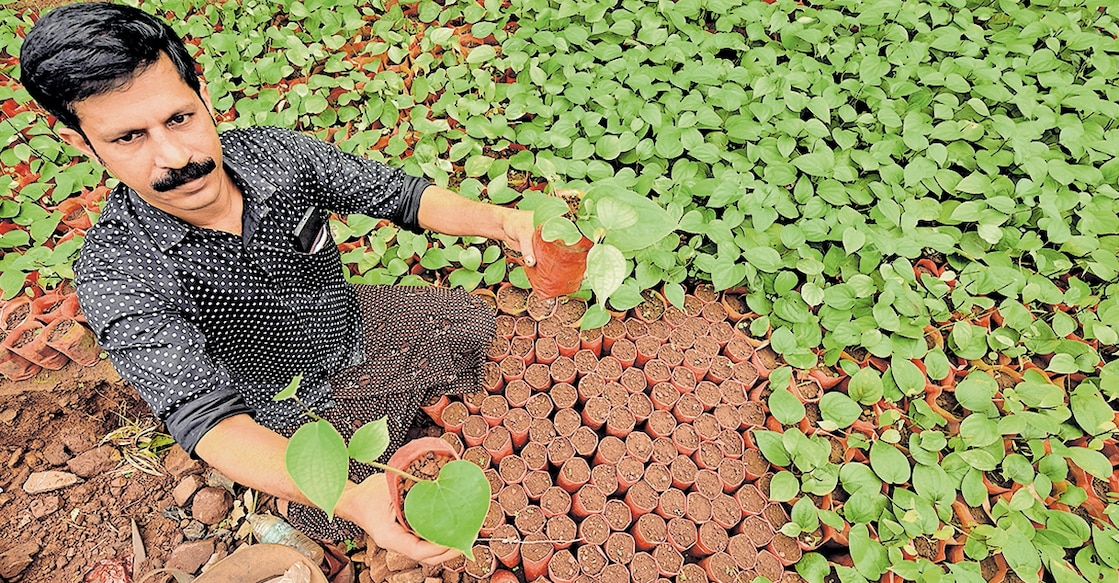
Managed by Jinesh Kaliyani, a young, forward-thinking farmer, the nursery produces 18 distinct varieties of black pepper. Every single sapling is cultivated using the specialised 'Nagappathi' propagation method, ensuring robust root systems and vigorous growth. For Jinesh, farming is far more than a source of income; it is a legacy. Having learned the ropes as a child from his father, veteran hill farmer George Kaliyani, Jinesh has transformed his family estate into a vibrant hub for agricultural education, sharing his hard-earned expertise with anyone eager to learn.
The power of mixed farming
Monoculture can be a risky gamble, which is why Jinesh champions a biodiversity-rich, mixed-cropping system. His farm hosts around 600 pepper vines belonging to several elite varieties. This includes the Panniyur research centre's popular selections (Panniyur 1 to 10), alongside high-performing varieties like Vijay, Panchami, Pournami, Thevam, Coorg XL, and Agali Pepper. By blending different varieties, Jinesh cushions his yield against sudden pest attacks and disease outbreaks. If one strain falters, another thrives, ensuring a stable harvest year after year. This season alone, he successfully sold over 4 quintals of high-grade pepper.
Precision cultivation and organic care
Instead of traditional concrete pillars, Jinesh trains his pepper vines on native trees like payyani (Indian trumpet flower) and matti (Indian tree of heaven). These trees naturally shed leaves and let in optimal sunlight, providing the perfect microclimate for the vines. He plants his saplings in deep, well-spaced pits (1.5 metres in length, width, and depth, spaced 8 feet apart). The soil is pre-treated with lime or dolomite to neutralise acidity, and enriched with a base of coir pith compost, poultry manure, and cow dung. From then on, chemical fertilisers are strictly off-limits. Jinesh relies entirely on observation: if a vine shows signs of nutrient deficiency, he revives it with organic foliar sprays. He also encourages the vines to climb higher, as his experience has proved that taller vines yield significantly more pepper.
Seedling sales and shade tolerance
With an impressive stock of 20,000 saplings prepared this season, Jinesh caters to diverse planting environments. His three-month-old, healthy, Nagappathi-propagated saplings are priced between ₹60 and ₹100. For areas with heavy shade, he recommends shade-loving varieties like Panniyur 2, Panniyur 8, and Coorg XL. The remaining varieties thrive beautifully in sunny, open spaces.
The legendary KGI Gold cashew and Onam crops
While pepper remains his core focus, Jinesh’s intercropping strategies are equally lucrative. Beneath his crop of 500 'Manjeri Kulla' Nendran banana plants, he has planted taro, tapioca, and nearly 1,000 elephant foot yams. Timed carefully for the festive Onam market, these yams are harvested in July. Another prized asset on his farm is a unique, high-yielding cashew variety developed by his father. Dubbed 'Kaliyani George Gold' (KGI Gold), this exceptional variety yields massive nuts, requiring only 65 raw cashews to make up a full kilogram.
Sharing the knowledge wealth
Driven by a mission to help fellow farmers, Jinesh has established an agricultural information and marketing hub on a long-term leased plot in Nellikutti. Alongside a newly planted coconut grove that will bear fruit by the end of his lease, this centre serves as a school of practical farming. As Jinesh notes, more local landowners are now coming forward to lease their fallow lands, inspired by his sustainable farming model. For consultations, sapling bookings, and farming guidance, Jinesh can be reached directly on +91 8606392944.
 Add as a preferred source on Google