

No whispers; Kerala women conductors who made a loud case for menstrual leave in HC

Mail This Article


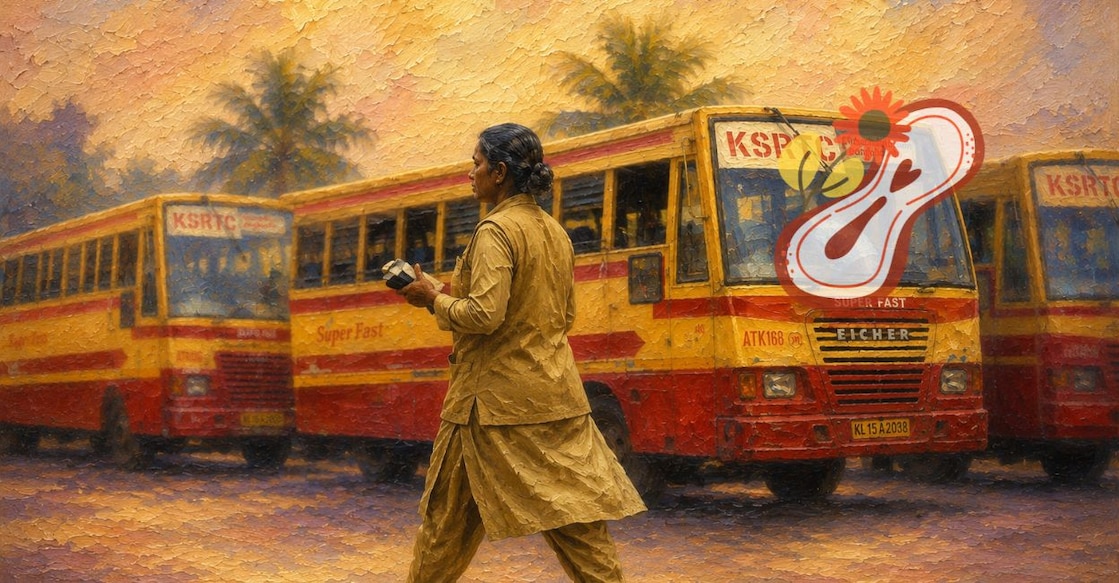
Stopping a KSRTC bus mid-route outside a medical shop to buy sanitary napkins, then waiting until the next depot to change them, has long been a harsh reality for Sreena S, a conductor with the Kerala State Road Transport Corporation (KSRTC). Like many of her women colleagues, she spends long hours on duty, stands continuously on crowded services and has little access to clean toilet facilities, making menstruation especially difficult while at work.
The ordeal prompted Sreena and two other women conductors to move the Kerala High Court, seeking two days of paid menstrual leave per month for women conductors in KSRTC. Taking note of their concerns, the court has directed the state government to consider framing an appropriate policy on the matter.
"There have been instances where colleagues stained their uniforms while on duty. We cannot leave the service midway. We have to wait until the bus reaches the next depot with enough halt to wash up and change our sanitary napkins. If we need to rest or change our clothes, we often have to wait until the trip ends," says Sreena, 43, a native of Kollam now posted at the Attingal depot.
"By then, abdominal pain, body aches and other physical discomforts become harder to bear. Despite that, we have to keep moving through crowded buses, issuing tickets and collecting fares," she adds.

The petition, filed by Sreena along with conductors Asha S S, Sajala M and the Forum for Justice (FFJ), a KSRTC employees' and family welfare society, in 2025, states that nearly 3,000 women work in the corporation's operating sector. It says conductors often work between eight and 16 hours a day with inadequate rest breaks, poor toilet facilities, limited access to water and no proper disposal system for menstrual products, resulting in physical discomfort, health issues and emotional distress.
Many women try to plan leave around their menstrual cycle, the petitioners say, but irregular periods caused by stress often make that impossible. "We have to be prepared even before the expected date. What if periods begin during a night service or on a long-distance trip where the next halt is hours away?" asks Asha (40), who also works at the Attingal depot.
"Nearly 90% of women conductors are above 40. Many have PCOD and other health issues. After the Priyadarshini free travel scheme, buses have become more crowded. There are days when we don't even get time to change a sanitary pad or drink water," she says, adding that many women avoid drinking water during duty because of the lack of accessible toilets. "Urinary infections are very common among us," she adds.
Observing that menstrual leave is a progressive welfare measure, the High Court said it recognises the physical and psychological impact of menstruation and the demanding nature of a conductor's job, which involves prolonged standing, constant movement, long working hours and limited access to hygienic restrooms. The court directed the state government to decide on the demand within three months after hearing the petitioners and KSRTC.
Asha says not everyone supports the demand. "Some ask why women should receive special treatment. My answer is simple: menstruation is unique to women. So women deserve the support needed to deal with it."
The petitioners clarify that they are seeking menstrual leave only for women conductors in the operating wing, not for all women employees of KSRTC. They hope the new state government, which has launched initiatives such as the Priyadarshini free travel scheme and proposed Project Menstrual Dignity for school students, will respond positively. Kerala has already been implementing menstrual leave for female students in state universities since 2023.
"The previous government argued that the matter was for KSRTC to decide. But under Section 34 of the Road Transport Corporations Act, policy decisions concerning transport corporations can be taken only by the state government," says advocate Anil Sivaraman, counsel for the petitioners.
He notes that Karnataka has introduced one day of paid menstrual leave every month for working women, while Bihar and Odisha have similar provisions. "Even if two days are not accepted, granting at least one day of paid menstrual leave every month would be a significant step," he says.
"We may not personally experience what our women colleagues go through, but we see their struggle every month. However, the Corporation often say the staff shortage limits them from such welfare schemes," says Riju Ramdas, an FFJ office-bearer and KSRTC conductor. "The petition is also about improving sanitation and restroom facilities in KSRTC depots."
