

Mail This Article


A few years ago, Anwar called me from Dubai. "Could you check out a plot in Chavakkad? I'm planning to build a house there," he asked. Naturally, I enquired if the area was prone to flooding. He confidently replied, "Never. Not in living memory, and there is absolutely no chance of it happening."
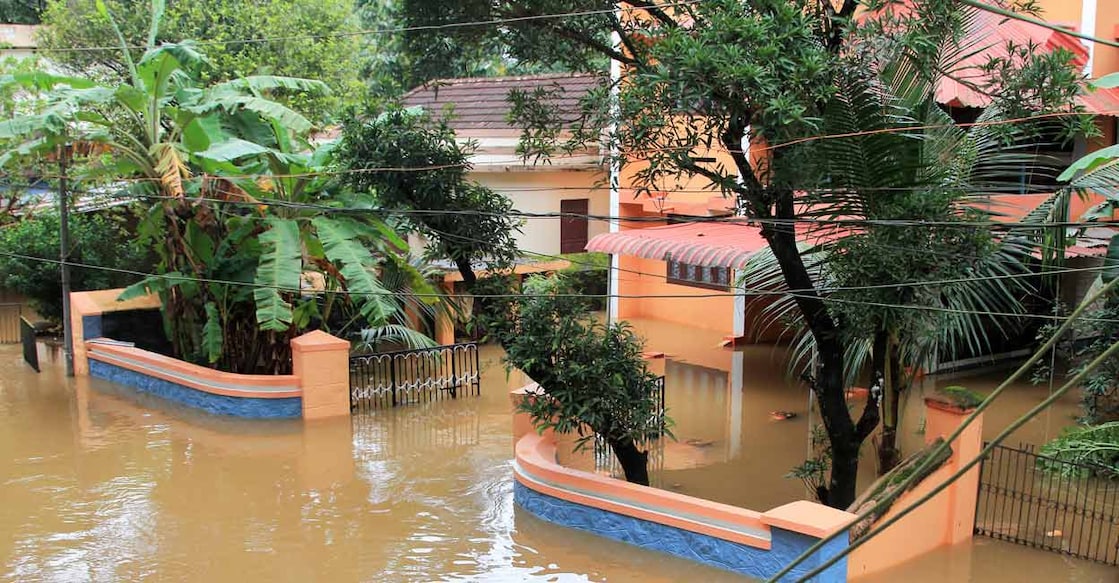
A few weeks later, in the middle of July, I navigated to the Google location he shared. Just as I approached, a group of locals flagged down my car. "You can't drive through here, the road is completely flooded," they warned. I parked and walked the remaining distance. Sure enough, the site was submerged under knee-deep water. I was intrigued. Why did a spot that had never seen a puddle suddenly turn into a mini lake?
Investigating further, I spoke to an elderly resident. The mystery was quickly solved. Behind Anwar's plot was a small open field where neighbourhood children used to play football. During heavy monsoons, this low-lying field acted as a natural holding basin for excess rainwater. Recently, the land owners built a high concrete boundary wall, blocking the water's natural escape route. The runoff, with nowhere else to go, collected straight on Anwar's plot. This story highlights the broader issue of unexpected flooding across Kerala today.
The geography of waterlogging: A double-edged sword
To understand why our homes are suddenly drowning, we must look at how Kerala's landscape was formed. Rainwater originally carved out tiny streams, which merged into canals, then into larger channels, and eventually joined major rivers flowing towards the Arabian Sea. Nature had designed a seamless drainage system.
The disruption did not start with modern skyscrapers. It began when we cleared land for farming. However, early agricultural impact was minor compared to the heavy engineering interventions of today. You do not need a massive dam or a multi-lane highway to choke a water channel; a single brick wall or a poorly planned house can do it.

Kerala's undulating terrain is both a blessing and a curse. Because our lands lie at varying heights, water normally flows down to the sea within five to six hours after the rain stops. If our topography were flat, our high water table would keep us submerged for months. However, the disadvantage of these varying levels is that any obstacle we build acts as a small retaining wall, creating a tiny artificial reservoir that floods surrounding properties.
Paving the path forward with science
What is the solution to this man-made crisis? The answer lies in rigorous topographical surveys. Local bodies, whether panchayats, municipalities, or corporations, must conduct detailed digital contour surveys, LiDAR mapping, or satellite-based assessments to understand our landscape's natural contours.
Once we map these natural water pathways, we can enforce strict zoning laws. We must mandate construction designs that do not disrupt the natural flow of water. Infrastructure like roads and bridges must be built based on historical flood data rather than arbitrary calculations.
Furthermore, drainage design must go beyond digging simple concrete trenches. It must be engineered after calculating precise water volume, slope gradients, and exit points. While we cannot stop torrential rains, we can certainly minimise the devastation they cause through smart engineering.
Immediate fixes for a pressing crisis
For existing waterlogged zones, local self-governments and district disaster management authorities must invest in high-capacity mobile flood-control pumps. These can rapidly pump out standing water from roads and residential areas into safe, larger channels. Farmers in regions like Kuttanad have long used basic versions of these pumps; it is time to modernise and scale up this strategy.

We must also employ drones to map flood progression in real time, a technique increasingly used in the Gulf to manage sudden cloudbursts. Basic protocols, like cleaning clogged drains before the monsoon and drafting comprehensive storm water management plans for urban areas, must be non-negotiable.
Nature's fury is inevitable, but human negligence is preventable. We must learn from the lessons history offers us. As the saying goes, those who do not learn from history are condemned to repeat it. Let us choose to learn, adapt, and build resiliently.
The author is a civil engineer with 25 years of experience working in India and the UAE, specialising in traditional architecture. He can be reached at naalukettu123@gmail.com.
 Add as a preferred source on Google