

Built for 56, holds 117, 24 broken CCTVs: Did overcrowding, security lapses enable Aluva jailbreak?

Mail This Article


Kochi: Four officers. More than 100 prisoners. Eight functioning CCTV cameras out of 32. And a sprawling list of duties that can pull personnel away from the prison floor at any given moment. And while officers juggle court proceedings, visitor management, inmate counts and routine duties, even basic surveillance can become a challenge.
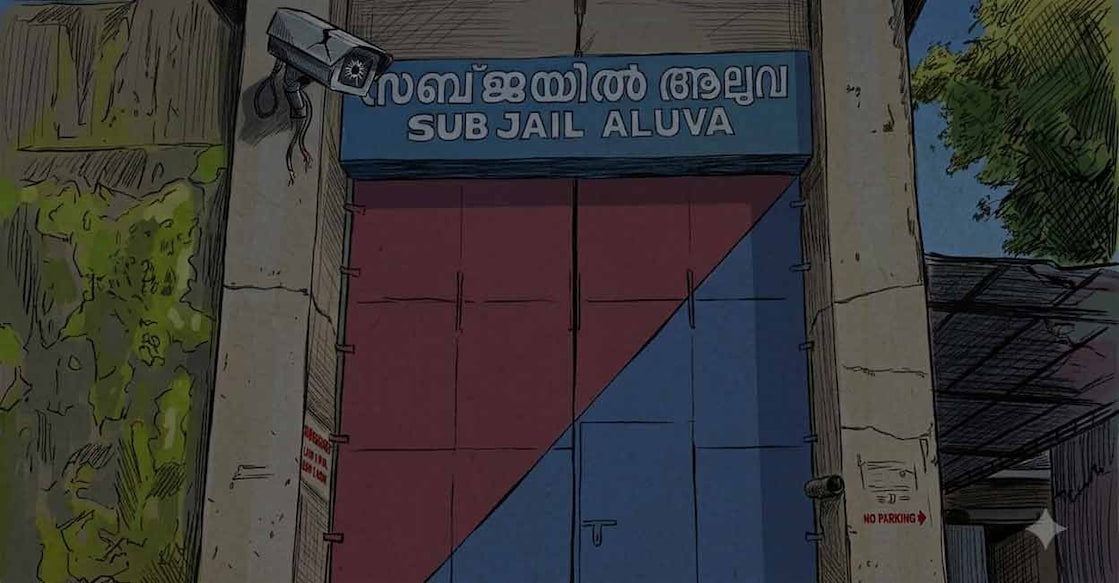
That is the security reality at Aluva Sub-Jail, where a 28-year-old Assamese prisoner, Madhurjya Sonowal, remanded in a theft case, scaled the compound wall and escaped on Monday evening and remains at large.
While a departmental inquiry targets officer security lapses following the escape, the jailbreak highlights systemic vulnerabilities in Kerala’s prisons. Chronic overcrowding, understaffing, ageing infrastructure, and surveillance gaps turn a single momentary lapse into an easy escape opportunity for inmates.
It once again underlines how these unresolved structural and systemic issues can have direct security consequences.
Kerala’s overcrowded prisons and staff shortages have been flagged repeatedly by courts, government-appointed commissions and prison authorities. Official records show that on August 26, Aluva Sub-Jail, authorised to accommodate 56 prisoners, was housing 101 inmates, which is 180% of its capacity. Three days earlier, when the jailbreak took place, the population had reportedly reached 117.
“Prisoners escaping the jail cannot be justified and the officers on duty are responsible. But, in a jail with an authorised capacity to lodge 56 inmates, there were 117 inmates that day. At any given time, we have only four duty officers on a shift,” an officer at Aluva sub-jail told Onmanorama.
Even those four officers are not all available for inmate supervision. “One officer was upstairs conducting court proceedings for six prisoners via Video Conferencing (VC). Another officer was stationed at the main gate verifying visitor applications and logging interview details into the computer. That left just two officers on the floor to manage unlock counts, cell sanitisation, and daily routines,” the officer added.
Compounding the risk, only eight of the 32 CCTV cameras remain functional due to expired annual maintenance contracts.
“The century-old facility is also undergoing renovation. A new building is under construction, and the escaped prisoner scaled up through the side of that structure. When officers are running around managing everything, it creates blind spots that inmates exploit,” the officer added.
Remand pressure
Sources with the Department of Prisons said that most sub-jails like Aluva receive four to five new admissions every day, including remand prisoners undergoing acute alcohol or substance withdrawal.
“Managing aggressive or medically unstable prisoners with just two or three guards on the floor stretches our personnel to their absolute limits,” the officer said.
The pressure has also been compounded recently by statewide enforcement drives, including Kerala Police’s Operation Toofan and the Excise Department’s Operation Thunder against habitual offenders and illicit narcotics.
“Substance abuse is a major menace requiring firm action, but our facilities already face persistent overcrowding and staffing deficits. Daily remands from recent enforcement drives force officers to secure new intakes within existing, severely cramped infrastructure,” a senior officer said on condition of anonymity.
A statewide problem
As of August 26, Kerala’s prisons currently house 9,482 inmates against an authorised capacity of 7,877, with 120.4% occupancy. Even the central prisons are operating at exceeding prisoner capacity.
Overcrowding reaches alarming levels in several sub-jails across the state, with inmate populations drastically exceeding official capacity. The crisis is most severe in Kannur, which holds 67 inmates against a capacity of 23 (291%), closely followed by Tirur at 285% capacity with 57 prisoners housed in a space meant for 20.
Facilities in Vythiri (268%), Ponkunnam (250%), and Attingal (250%) are similarly operating at two to two-and-a-half times their intended limits, while Chavakkad houses 55 inmates in a 23-person facility, pushing its occupancy rate to 239%.
Remand prisoners (4,101) and undertrials (1,094) together account for 54.8% of the state's prison population as per the latest statistics.
More than a vacancy problem
More than 95% of active custodial posts are filled according to official data from the department. The bigger issue is that sanctioned strength has not kept pace with changing requirements.
Sunil S Kumar, State Secretary of the Kerala Jail Executive Officers Association, said sub-jails also lack dedicated administrative staff.
“It’s not that posts are lying vacant without recruitment. We need to create and sanction additional staff strength. In sub-jails, duty personnel work continuous 24-hour schedules, reporting at 9 am and leaving at 9 am the next day. Out of a total staff on any day, two must be diverted exclusively to office work because sub-jails have no sanctioned clerical staff,” Sunil said.
Prisons DIG (Central Zone) Sajeev said the limitations have repeatedly been brought to the government’s attention.
“The requirement under national standards is one officer for every six inmates, but in our sub-jails, it is not even 1:60 or 1:100 during shift hours. Most sub-jails were built in the 1950s and 1960s on plots of 30 to 60 cents, leaving little scope for expansion. We are identifying available government lands to construct new, spacious prison facilities using State and Central funds. Urgently, at least two new Central Prisons must come up and the staff strength must be increased,” Sajeev said.
However, Sajeev stressed that systemic weaknesses cannot become an excuse for an escape. “Inquiry is underway. While the departmental inquiry will fix accountability for lapses, incidents like Aluva underscore how urgently we need to speed up prison modernisation and post creation,” he said.
