

Mail This Article


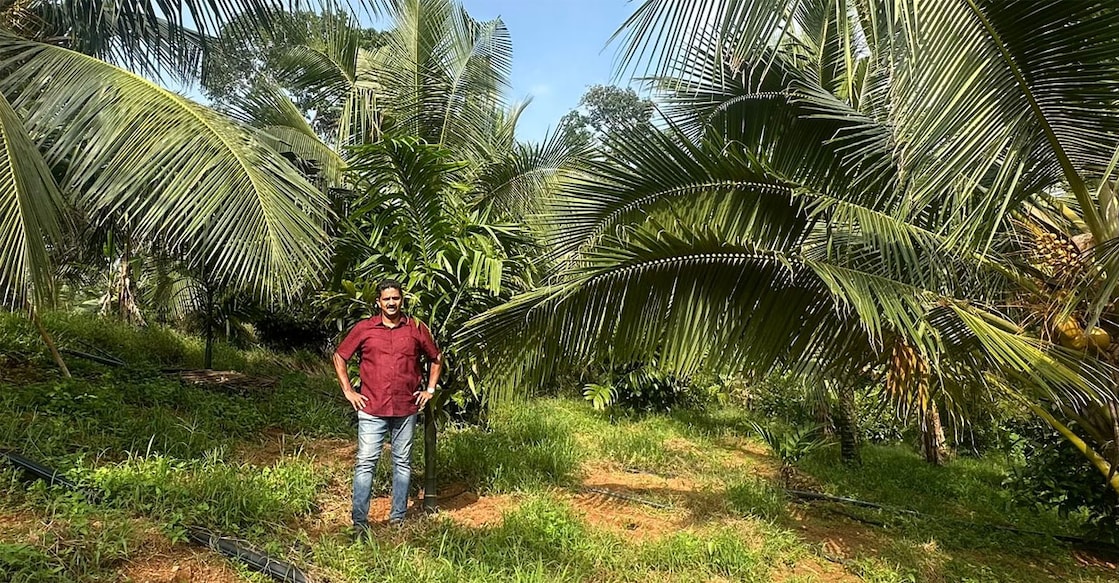
While falling rubber prices have left many farmers in Kottayam distressed, Alex from Vazhoor decided to chart a different course. Strongly believing in the traditional wisdom that coconut palms never let a farmer down, Alex took a bold step. He cleared his entire six-acre rubber plantation to make way for 300 hybrid coconut palms. Years later, this daring transition has rewarded him with immense success and a steady stream of income.
Alex’s approach challenges the age-old notion that nothing else should be grown in a coconut grove. By adopting a multi-tier farming model, his land yields two, three, or sometimes even four different crops simultaneously. To mark World Coconut Day, observed on 2 September, Alex shared his inspiring journey of resilience and agricultural innovation.
Beating price drops with tender coconuts
'My farm features premium hybrid palms. When I decided to say goodbye to rubber—the staple crop of Kottayam—and transition to coconut cultivation six years ago, I had zero doubts. Today, I have absolutely no worries about market fluctuations,' Alex says. The secret lies in his business model: he sells tender coconuts instead of waiting for them to mature. Every 35 days, wholesale merchants arrive at his farm to harvest, clean, and transport the tender coconuts. This ensures a steady cash flow, insulated from the volatile price drops of mature coconuts.
Why dwarf hybrids are a smart choice
Hybrid palms offer distinct advantages over traditional tall varieties. They are significantly shorter and bear a much higher yield. However, because the heavy clusters can sometimes break under their own weight, they require physical support. This weight factor is another reason why Alex prefers harvesting them early as tender coconuts. Selling tender coconuts also yields much better profit margins than dealing in dried mature coconuts.
A strict nutrient and pest control routine
To sustain high yields, a disciplined fertiliser regime is crucial. Following expert guidance from the local Krishi Bhavan, Alex applies a balanced mix of potash, urea, and phosphate in six split doses throughout the year. Before each application, he carefully adjusts the soil pH to ensure optimal nutrient absorption. Despite these efforts, pest control remains his biggest hurdle. To tackle the persistent threat of rhinoceros beetles, he carries out systematic monthly preventative treatments.
The power of intercropping
Alex is a strong advocate for maximising land utility. In his coconut grove, he has successfully integrated mangosteen and coffee as companion crops. This multi-crop system acts as an excellent safety net, allowing him to generate multiple revenue streams from the very same plot of land.
An inspiration for the younger generation
Through sheer dedication and smart planning, Alex has proved that farming can be a highly lucrative career. He believes that by stepping away from rigid traditional methods and aligning with market demands—such as the high demand for tender coconuts—younger generations can confidently choose agriculture as a profitable full-time profession.
