

Fire hits Koder House, Kochi landmark tied to Jewish heritage and early power supply
Mail This Article


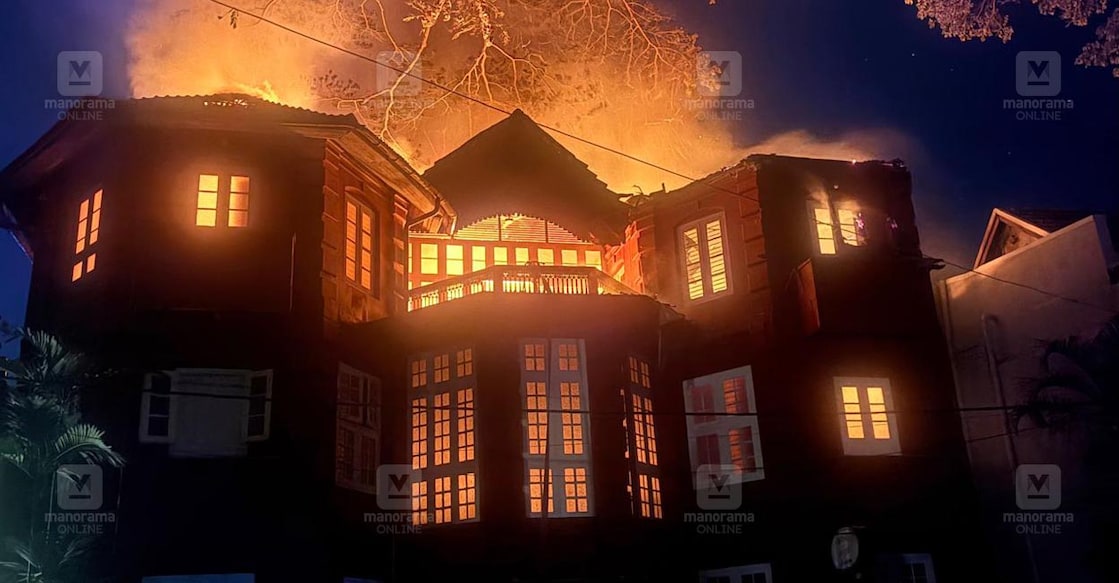
Kochi: The fire that tore through the upper floors of Koder House on Tuesday has damaged more than an old building in Fort Kochi. It has affected a structure closely intertwined with the story of Kochi’s Jewish community, its colonial past and the city’s early tryst with electricity.
The three-storey red-brick mansion on Tower Road has long been one of the familiar landmarks of Fort Kochi. Its distinctive architecture and association with the Koder family have given it a place in the city’s history, even as the building continued to function as a privately owned heritage property.
For heritage researcher Bony Thomas, who is also an artist, writer and a co-founder of Kochi Biennale Foundation (KBF), Koder House represents one of the many layers of history that make Fort Kochi unique.
“The history of the old buildings in Fort Kochi is closely connected to the colonial history of the place,” Thomas told Onmanorama.
The Portuguese established their settlement in Kochi in the early 16th century. The Dutch took control of the territory in 1663, followed by the British in 1795. Over the centuries, buildings and spaces in Fort Kochi underwent changes, including architectural ones, under successive colonial powers.
Koder House acquired its present identity under the Koder family. Ephraim Isaac Koder, who came to Cochin from Baghdad in the 19th century, became part of the city’s prominent Paradesi Jewish community. His descendant Samuel S Koder, popularly known as Satu Koder, extensively remodelled the house in the early 20th century.
The mansion was given an Indo-European character, with elaborate woodwork, Belgian glass and other imported features.
“He lived almost royally there. The furniture and other components were brought from different parts of the world, including Belgian glass,” Thomas says.
But the significance of the Koder family in Kochi went beyond the mansion.
One of their most important contributions was in the field of electricity. Samuel Koder registered the Cochin Electric Company in 1926. The company later obtained permission to generate thermal power and supplied electricity to parts of Fort Kochi and Mattancherry.
The company operated power-generation facilities and utility offices in Mattancherry and Thoppumpady. By 1970, it had more than 130 employees, before the state power board KSEB took over its operations.
The Koders were also involved in other aspects of the city’s commercial and civic life, including ferry services and department stores that catered to customers in Cochin and Travancore.
Koder House itself was more than a residence. Its association with Samuel Koder, who served for several years as president of the Paradesi Synagogue, also connected the property to the wider social and political history of Kochi.
“The family’s links with prominent public figures were reflected in the visit of Prime Minister Indira Gandhi to Kochi in 1968 for the 400th anniversary celebrations of the Paradesi Synagogue,” Thomas says.
For a city where historic buildings continue to exist alongside modern commercial and residential spaces, the fire has once again raised questions about how privately owned heritage structures can be protected.
The Academic Coordinator of Kerala History Congress and Head of Environmental History at the Tropical Institute of Ecological Sciences (TIES) said the incident should prompt a wider discussion on conservation.
“This is like burning down our heritage,” he said. “There should be a policy on how such old buildings should be preserved and conserved. This had not really become a formal heritage monument. The lack of attention and care towards such structures is what leads to incidents like this.”
Koder House may have remained a privately owned property and a well-known heritage hotel in the modern Fort Kochi, but its history belongs to a much larger story, one that runs through Fort Kochi’s Jewish heritage, its colonial past and the early infrastructure that helped transform West Kochi into a modern urban centre.
The extent of the damage caused by Tuesday’s fire will become clearer only after a detailed structural assessment. But the blaze has already brought renewed attention to a question that extends beyond one building: how much of Kochi’s built history can be protected before it is lost?
