

Fishers made most of Kochi’s 2025 clam harvest, alarmingly they caught mostly juveniles, shows CMFRI study

Mail This Article


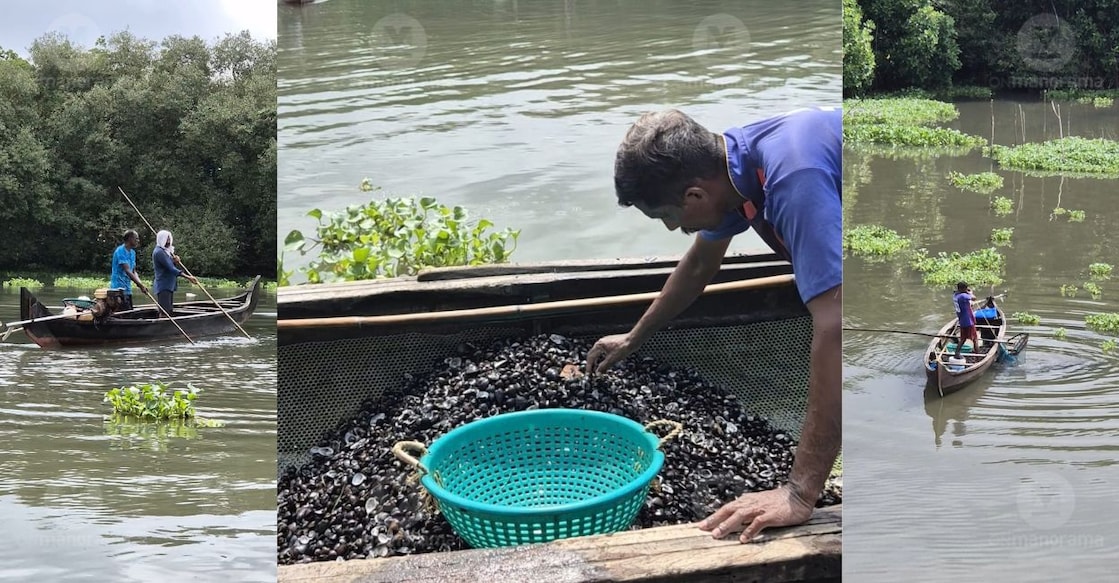
Kochi: The unusual clam harvest in Kochi’s backwaters last year drew fishers from across the Vembanad region to places such as Kundannoor and Vaduthala. But a subsequent scientific assessment has revealed a worrying side to the rush: more than 71% of the clams harvested at Vaduthala were below the prescribed minimum legal size.
The finding comes from a rapid field assessment by scientists of the ICAR-Central Marine Fisheries Research Institute (CMFRI), Kochi, conducted after reports of intensive harvesting of black clam in the two Kochi regions during the post-monsoon period in 2025. The study examined the size composition of the catch to assess compliance with the 20-mm Minimum Legal Size (MLS).
The assessment, however, found that the two clam beds were being exploited very differently.
At Kundannoor, where a spectacular return of black clams last August was reported as Kakkachakara (a bumper harvest), more than 75% of the sampled clams were above the MLS. The fishery was dominated by clams in the 30-35 mm size group, with the harvested clams ranging from around 20 to 45 mm.
At Vaduthala, where a similar big harvest was reported, the situation was almost the reverse. Although the fishery also contained clams ranging from 20 to 45 mm, the assessment found that more than 71% of the harvested clams were below 20 mm.
The findings are significant against the backdrop of a long-term decline in Vembanad’s black clam resource.
According to CMFRI estimates, black clam catch in the region fell from a peak of 75,592 tonnes in 2006 to 45,601 tonnes in 2024, a decline of nearly 40%.
The black clam, Villorita cyprinoides, is one of the most important fishery resources of Vembanad Lake and supports the livelihoods of more than 6,000 families directly, with nearly twice that number depending on allied activities.
The story of last year’s Kundannoor clam boom began in late August, when the backwaters suddenly became crowded with clam collectors. Around 70 fishers were actively harvesting in the area through August and September.
The abundance was not confined to local fishers. CMFRI found that people from Chempu, Vaikom and Panavally had travelled to Kundannoor and Vaduthala to exploit the clam beds. Their traditional fishing grounds, according to the assessment, contained predominantly juvenile clams, which the fishers largely avoided harvesting.
The scientists attributed the unusual abundance at Kundannoor to the successful spatfall of the previous year, rather than treating the sudden harvest as evidence of a general recovery of Vembanad’s clam resource.
The episode also highlighted the importance of monitoring individual clam beds. While the Kundannoor harvest consisted largely of legally harvestable-sized clams, the high proportion of undersized clams at nearby Vaduthala pointed to the risk of juvenile stock being removed before reaching maturity.
That concern assumes added significance with CMFRI now reporting an encouraging result from a separate effort to replenish depleted clam beds through scientific stock enhancement.
At Vadakkumkara in Alappuzha district, CMFRI relayed five tonnes of black clam seed in a one-hectare area in September last year. After a 12-month culture period, the clams recorded a survival rate of around 80-90%, while the harvested stock was about seven to eight times the quantity initially stocked.
Production from the one-hectare area is expected to reach around 40 tonnes, according to CMFRI.
The project was implemented with 100% subsidy for Scheduled Caste communities under the Central Government’s Scheduled Caste Sub Plan (SCSP), with technical guidance from CMFRI and in collaboration with the Thaikkattussery Black Clam Co-operative Society.
Inaugurating the harvest, CMFRI Director Grinson George said the results demonstrated how scientific regeneration could help address the decline in the clam resource while supporting fishing communities.
“The stock enhancement initiative shows how scientific regeneration can help replenish the declining clam resource while providing sustained livelihood support to fishing communities.”
He also pointed out that replenishing natural clam stocks could contribute to the ecological functioning and productivity of the estuarine ecosystem, where clams play an important role as filter-feeding organisms.
CMFRI Senior Scientist Vidya R, who coordinated the stock-enhancement project and was also among the scientists involved in the earlier study held at Vaduthala and Kundannur, said the relaying site was identified through scientific assessment and had no existing clam stock.
“Standard sampling methods and an appropriate stocking density were adopted to ensure effective stock enhancement. The successful outcome highlights the potential of scientific intervention to combine resource regeneration, ecosystem recovery and sustained livelihood support for local communities”.
The latest project therefore offers a different response to the boom-and-bust pattern seen in Vembanad’s clam fishery: rather than depending entirely on natural spatfall and harvesting sudden concentrations of clams, depleted areas could potentially be replenished through scientifically planned relaying.
