

A dairy farm in Wayanad that cultivates success with technology and planning
Mail This Article


“I will sell only the milk that I would be happy to give my daughter to drink.”
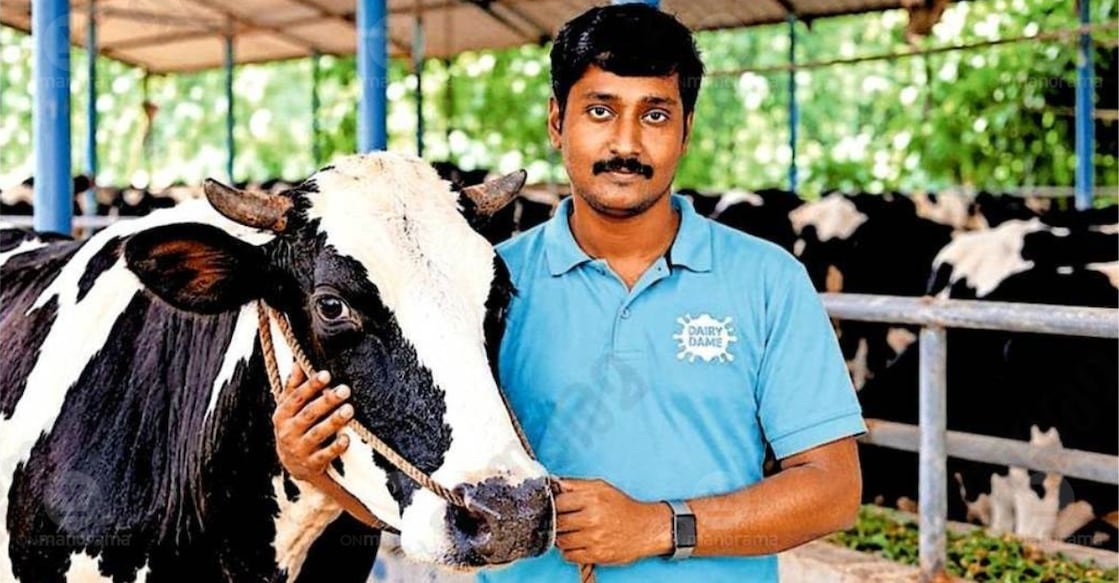
At Kumbalad Dairy Farm in Madakkimala, Muttil, Wayanad, this is the promise that K S Anoop and his wife Athira have built their business around. Under their Dairy Dame (Paalkkari) brand, the couple have made it a guiding principle, shaping everything from how they manage their farm to the products they bring to market.
The farm has 70 cows, 40 of them lactating, each yielding 20 to 40 litres of milk a day. But fresh milk is only part of the business. The couple make 12 value added products, including buttermilk, curd, ghee, paneer, peda, gulab jamun, almond milk and lassi. They sell their products through four outlets and an online channel.
Anoop started the farm six years ago with just four cows. He now aims to expand the herd to 200. The couple also cultivate fodder on 10.5 acres to meet their cattle’s nutritional needs.
An engineer working for California-based semiconductor company KLA Corporation, Anoop can work from home for 10 months a year. Athira, too, is an engineer.
It was a newspaper report on the detection of formalin in milk that first sparked Anoop’s interest in dairy farming. His initial enquiries, however, soon exposed the challenges of running such a business. He heard of farms that had shut down and others struggling under mounting losses. Rather than rush in, he studied what had gone wrong and resolved to avoid the same mistakes. Anoop credits this research-driven approach with helping Kumbalad Dairy Farm grow steadily.
Breeding and feeding hold the key
Anoop considers breeding and feeding the twin pillars of successful dairy farming. The farm focuses on high-yielding cows of pure breeds, with each successive generation bred for better milk production and disease resistance. Nutrition receives equal attention. Fodder cultivation is planned around the cattle’s dietary needs, while quality feed ensures a balanced intake of essential nutrients.
A digital record for every cow
Managing a growing herd calls for more than experience and intuition. At Kumbalad Dairy, technology helps Anoop keep track of every animal, from milk yield and feed requirements to vaccination schedules and calving dates. There is no need to memorise the details or rummage through handwritten records. The Milk Cloud digital register stores these details and sends reminders directly to his phone. Artificial intelligence-based technology also helps assign tasks to workers.
The farm uses sex sorted semen technology to increase the chances of female calves being born. It also has its own feed mill and feed plant, where maize, bran, mineral mixtures and other ingredients are blended into cattle feed. This gives the couple greater control over the feed their animals receive. Sensors monitor the temperature inside the cowshed and automatically switch on sprinklers and fans when needed.
Technology also helps detect health problems early. A small device fitted to the milking machine can detect subtle changes in milk that may signal mastitis, an inflammation of the udder.
Nothing goes to waste
Two biogas plants process the cow dung generated at the farm, while the resulting slurry is used as manure for fodder cultivation. Wastewater from cleaning the cowshed is treated and reused for irrigation. Fodder is harvested mechanically, and surplus stocks are preserved in a silage bunker for later use.
The farm sells only 10% of the milk produced fresh; the rest is converted into value-added products. Neither the milk nor the processed products contain preservatives, in keeping with the couple’s commitment to quality. “Life is more important than shelf life,” says Athira, who manages the Dairy Dame brand.
For more information, contact Anoop on 9884848909.
(The author is the Dairy Development Officer, Vettikkavala Block Panchayat, Kollam.)
