

This 'British' ferry is run by a Kochi temple & it's free for students
Mail This Article


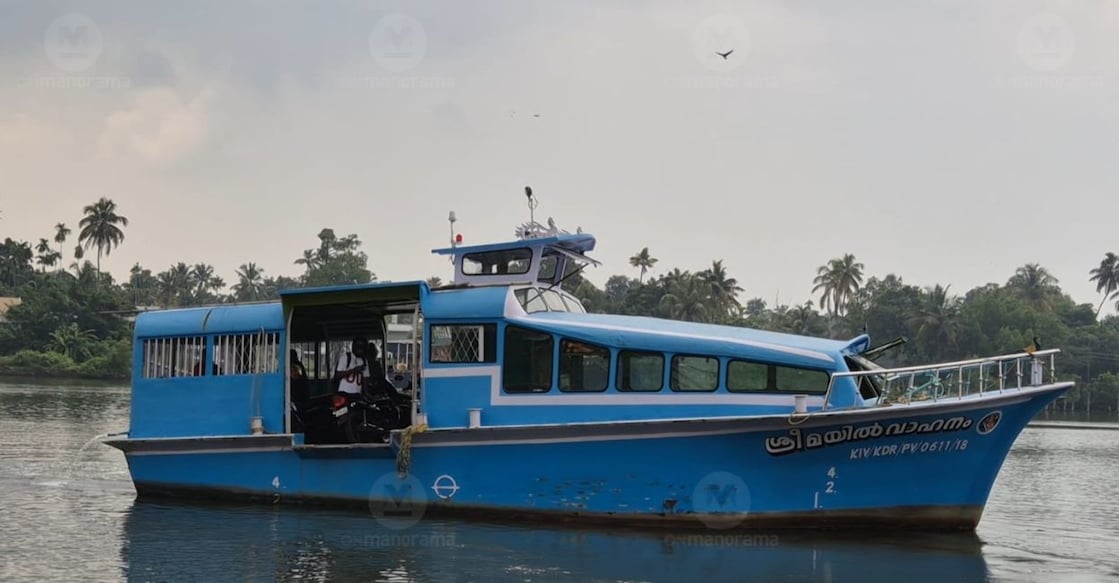
Kochi: Every morning, Anil wheels his motorbike onto the steel deck of a passenger boat named ‘Sree Mayilvahanam’ at Kunjithai jetty near North Paravur. He hands over ₹12 and watches the boat glide across the Kochi–Kottappuram canal in Periyar toward Pallipuram. In barely five minutes, he is across, heading toward his work at the Munambam fishing harbour.
By road, that journey would mean a 14-km detour through heavy traffic via Moothakunnam, taking half an hour and far more fuel. “By ferry, I reach the other side in five or six minutes. Otherwise, it’s a long, frustrating ride all the way around,” Anil says.
For generations along northern Vypin island, this waterway has been an unavoidable boundary. Known locally as British Kadathu (British Ferry), the crossing predates the motorised ferry by decades, tracing back to when Travancore and Cochin were separate princely states.
Today, this public lifeline is owned, fuelled, and operated by a temple committee in Kunjithai that first took it at auction to raise money for a larger shrine. Over nearly three decades, the temple and the ferry have grown side by side, sustained by the same community.

A crossing through history
Long before engines arrived, commuters crossed in small wooden canoes - V V Vidyadharan, secretary of the Sree Balasubrahmanya Swami Kshetra Kshema Sangham, which now runs the boat, recalls elders describe the time when the waterway marked the formal customs frontier between Travancore and Cochin. Goods were subject to strict inspection and levies, particularly salt. Royal postal runners (anchalottakkaran) sprinted along the banks ringing brass bells, asking people to clear the road, while a border post checked cargo.
“The name British Kadathu was coined when the crossing was leased during colonial rule to link passengers and mail to the Murikkumpadam railway line across the border. Across the water, Pallipuram had evolved into an administrative centre under Portuguese, Dutch, and British administrations, home to a police station, registry office, and the historic Church of Our Lady of the Snows (Manju Matha Church),” he told Onmanorama.
“Families depended on this crossing for everything, from administrative work to attending the church’s annual feast (perunnal),” says senior committee member K S Balakrishnan.
Decades ago, when authorities proposed a bridge here, local landlords resisted land acquisition. The alignment was eventually shifted kilometres south to Cherai, leaving Kunjithai dependent on the water.
A temple’s gamble
The temple’s own origin traces back to a village crisis. P N Balakrishnan, the committee’s oldest member, recalls a smallpox epidemic that struck the household of a prominent traditional midwife in the mid-1960s. The midwife died, and following a large post-funeral gathering, dozens of people fell severely ill with internal smallpox. Over twenty people in that single house were bedridden.
An astrological divination revealed that ancient rituals dedicated to Lord Subrahmanya were stopped and had fallen into neglect on the land. Local youths gathered soil and bricks from neighbouring houses to build a modest shrine. The astrologer prophesied that within seven years, an adjacent 22-cent pond would be filled and a permanent temple would rise.
That prophecy took physical shape as the Sree Balasubrahmanya Swami Temple, but maintaining it required steady funds.
In the late 1990s, when the panchayat auctioned the ferry rights, the committee stepped in to secure revenue while providing a safer alternative to hazardous canoes. Around 1998–99, they won the contract with a bid of ₹31,100 for 20 months.
The catch: they did not own a boat. “We rented a vessel first just to test viability,” Vidyadharan recalls. As passenger volume grew, members pooled savings; some even pawned their wives’ gold wedding chains (thalimala). In 2001, drawing on their fishing backgrounds, they bought a second-hand wooden boat fitted with a fuel-saving, three-cylinder Ruston engine for ₹1.75 lakh.
What started as a fundraising venture quickly became an essential public service.
From timber to steel
The wooden boat served for nearly 17 years. Following inland boat tragedies in Kerala, regulations tightened, and the committee refused to compromise on passenger safety.
In 2016, they commissioned the present steel vessel, Sree Mayilvahanam, named after Lord Murugan’s mount. Built with technical guidance from CUSAT’s Department of Ship Technology, the 50-foot vessel cost approximately ₹32 lakh, funded through member contributions and chit funds.
The boat runs daily from 6 am to 9.10 pm, carrying life jackets and safety provisions under periodic dry-dock fitness checks. Students up to Plus Two travel completely free, a tradition maintained unbroken for 27 years. Regular passengers pay ₹5, while those with two-wheelers pay ₹12.
For Sunitha, who crosses daily with lottery tickets to sell at Munambam, the boat is vital to her livelihood. For Vilasini, who crosses to care for her daughter’s newborn, the sturdy steel craft brings peace of mind. “In the old days, we crossed in canoes with constant fear,” Vilasini says. “The boat took that dread away.”
The service also sustains its crew. Conductor Sheeba, whose husband is bedridden, was taken on by the committee nine years ago; her wages keep her household running.
“At six in the morning, our shift begins,” says Soman, the boat’s Serang, though he notes an operational hurdle. “Silt accumulates near the shore, making steering and docking difficult during low tide, especially at night. Regular dredging would make this crossing far smoother,” he said.
Community over commerce
Financially, the ferry runs on a razor’s edge. V K Sunilkumar, the committee president, points out that the ferry brings in ₹5,000 on an average day. Against this, diesel costs around ₹2,700, while crew wages total ₹2,500, meaning routine operations often run at a slight deficit, buffered only by festival crowds and boat launch ceremonies in nearby yards.
“The service is operated without looking at profit, purely for the convenience of the local people,” Sunil Kumar said.
During the COVID pandemic, the committee ran the ferry free for over two months and distributed grocery kits to families across the village, irrespective of religion.
When the vessel undergoes mandatory dry-dock maintenance, their dedication shows most clearly. “Most operators would simply hang a ‘Service Suspended’ board,” says K S Balakrishnan. “We hire a country canoe and a boatman at the temple’s expense. The ferry may pause, but the people's journey never stops.”
The princely borders have dissolved, canoes have yielded to a CUSAT-designed steel hull, and a makeshift altar has become an active temple. Yet every few minutes at British Kadathu, the engine turns over, honouring an unwritten promise that no one on either bank gets left behind.
