On epic (dis)proportions and hyper documentation of pop feminism on the internet

Mail This Article


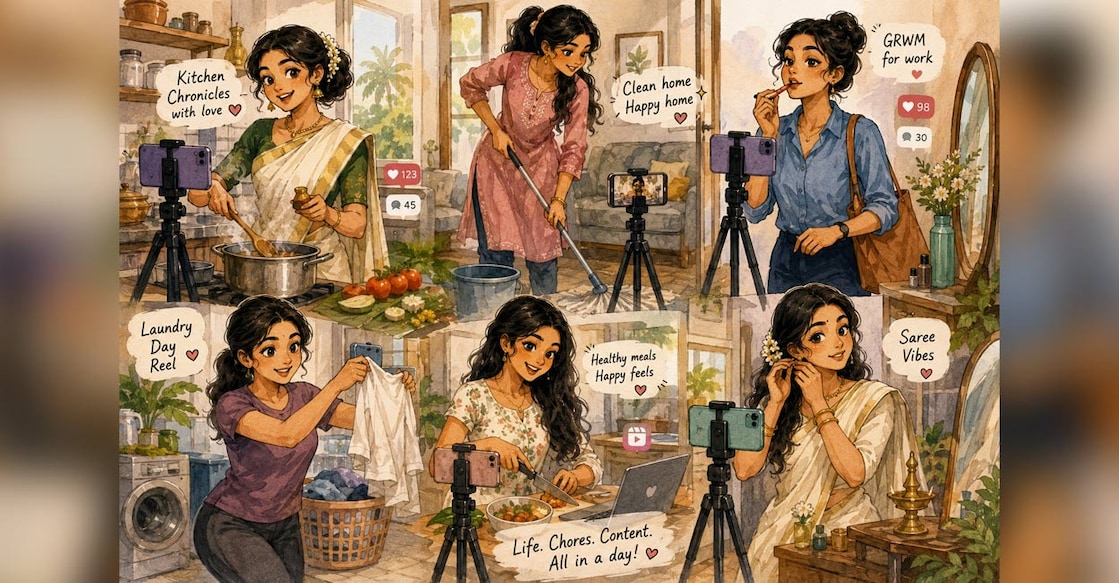
Watching a young woman coo about a sari documenting her “fit”, standing in what is clearly a Kerala backyard is nothing new on an Instagram reel, but when the hook of the reel is about dressing up for the family court to get the divorce decree, something is amiss in the world we live in. You scroll down, only to see a young schoolgirl lip-syncing to a trending song for a get ready with me (GRWM) with lip gloss, moisturiser and sun screen, things she puts down as basics. The internet is full of things getting disproportionate attention through hyper documentation, where creators don’t create, but live it out by the minute in full public glare. These are the girl bosses of the 2020s armed with a data pack on their smartphones, rewriting rules of empowerment and liberation one sari and a song at a time.
To document is to teach, if we break it down to its Latin parent, docere. One taught by example, a model or a lecture. Back in the day, teachers were a select few, lessons were often explorations into subjects that were weighty and learning was effortful. In the modern times though, we are all teaching and learning from others on social media -- to bake bread from scratch or how often to water the curling pothose on the windowsill. If earlier, every thought was refined in the furnace of time and experience, there is now room for unfiltered. No edits. Effortless and sometimes even casual. In the process, credibility became the first martyr. Every wild thought of a lonely night is broadcast as an analysis with the opening line of I don’t know who needs to hear this.
Faithful documentation of one’s life’s minutiae has a prescriptive quality to it, sometimes passionately evangelical. Documenting a GRWM tacitly prescribes cosmetics with links to purchase the exact items, teaching how to layer moisturiser under sunscreen and the difference between a contour and a bronzer. It is the tip of the colossal iceberg where make-up has been so normalized, it is impossible to step out without filling your eyebrows and lining your lips. And the new target is young girls, whose fixation with blemishless skin is now leading to a phenomenon called cosmeticorexia.
Virtuous women with perfectly arched eyebrows and blow-dried hair laugh into the camera smugly documenting how a spin scrubber dislodges grout from between tiles, even as patriarchy sticks. Changing bed linen, setting flowers in the vase, there is romance in routine. Care is at the core, whether it be for self or family. Packing school lunches, prescribing how much to eat, exercise and sleep -- the day begins and ends on social media with an infinite number of personal documentaries on how best to live in the best bodies with the best face, in the best clothes and in the best home with the best garden possible. It is not so much optimization as much as it is creating a vision board for yourself, parked in a deep recess of the mind. Documentaries, might I add, have become mock commentaries.
Built into the What I Wore (to job, to college, for children’s admission, grad party, coffee run, picking up children from the pool or the school, girl’s day out) hyper documentation is the ultimate coda of look at me, I am so cool. Look at me is the prime sentiment underlying the content creation around travel, the ‘diys’, the home décor, the plating and the planting. That we have been pushed to a brink of mindlessness is apparent from the fact that me, my dermatologist and electrician are all on Instagram teaching and documenting “our journey” that has replaced the “Dear Diary” era. Our journey is for all to see, Dear Diary was not.
****
The hyper documentation of every micro moment and every passing feeling and its faithful broadcast into the world, sometimes crying-at-midnight-but-jogging-in-the-park by daybreak, sometimes wise with words and wounds and sometimes venting-- is so tuned to the marketing gimmickry of self-worth that is tied to indulgent spending. A lipstick to feel good or a trending manicure (soap nails or polka dots) to lift the spirits as a moral dessert for the tasks we multi, despite the odds. Little pick-me-ups when one is down never killed anyone; retail is therapy. If self-care is done with a quote from a Maya Angelou or an Audre Lorde, the better, for now you are a feminist too, or at least seemingly so.
For all the liberation that women have been preaching and attaining, the neo tech capitalist model foisted by social media has aggressively brought back the focus on how you look, documenting every whip of paint on nails and fold of the sari. It is about perfectionism and maintenance, even as they tell you in hushed voice ASMR to embrace vulnerabilities and slowmax. We live in the splendid contrariness of being everything all at once and hence nothing.
I remember reading Jessa Crispin’s ‘Why I am not a Feminist’ and sitting with the title of the fifth chapter for long. Uncomfortably. It read ‘Self-Empowerment is Just Another word for Narcissism’. As Stephanie Fairyington’s Ugly: A Letter to my Daughter is being discussed all over the world, I often wonder how one can refuse to participate in the tropes of looking pretty. The social media ban on minors may not be a bad thing after all. With focus on the everyday romance, one wonders whether we are missing the big picture. Perhaps this lack of proportionality is what we should actively address. School for school’s sake than a GRWM for it. We could reclaim focus and free our headspace by worrying less about the right way to use a guasha tool. It is okay to have a less-than-perfect jawline. Let a few moments of life go undocumented, a few thoughts unrelayed to the public, and may a few fits not make it to the grid.