
PR Sreejesh questions India's Olympic plans after failing to reach Hockey World Cup semis
Mail This Article


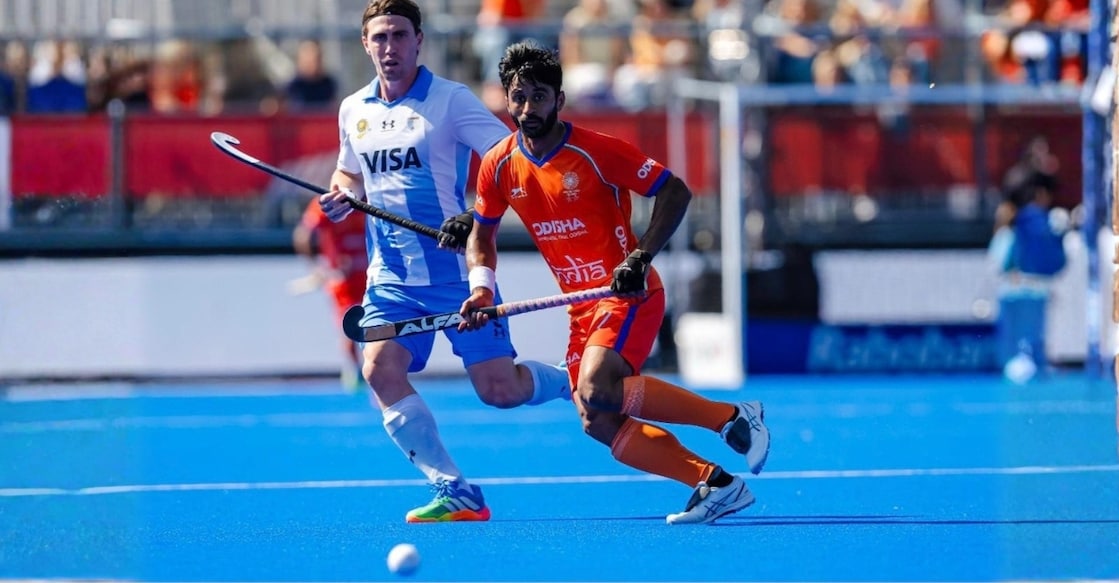
India's men's hockey team crashed out of the World Cup after a 3-5 defeat to Argentina, with the early exit raising fresh questions over the team's consistency, transition and long-term planning.
Two-time Olympic bronze medallist P R Sreejesh has now questioned India's preparations for the 2028 Los Angeles Olympics, expressing concern over the lack of opportunities for promising youngsters with less than two years to go for the Games.
"Who is there to take the reins when seniors retire? Have we developed a second string? LA Olympics is just two years away, and we will play around 30 quality international matches before that. Is that enough to prepare a player for the Olympics? No," a fuming Sreejesh asked.
His comments came after India lost 3-5 to Argentina in a second-round pool match to crash out of the semifinal race. Tomas Domene (33rd, 45th minutes) and Joaquin Toscani (1st, 53rd) scored a brace each for Argentina, while the other goal was scored by Nicolas della Torre in the sixth minute.
India's two goals were scored from field efforts by Sukhjeet Singh in the 34th and 58th minutes. The loss also exposed several weaknesses that have persisted since the Paris Olympics.
Sreejesh pointed out that the World Cup squad continued to revolve around the same core group of senior players, despite the emergence of several promising youngsters.
"The 2026 World Cup team is still revolving around the same core group of players while promising juniors like Manmeet Singh, who was the top scorer at the Junior World Cup with six goals, Amir Ali, Roshan Kujur, Shardanand Tiwari, Talem Priyabarta, Rohit, and Arshdeep Singh were simply overlooked," he told PTI.
The criticism was echoed by former India captain and 1980 Moscow Olympics gold medallist V Baskaran, who questioned both India's attacking output and its approach to the transition from junior to senior hockey.
"The transition from junior to senior has not taken place properly. Germany and the Netherlands have had a smooth transition. Look at the Netherlands team from the Paris Olympics and the World Cup - six gold medallists are missing," Baskaran said.
"We are selecting the team on sympathies, past records and numbers. Six players could have been tried in the Pro League," he added.

Baskaran also questioned whether India was making adequate use of the expertise within its junior setup. "In other countries, junior coaches are very important. Why was Sreejesh not consulted when his team had won the bronze at the Junior World Cup?" he asked.
India's problems were not restricted to team selection. The side's defensive frailties, inconsistency and over-reliance on key senior players were once again exposed at the World Cup.
The team had travelled to the Swiss Alps for mental conditioning ahead of the tournament, as it had done before the Tokyo and Paris Olympics, but still struggled to handle pressure situations.
Captain and drag-flick specialist Harmanpreet Singh was also not fully fit, while experienced players such as Manpreet Singh and Mandeep Singh failed to make the expected impact.
Head coach Craig Fulton has repeatedly stressed the importance of defensive solidity, but India's defence remained one of its biggest weaknesses.
Baskaran also pointed to technical shortcomings in India's forward line, particularly its inability to create and finish chances consistently. "I have not seen any Indian forward in the last four years performing exceptionally well. There was no contribution from anyone. Where were the back passes, how many times did you shoot at goal? When you go for a full press, there was a huge gap in midfield," he said.
Former captain Pargat Singh, meanwhile, blamed the lack of bench strength on weaknesses in India's domestic hockey structure. "We don't have good bench strength due to a lack of robust domestic competitions. In Europe, they have many divisions of league competition, which we don't have," Pargat said.
"Earlier, we used to have tournaments like the Beighton Cup, Aga Khan Cup, Bombay Gold Cup, Murugappa Cup, and Nehru Tournament. That structure has been destroyed, and it has resulted in a lack of internal competition," he added.
India had shown flashes of promise before the World Cup. It won the Asian Champions Trophy in September 2024 and reclaimed the Asia Cup in 2025 to qualify for the tournament.
However, consistency against the world's leading teams, particularly Europe's top sides, has remained a concern. India finished eighth in the 2024-25 Pro League and eighth again in the 2025-26 edition.
The latest Pro League campaign was a reflection of that inconsistency. After a disastrous home leg, India produced an impressive turnaround in Europe, beating world champions Germany and Olympic champions the Netherlands.
But the World Cup brought the same concerns back to the fore.
