

The GOAT! ‘There will never be another cricketer like Sir Gary Sobers’

Mail This Article


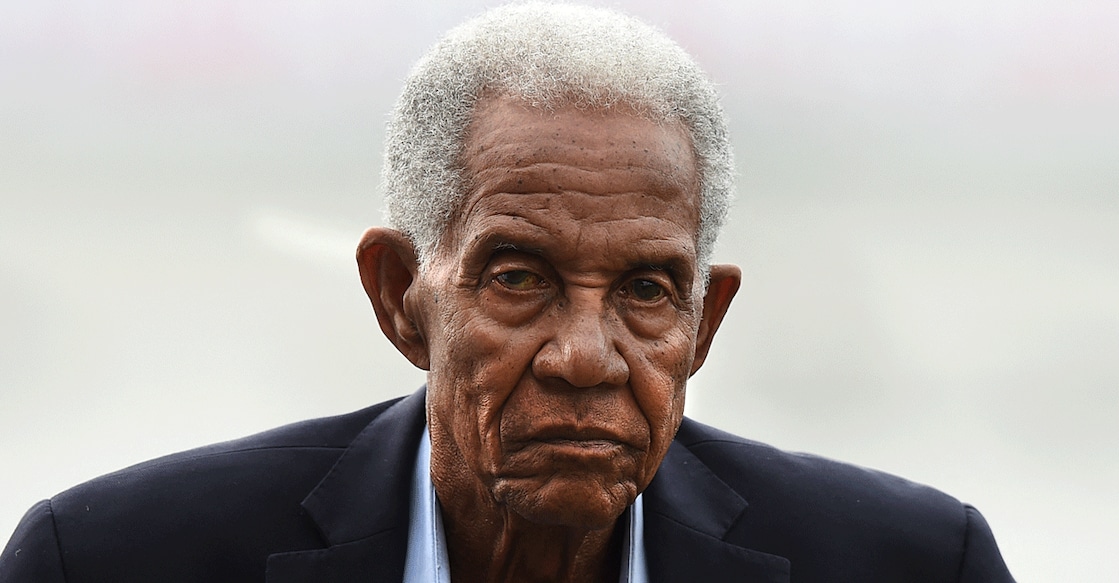
No cricketer will fit the acronym of GOAT (Greatest Of All Time) better than Sir Gary Sobers, who passed away during the week that went by.
He was the ultimate all-rounder - a batsman who could bat in all positions in the order, a bowler who had in his repertoire all types of deliveries known to cricket and a magnificent fielder who could pluck unbelievable catches while standing close to the bat. As is often remarked about him, there was nothing Sobers could not do on a cricket field, except umpiring! It is a tribute to this outstanding cricketer that Don Bradman, never one to indulge in hyperbole, did not hesitate to state that he considered Sobers as the greatest cricketer of all time!
Born in July 1936 in the British colony of Barbados, Sobers lost his father during World War II when the ship he was travelling on was sunk by a German submarine. Though Sobers excelled in all sports that he tried his hand at, it was his prowess on the cricket field that attracted attention. He was offered a job in the Police Department of Barbados while still at school by an inspector who saw him play inter-school cricket matches. He was chosen as 12th man for the Barbados side that played against the touring India side in 1952 but got a chance to play as one of the players reported unfit. He equipped himself well, picking up 7 wickets in the two innings with his left-arm spin bowling. His second first-class appearance was against the touring England side the next year, where he did well with both the bat and the ball.
Sobers was selected to the West Indies team based on his performance in only two first-class matches. He made his debut in the fifth Test of the series against England at Kingston, Jamaica in January 1954. Chosen primarily as a left-arm spin bowler as he replaced the injured Alf Valentine, Sobers bowled well, picking up 4 wickets for 75 runs. Batting at No. 9, he did not get much of an opportunity to showcase his talent with the willow.

Although the next three years saw Sobers improve by leaps and bounds as a batsman, a big score eluded him till the series against Pakistan in 1958. He ensured that his first three-figure mark in Test cricket became a memorable one as he not only went on to strike a triple hundred but also erased the highest individual score recorded till then. His unbeaten innings of 365 against Pakistan at Kingston in 1958, which broke the record of Len Hutton, was to remain the tallest score in Test cricket till Brian Lara broke it in 1994. Sobers was only 21 years and 216 days old when he rewrote the record books and he still remains the youngest triple centurion in international cricket.
After this innings, there was no looking back for Sobers. He strode the international cricket arena like a colossus during the 1960s as centuries and double hundreds flowed off his bat. He possessed the distinct ability to raise his game by a notch or two in critical games, considered as the hallmark of a true champion. He was equally at home while playing spin bowlers on turning tracks in India as he was while facing fast bowlers on hard, bouncy pitches in Australia. He also had the unique skill to change his stroke at the last moment and thus catch both the bowlers and the fielders on the wrong foot.
Two knocks that he played in Australia stand out. The first was the innings of 132 runs in the first Test at Brisbane in 1961, the game that saw the first-ever tie in the history of the game. His mastery at the crease was so brilliant that Alan Davidson, the leader of the Aussie attack, confessed that it was impossible to set a field while bowling to him. The other was the knock of 254 at Melbourne in 1971 while leading Rest of the World XI, when he tore Dennis Lillee, then a young tearaway fast bowler, to shreds, by smashing him out of the park. Sobers had sent bouncers to Lillee when the latter was batting to rile him up and then went out with the willow to put the brash youngster in his place.
India too bore the brunt of the brilliance of Sobers whenever they came up against him. He scored 1,920 runs in the 18 Tests that he played against India at an average of 83.48, which included eight centuries! He toured the country on two occasions - in 1958-59 and 1966-67 and created an abiding impact on the followers of the game here. Though his usual style of batting involved dominating the bowling with his nimble footwork and dazzling stroke play, the final innings of the last Test of the 1966-67 series was different in that it saw another facet of Sobers at the batting crease. Chasing a final innings target of 322, West Indies were in deep trouble when their seventh wicket fell at 193. But Sobers held one end firm and coaxed Charlie Griffith to stay put at the crease to ensure that they did not lose the match. Sobers eschewed his natural style of attacking batsmanship and played a watchful and circumspect knock, showing that he possessed the temperament and expertise to play the defensive game to perfection.
As a bowler, Sobers was a captain’s dream in that he could bowl just about everything with a cricket ball- fast, medium pace with seam up, left-arm orthodox spin and even the unorthodox stuff (Chinaman). Though he started out as a left-arm orthodox spin bowler, he took upon himself to bowl with the new ball and later added the Chinaman also to his armoury. But it should be admitted that he did not have the ability to run through batting orders like Ian Botham or Kapil Dev. Sobers was more of a workhorse who could bowl long spells and keep the batsmen on a tight leash while picking up the occasional wicket or two. This is reflected in the fact that he had only six 5-wicket hauls in his career, which saw him pick up 235 wickets in 93 Tests.
Sobers took over as captain of the West Indies in 1965 after Frank Worrell stepped down. He enjoyed a successful start to his stint as skipper when the side won series against Australia, England and India, but things started going downhill from 1968 onwards. The turning point came in the home series against England, which West Indies lost 0-1, with the sole defeat taking place at Trinidad in the fourth Test. Sobers made a sporting declaration on the last day, setting England a last innings target of 215 in 55 overs, in the hope of forcing a result. Unfortunately, this backfired as England reached the target comfortably, losing only three wickets. Sobers was pilloried by the press and the public for his decision to declare the innings. After this, the West Indies lost series against Australia, England and India. With that, Sobers was replaced by Rohan Kanhai when Australia toured the West Indies in 1973.

Statistics do not tell the whole story of the brilliance that radiated from the bat of Sobers. He played cricket in an era where pitches were not covered, and the protective equipment in use was rather primitive. More than his tally of 8,032 runs from 160 innings at an average of 57.78, it was the manner in which he scored them that made Sobers unique. He had all the shots in the coaching manual, and he could use them at will against any opposition, which was why Barry Richards called him the only 360-degree player in the game. One instance narrated by John Benaud, the former Aussie batsman who played against Sobers during the Australia vs Rest of the World series in 1971, will confirm this. Sobers was facing Bob Massie, who could swing the ball both ways in a prodigious manner; he prepared to leave a ball thinking it was moving away when he suddenly saw that it was coming in. With a quick feint, Sobers readjusted his feet and clipped the ball to the mid-wicket boundary, even as he muttered “Well Bowled”! Such was the genius of the man that he could even afford to appreciate the bowler while readjusting his stroke and sending the ball thudding to the fence!!!
The most alluring part of the personality of Sobers was the fact that he was a perfect gentleman, both on and off the field. He played positive cricket, always upheld the spirit of the game, and never questioned the umpires' decisions. One incident that took place during India’s tour to the West Indies in 1971 stands as testimony to this fact. The West Indies were trailing India 0-1 when the last Test of the series began at Trinidad: West Indies badly needed to win this game, not only to draw the series but also to retain their prestige in front of their supporters. This was a six-day Test where the toss held considerable significance. Both Sobers and Ajit Wadekar, the Indian captain, believed they had won the toss. In those days before the advent of the Match Referee, there was no mechanism for independent verification of the winner of the toss, and a dispute of this nature could have developed serious ramifications. But Sobers sportingly withdrew his claim and asked Wadekar to decide whether he wished to bat or field. One cannot imagine any other captain from any generation committing such a generous and selfless act.
Rest in Peace, Sir Garfield St Aubrun Sobers. You will be remembered forever as the most complete cricketer to grace the game. There will never be another one like you.
 Add as a preferred source on Google