

India’s age-group cricket dominance: BCCI’s multi-team strategy to harness vast talent pool
Mail This Article


Given the infrastructure and resources available to the Board of Control for Cricket in India (BCCI), it is not surprising that India has an excellent system for unearthing young talent from across the country. The system's efficiency is evident in India’s dominance in age-limit championships in this sport, both globally and in Asia.
For the record, India has won the Asia Cup under-19 championship, the latest version of which concluded on 14 November, on 9 out of the 13 occasions that this tournament was conducted since its inception in 1989. The Indian boys finished as runners-up twice, and it was only in 2017 and 2023 that they failed to reach the finals.
Despite this overwhelming dominance, India had not won this championship since they last lifted the trophy at Colombo in 2021. After falling at the last four stage in 2023, they had come second best in the finals in both 2024 and 2025. Bangladesh defeated India by 59 runs in the 2024 finals, while the side lost to Pakistan by a huge margin of 191 runs in 2025. The losses on both these occasions had taken place despite Vaibhav Sooryavanshi, the new sensation in Indian cricket, turning out for the side.
What you should read next

Hence, there was considerable expectation from the side that left the shores of the country for Oman to take part in the 2026 edition of the championship. The side started well, crushing Nepal by 10 wickets in their first match. However, they faltered in the next game, which was against Pakistan, going down by a margin of 3 wickets. But they picked themselves up well after this reverse to defeat United Arab Emirates (UAE) in the last group match by 70 runs before overcoming the challenge posed by Afghanistan in the semi-finals. This set up the clash with Pakistan in the finals.
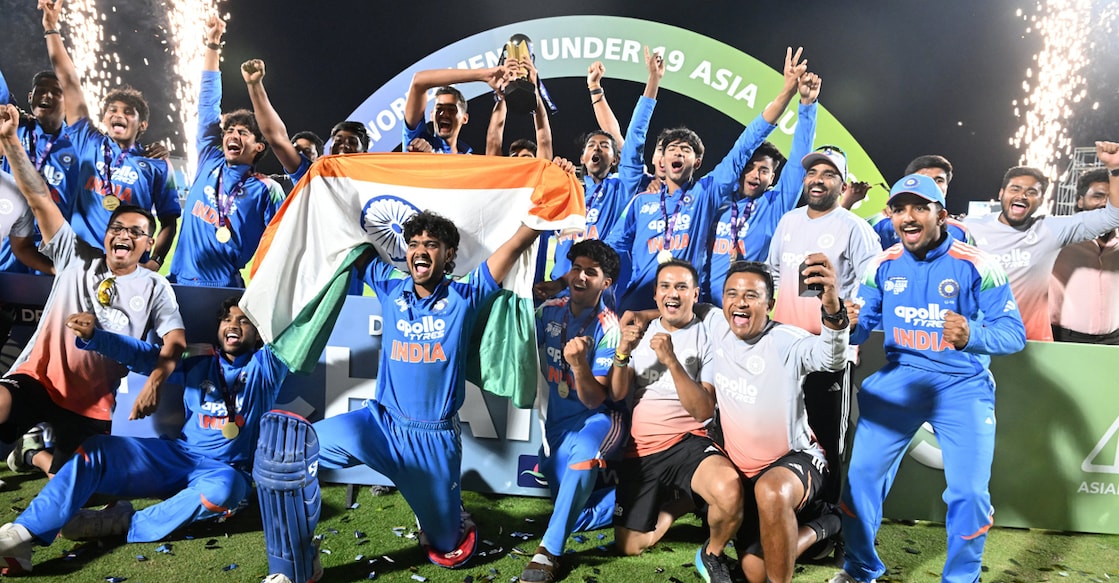
India managed to win the finals by a margin of one wicket, with the game going down to the last ball. Pakistan's innings was built on a blistering 107 by their opening batsman Usman Khan. He was given good support by Abdul Qadir, who struck 8 sixes in a rapid 54-ball knock of 80 runs and skipper Farhan Yousuf, who made a brisk 63 off 60 balls, which included three hits that landed beyond the boundary. At one stage, Pakistan looked set for a total exceeding 400 but Indian bowlers struck back strongly in the last 15 overs to restrict the opponents to a final score of 337 runs.
India sorely missed the presence of fast bowler Ishan Sood, who was forced to sit out on account of a back niggle. He was easily the best bowler on view for India with a haul of 11 wickets in the four matches leading to the finals. Unfortunately, the bench strength available with the side was weak, and this was exposed during the finals, when the Pakistan top order made merry.
India started their reply in a strong manner with skipper Lakshya Raichandani and Aaryavir Sehwag putting on 95 runs for the first wicket. After Aaryavir left for 58, which came from 61 balls, none of the Indian batsmen could spend a sufficiently long time at the crease to create an impact. VK Vineeth and Arjun Rajput started well but perished in their efforts to push the scoring rate. When Raichandani and Anvay Dravid were dismissed off consecutive balls in the 37th over, it appeared that the game had slipped out of India’s hands.
However, Manal Chauhan, who reached the crease after the fall of the fifth wicket, had other ideas. He saw the unfortunate run-out of Dravid and later lost two partners in quick succession, which brought the score to a near-hopeless position of 252 for 8 wickets. But he did not lose heart, and instead, in the company of Mohit Ulva, he chose to counterattack with gay abandon. The duo took the side to a total of 309 when Chauhan was dismissed. With 29 runs required off 16 balls with one wicket in hand, Ulva chose to let loose. After last man Churugurupati Venkata scored 4 runs off the remaining balls of the 48th over, Ulva struck 17 runs in the penultimate over, thus bringing the target down to 8 runs in the final over.
Ahmed Hussain, who bowled the last over for Pakistan, tied the batsmen down brilliantly, giving away only 5 runs from the first five balls. But in a classic do-or-die situation, Ulva decided to launch himself into the last delivery sent by Hussain and managed to connect, sending the ball wide of long-off for a boundary. This sealed an unbelievable win, where India fought back strongly from the verge of defeat to script a near miracle.
This victory comes nine months after India won the International Cricket Council (ICC) Under-19 World Cup held in February 2026 with considerable ease. It may look ironic that a side that won the World Cup on three out of five occasions since this championship was held in 2018 finds it difficult to win a regional championship, where the other participants are teams that cannot match India in terms of either resources or talent. One reason for this is the BCCI’s policy of restricting a player from taking part in more than one ICC under-19 World Cup. This forces the selectors to literally start from scratch after the conclusion of the premier international championship. This is what happened in the present instance also, wherein one finds that the squad that took part in the Asia Cup does not have in it any member of the side that won the World Cup nine months ago.
An important reason behind this policy is to prevent allegations of “age fraud” by the players. There exists a tendency amongst a section of the players to extend their participation in international tournaments at the junior level by manipulating their age. It was Rahul Dravid, then coach of the junior side, who actively advocated the “one World Cup” policy for juniors to bring down the tendency amongst the players to forge age certificates to squeeze in an additional World Cup.
This policy is also reflected in the choice of coach for the two championships. While the World Cup squad received the services of former international player Hrishikesh Kanitkar, the chief coach of the junior side, the side that played in the Asia Cup was coached by Yere Goud, who had played first-class cricket with distinction. So one can state with certainty that BCCI reserves the best for the ICC tournament and uses the regional championships as arenas for giving opportunities to other budding talent.
Though this policy may cause occasional heartburn, it can bring in excellent results like the one enjoyed by this side. Moreover, this will prove to be beneficial in the long run, with more young players being given opportunities for donning the national colours and proving their worth on the big stage. The large talent pool only serves to enhance the core strength of the national side by providing a good bench strength and having a tried and tested bunch of players who are ready to take over when the present lot hang up their boots. For these reasons, BCCI management will have reasons to view this victory of the junior side with a lot of satisfaction and pride.
One additional factor that caused increased interest amongst the followers of the sport in the country in this edition of the championship was the presence of sons of Rahul Dravid and Virender Sehwag in the side. Aaryavir Sehwag, an opening batsman, was among the top run-scorers in this tournament, scoring a century (160) against UAE, besides striking fifties against Nepal, Afghanistan and Pakistan (finals). He won the “Player of the Series” award for his consistent batting. Anvay Dravid, on the other hand, did not score heavily but performed tidily behind the stumps. Other Indian players who caught the eye include captain Lakshya Raichandani, middle-order batsman Arjun Rajput and fast bowler Kavya Patel.
Congratulations to the India under-19 side for holding their nerve and sealing a brilliant win. You made us proud with your sterling performance.
