

India launches Namo Green Rail, country's first hydrogen-powered train; to run on 89 km route in Haryana
Mail This Article


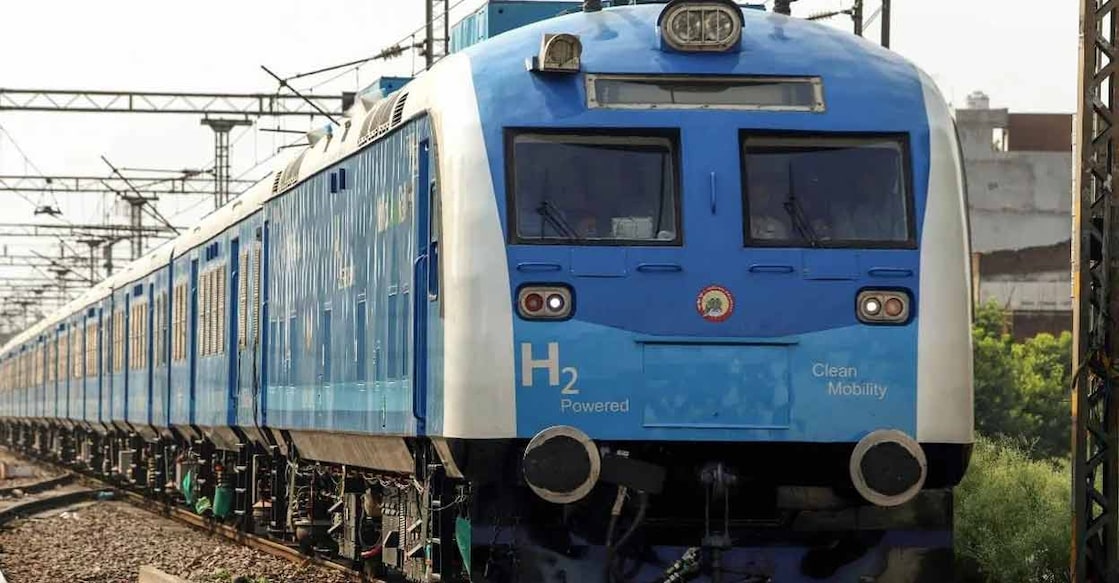
India has officially entered the elite global club of nations utilising hydrogen technology for rail transport with the launch of its first indigenous hydrogen-powered train. Flagged off by Prime Minister Narendra Modi, this ground-breaking passenger service is set to run on the 89-kilometre Jind-Sonipat route in Haryana.
Christened 'Namo Green Rail', the train was entirely designed and developed within the country. It holds the record for the world's longest broad-gauge hydrogen train, positioning India alongside technological leaders such as Germany, Japan, China, and the USA.
A vital piece of infrastructure for this landmark project – the high-pressure hydrogen refuelling station – was developed by Fluidtron, a technology firm based in Kochi. This specialised station compresses hydrogen generated via electrolysers and transfers it directly into the train. The train requires only 300 kg of hydrogen to cover 356 kilometres.
How the green tech works
The Namo Green Rail generates its propulsion electricity by combining hydrogen with atmospheric oxygen inside fuel cells. The propulsion system is housed within two power cars, consisting of four sets of integrated power packs that combine high-pressure hydrogen fuel cells with lithium ferro-phosphate batteries. With 440 kg of hydrogen stored under extreme pressure, the fuel cells generate electricity cleanly, emitting only water vapour and operating in near-total silence.
How to book seats, ticket fare
The train's ticket can be booked via the standard IRCTC website. The ticket fare costs between ₹5 and ₹25.
Key specifications of the train
• Engineered by the Integral Coach Factory in Chennai, the train features 10 coaches in total, including eight passenger chair cars and two driving power cars.
• It has a massive passenger capacity, capable of carrying up to 2,600 commuters at a time.
• The train is equipped with a 2400 kW (3200 hp) engine designed for optimal efficiency.
• While the train can reach speeds of up to 120 km/h, it is scheduled to operate at a service speed of 75 km/h for its regular runs.
