

What is the role of UNGA president?
Mail This Article


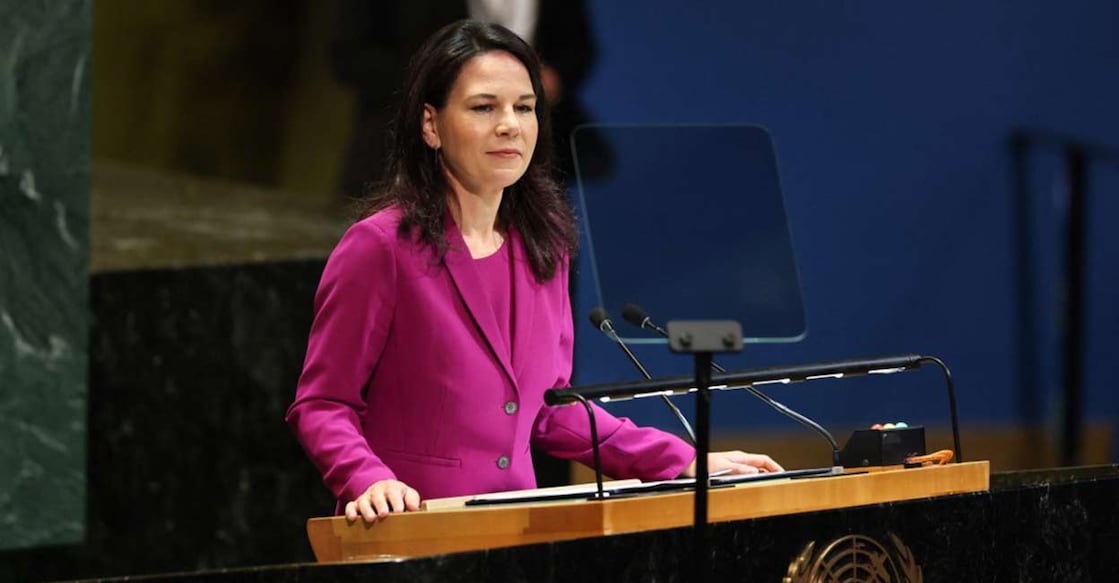
• The president of the 80th Session of the UN General Assembly Annalena Baerbock will visit India on April 28.
• During the visit, Minister of External Affairs S. Jaishankar and Baerbock will discuss key multilateral issues of mutual interest.
Who is Annalena Baerbock?
• In June 2025, Germany’s Annalena Baerbock made history as the fifth woman ever elected to preside over the United Nations General Assembly.
• She also became the first woman from the Western European group to hold the post.
• The presidency rotates among the world body’s five regional groups.
• Baerbock, 45, is also one of the youngest leaders to secure the top job.
• She was born in Hanover on December 15, 1980.
• Baerbock is the fifth woman to preside over the United Nations General Assembly.
• She served as Germany’s Federal Minister for Foreign Affairs from December 2021 to May 2025, and was a member of the German Parliament from 2013 to June 2025.
• In 2018, she was elected co-chairperson of the Green Party and held the position of party leader until 2022.
• Prior to becoming an MP, Baerbock advised her party’s parliamentary group in the German Bundestag on matters of foreign and security policy and served as chairperson of her party in the federal state of Brandenburg.
• From 2005 to 2008 she worked as a Member of the European Parliament.
UN General Assembly (UNGA)
• The General Assembly is the UN’s most representative body, comprising all 193 Member States.
• Established in 1945 under the Charter of the United Nations, the General Assembly is the main policy-making organ of the Organisation.
• It provides a unique forum for multilateral discussion of the full spectrum of international issues covered by the Charter.
• It also plays a central role in the process of standard-setting and the codification of international law.
• The Assembly meets from September to December each year (main part), and thereafter, from January to September (resumed part), as required.
• In addition to its regular sessions, the Assembly may meet in special and emergency special sessions.
• Each of the 193 Member States in the Assembly has one vote. Votes taken on designated important issues – such as recommendations on peace and security, the election of Security Council and Economic and Social Council members, and budgetary questions – require a two-thirds majority of Member States, but other questions are decided by a simple majority.
Functions and powers of the General Assembly:
According to the Charter of the United Nations, the General Assembly may:
• Consider and approve the United Nations budget and establish the financial assessments of Member States.
• Elect the non-permanent members of the Security Council and the members of other United Nations councils and organs and, on the recommendation of the Security Council, appoint the Secretary-General.
• Consider and make recommendations on the general principles of cooperation for maintaining international peace and security, including disarmament.
• Discuss any question relating to international peace and security and, except where a dispute or situation is currently being discussed by the Security Council, make recommendations on it.
• Discuss, with the same exception, and make recommendations on any questions within the scope of the Charter or affecting the powers and functions of any organ of the United Nations.
• Initiate studies and make recommendations to promote international political cooperation, the development and codification of international law, the realisation of human rights and fundamental freedoms, and international collaboration in the economic, social, humanitarian, cultural, educational and health fields.
• Make recommendations for the peaceful settlement of any situation that might impair friendly relations among countries.
• Consider reports from the Security Council and other United Nations organs.
• Every year, the General Assembly elects a president to serve a one-year term of office.
The role of UNGA president
• The General Assembly elects a president and 21 vice-presidents at least three months before the opening of the session over which they are to preside.
• The president and vice-presidents will assume their functions only at the beginning of the session for which they are elected and shall hold office until the close of that session.
• The vice-presidents are elected according to a pattern that ensures equitable geographical representation.
• The president shall declare the opening and closing of each plenary meeting of the session, direct the discussions in plenary meeting, ensure observance of rules of procedure, accord the right to speak, put questions and announce decisions. He/she shall rule on points of order and, subject to these rules, shall have complete control of the proceedings at any meeting and over the maintenance of order.
• The president may, in the course of the discussion of an item, propose to the General Assembly the limitation of the time to be allowed to speakers, the limitation of the number of times each representative may speak, the closure of the list of speakers or the closure of the debate.
• He/she may also propose the suspension or the adjournment of the meeting or the adjournment of the debate on the item under discussion.
• If the president finds it necessary to be absent during a meeting or any part thereof, he/she shall designate one of the vice-presidents to take his place. A vice-president acting as president shall have the same powers and duties as the president.
