

NASA ends MAVEN mission

Mail This Article


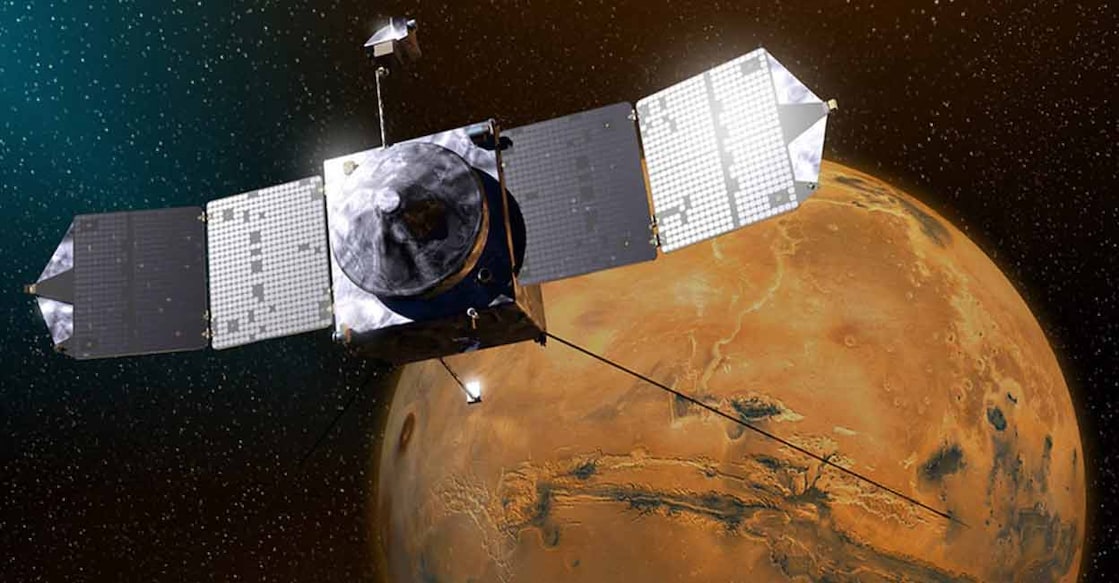
• NASA has officially ended its MAVEN mission after more than 11 years in orbit at Mars.
• The spacecraft was heard last on December 6, when it experienced an unexpected loss of signal after it passed behind the Red Planet.
• Mars Atmosphere and Volatile Evolution (MAVEN) was launched on November 18, 2013 from Cape Canaveral Air Force Station in Florida and successfully entered Mars’ orbit on September 21, 2014.
• MAVEN began its primary science mission on November 16, 2014.
• It was the first spacecraft dedicated to understanding Mars’ upper atmosphere.
• The mission explored the Red Planet’s upper atmosphere, ionosphere, and interactions with the Sun to explore the loss of the Martian atmosphere to space.
• Understanding atmospheric loss gives scientists insight into the history of the planet’s atmosphere and climate, liquid water, and planetary habitability.
Key achievements of MAVEN:
• One of MAVEN’s first major results was that the erosion of Mars’ atmosphere increases significantly during solar storms.
• The team studied how the solar wind, which is a stream of charged particles continually streaming from the Sun, and solar storms continually strip away Mars’ atmosphere, as well as how this process played a key role in altering the Martian climate from a potentially habitable world to today’s cold, arid planet.
• The MAVEN mission made unprecedented strides in advancing our understanding of how the Sun and space weather affect Mars, as it was the only spacecraft that could simultaneously take measurements of both the Sun and the Martian atmospheric response.
• The MAVEN mission discovered several types of auroras that light up when energetic particles plunge into the atmosphere, bombarding gases and making them glow.
• To better understand how Mars lost most of its atmosphere, MAVEN measured atmospheric sputtering for the first time on any planet. The team did this by observing argon, which is a noble gas, meaning it rarely reacts with other constituents in the Martian atmosphere.
• In addition to science, the MAVEN spacecraft was an instrumental player in NASA’s Mars Relay Network, communicating data from Mars rovers to Earth.
