

Third parts, higher stakes: Can ‘Drishyam 3’, ‘Aadu 3’ defy cinema’s sequel pattern?

Mail This Article


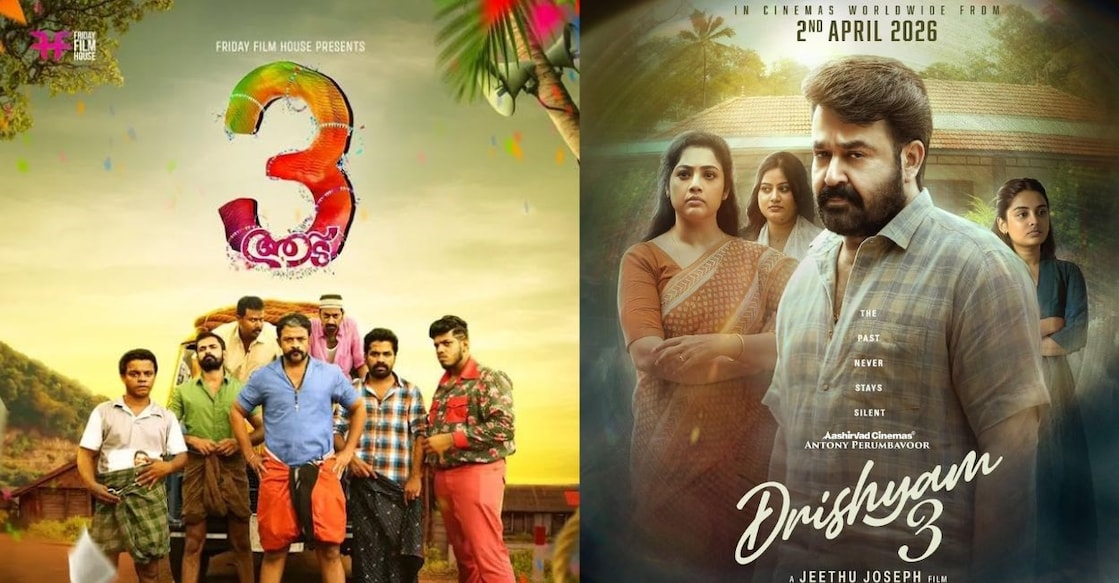
This year, Malayalam cinema is witnessing an unusual surge of third instalments in popular films. ‘Drishyam 3’, starring Mohanlal, is the most anticipated, while Jayasurya’s ‘Aadu 3’ is also in the line-up. While sequels naturally benefit from audience familiarity with characters and worlds, third instalments occupy a particularly precarious space. They are expected to deliver novelty, suspense, or closure, even as they remain weighed down by the success and emotional memory of their predecessors. This tension often determines whether they succeed or falter.
When ‘Drishyam’ released 13 years ago, it was a landmark in Malayalam cinema. Its tightly constructed suspense and grounded domestic setting resonated deeply with viewers and offered a narrative that felt complete. With ‘Drishyam 3’, filmmakers now face an audience whose sensibilities, humour, and expectations have changed considerably. Film critic A Chandrasekhar notes, “When there is a significant time difference between two movies, the connect with the audience changes. Comedy, plot twists, and emotional beats that worked in the past may not land the same way today.”
‘Drishyam’ was never conceived as a franchise. Its overwhelming success, however, led not only to multiple remakes across languages but eventually to a sequel. While ‘Drishyam 2’ was commercially successful, it also prompted debates about whether the story needed to be extended further. Sequels like these are created by audience demand, and once a formula starts working, filmmakers feel pressured to replicate it.
A similar but slightly different trajectory can be seen with ‘Aadu’. The first film did not perform well at the box office, but its characters and irreverent humour found a loyal audience over time. That growing popularity resulted in ‘Aadu 2’, which went on to become a hit. Nearly nine years have passed since then, and audience tastes have evolved. What connected then may not automatically work now unless the makers are able to read the current pulse and adapt accordingly.
Across global cinema, the pattern is easy to spot. ‘The Godfather Part III’ is frequently cited as a classic example of a third instalment that arrived without narrative necessity. Chandrasekhar observes, “‘The Godfather Part III’ didn’t fail because it was terrible. It didn’t work because it arrived when it didn’t need to exist. ‘The Godfather Part II’ ended Michael Corleone’s arc perfectly—alone, hollow, morally destroyed. Part III tried to reopen a closed wound.” The 16-year gap between Part II and Part III only heightened the disconnect. By then, cinema had evolved, audience expectations had shifted, and the urgency that once powered the story had dissipated, leaving the third instalment struggling to justify its existence.
Time and audience perception are equally crucial in determining how sequels are received. A key distinction is between planned franchises and films that turn into franchises due to popularity. Franchises like the Marvel series or the ‘Lokah’ films are conceived with an overarching structure, where individual stories form part of a larger whole. Films like ‘Drishyam’ and ‘Aadu’, however, were not designed this way.
Some third instalments manage to stretch their stories while retaining audience interest, while others reveal the strain of forced continuation. Chandrasekhar cites the ‘Nadodikattu’ series as an example where extending the narrative worked. “‘Nadodikattu’ became a hit, which led to ‘Pattanapravesham’. While the story could have comfortably concluded there, its popularity opened the door for Priyadarshan to explore the characters further in ‘Akkare Akkare Akkare’. The narrative was extended, but the film managed to connect with audiences.” Similarly, ‘Kireedam’ found a natural continuation in ‘Chenkol’, where the protagonist’s journey progressed organically rather than feeling artificially extended.
Not all sequels manage this balance. The later films in the ‘In Harihar Nagar’ series, while profitable, never captured the immediacy or cultural relevance of the original. As Chandrasekhar points out, audiences themselves change. “People have changed. Comedy has evolved. If you repeat the same kind of jokes, they are not going to land.” What once felt relatable or fresh can begin to feel dated when revisited years later without sufficient rethinking.
Looking beyond Malayalam cinema, franchises like ‘Spider-Man 3’ and ‘Rocky 3’ demonstrate the delicate balancing act required of third entries. ‘Rocky 3’ stands out largely because it resisted the impulse to inflate spectacle for its own sake. Instead, it stripped the protagonist back to his core struggle, confronting him with complacency and forcing a return to emotional fundamentals through Clubber Lang. As Chandrasekhar puts it, “Third parts fail not because audiences are tired, but because filmmakers mistake escalation for evolution.”
By the third instalment, many franchises also struggle with questions of identity. Filmmakers are often pulled in different directions by fan expectations, studio pressures, and the desire to outdo earlier successes. The attempt to balance nostalgia with reinvention can result in a diluted tone, where familiar elements remain but the narrative lacks clarity. Even with recognisable characters, settings, and plot devices, audiences can sense when a film is unsure of what it wants to be, making the third instalment feel hollow despite its scale.

The success of third instalments, then, depends largely on evolution rather than repetition. Malayalam cinema offers similar lessons: sequels succeed when they feel necessary, respect the audience’s emotional memory, and allow characters and themes to grow organically. Films like ‘Chenkol’ or the extended ‘Nadodikattu’ series demonstrate this approach, while others falter when they rely too heavily on familiar formulas.
 Add as a preferred source on Google