

Kerala Kumbh mela: Did revival of Mahamagha ritual at Thirunavaya become political?
Mail This Article


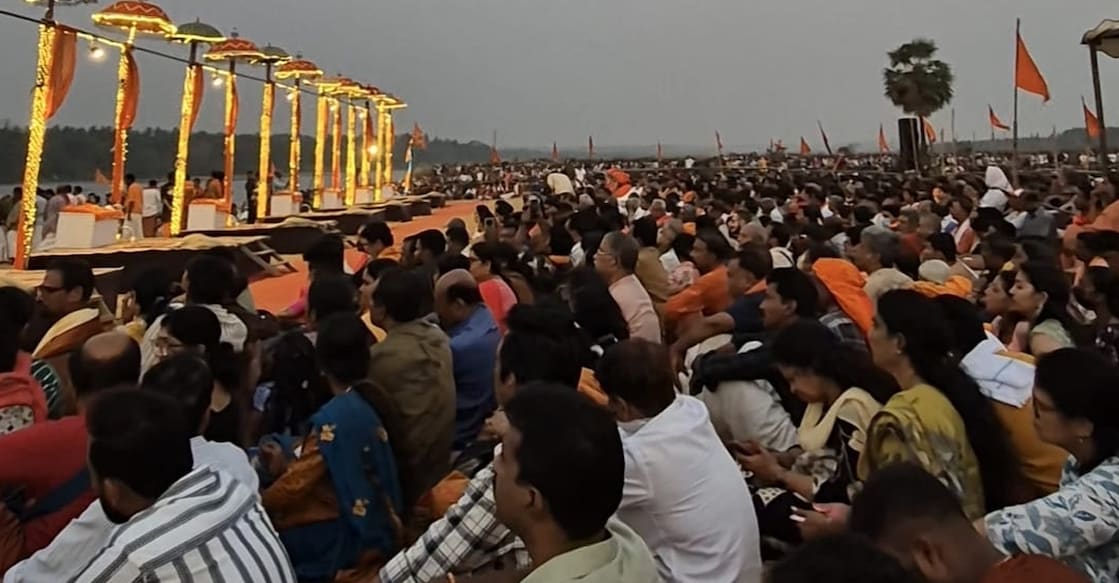
Malappuram: As dusk settled over Thirunavaya on Monday, the banks of the Nila river transformed into a surging sea of faith. Every road leading to Thirunavaya and Thavanur—on both sides of the river—was choked with humanity, as lakhs of devotees, including a striking number of women and children, streamed in to witness the Nila Arathi against the backdrop of a fiery sunset.
People flowed across the makeshift bridge to the vast sandbank midstream, now resembling a sprawling ritual ground, where chants, mantras and bhajans rose in unison. Saffron flags fluttered atop bridges and temporary structures, while the air vibrated with devotion, defying the alleged attempts to portray the Mahamagha Mahotsavam, Kerala's Kumbha Mela, as a marginal affair, even as the festival entered its concluding day on Tuesday.
Beyond the spectacle, the big success of the event in people particiaption carries significant social and political resonance. Organised by the Juna Akhada, one of the most revered Akhadas in Hindu tradition, with the strong backing of different sanyasi communities in Kerala and Sangh Parivar organisations, the revival of a more than 230-year-old ritual—last believed to have been held over two centuries ago—has evolved into a moment of religious mobilisation with wider implications.
The decision of the major political parties—the ruling CPM and the opposition Congress—to stay away from the event has drawn attention to a possible gap between mainstream political engagement and a visible expression of public religiosity.
With an estimated three to four lakh devotees participating daily, the Mahamagha Mahotsavam could well serve as an eye-opener for Kerala’s dominant political parties—especially as the BJP seeks to make electoral inroads and the organisers prepare for an even larger Maha Kumbha Mela in 2028.
According to the organisers, the Mahamagh Mahotsavam originated from the first yajna performed by Parashurama on the banks of the Bharathapuzha at Thirunavaya, under Brahma’s guidance. Believed to be held every twelve years, the festival evolved into a major cultural, spiritual and commercial congregation of South India.

After Cheraman Perumal, the festival lost royal patronage, leading Perumbadappu Swaroopam to assume the chairmanship and appoint Valluvanadu’s Valluvakkonathiri, a position later seized by the Zamorin, triggering prolonged rivalry and the blood-stained Mamankam that came to an end nearly 250 years ago, they said.
In recent years, efforts to revive the ancient festival gained momentum when Swami Anandavanam Bharati Maharaj of the Juna Akhada, appointed Mahamandaleshwar for South India at the Prayagraj Kumbh Mela, initiated its revival at Thirunavaya—reimagining the centuries-old Mahamagh Mahotsavam as Kerala’s own Kumbh Mela.
Apart from members of several royal families of Kerala, monks from different mutts and spiritual centres across South India attended the Mahamagha Mahotsavam. Mata Amritanandamayi and Acharya Mahamandaleshwar Avdheshanand Giri were among the chief patrons of the event, which was conceptualised and spearheaded by Swami Anandavanam Bharati, Mahamandaleshwar of the Juna Akhada.
According to the organisers, one of the major achievements of the festival was the participation of representatives from diverse Hindu traditions in Kerala. Spiritual leaders and reformers such as Adi Shankaracharya, Sree Narayana Guru, Chattampi Swamikal, Ayyankali-inspired spiritual streams including Ayya Vaikunda Swamikal, Swami Chinmayananda, Swami Nijananda Saraswathi and Satchidananda Saraswati were collectively acknowledged as guiding gurus, underlining the organisers’ claim of inclusiveness across sects and philosophies.
Avanthika Bharati, who coordinated the festival activities along with Swami Anandavanam Bharati, said the scale of public participation exceeded all expectations. According to her, nearly seven lakh devotees visited Thirunavaya on Sunday alone, while an average of five lakh people attended the rituals each day.

“The response points to a spiritual awakening of Hindu traditions in Kerala. We never anticipated such overwhelming support from devotees. Encouraged by this response, a much larger event is being planned for January 2028,” she said.
Swami Anandavanam Bharati also highlighted the economic impact of the festival, stressing that spiritual congregations of this scale carry significant business potential for the region. He estimated that commercial activity worth ₹50 crore to ₹100 crore was generated in Malappuram district during the event.
“Along with spiritual rejuvenation, such festivals stimulate the local economy. The government should recognise this potential and provide adequate infrastructure support for future editions, instead of keeping a distance from spiritual gatherings,” he said.
Notably, apart from senior leaders of the Congress and the CPM, even the MLAs and MPs representing the region stayed away from the festival. In contrast, several BJP leaders—including Kummanam Rajasekharan, Sobha Surendran, M T Ramesh and actor-turned-politician Suresh Gopi—visited the venue on different days.
Sangh Parivar organisations were actively involved in coordinating various activities, with Sevabharati volunteers managing crowd control, assisting the elderly, and carrying out cleaning drives on the river sandbanks.
Speaking to Onmanorama, BJP leader M T Ramesh said there were sustained efforts to erode the cultural significance of the Nila river and that the Mahamagha Mahotsavam marked a revival of its spiritual heritage. “The spiritual prominence of the Nila and the Navamukunda temple has been restored. This festival will contribute to a broader spiritual awakening in Kerala,” he said.
Though Congress leaders largely distanced themselves from the event, senior Congress MP Shashi Tharoor extended greetings to the Mahamagha Mahotsavam through social media.
Congress spokesperson Sandeep Varrier said the party was not opposed to religious gatherings or to its workers attending such events, but maintained that religion should not be politicised. “Party workers and supporters are attending the event at Thirunavaya, just as people from all sections of society visit the Guruvayur temple. There should be no party politics involved,” he said, accusing BJP leaders of attempting to communalise the event by raising what he described as baseless allegations. “They lack mass support and are therefore seeking visibility by associating themselves with large public gatherings,” Varrier added
Meanwhile, CPM leader M Swaraj said the party had nothing to do with the festival and had not discussed any political implications arising from the event. On the concluding day of the festival on Tuesday, thousands of devotees, including over 300 monks, took a holy dip in the Nila as part of the Amrutha Snanam ritual held in the morning. The Nila Arathi scheduled for Tuesday evening will mark the formal culmination of the Mahamagha Mahotsavam.
Local residents, irrespective of religion, played a key role in supporting the event. “We never expected such a huge turnout. Lakhs of devotees are visiting daily, and the local community—predominantly Muslims—has extended remarkable cooperation by providing parking spaces, food and transport facilities, despite limited infrastructure in this small town,” said Devayani Mambatta, former panchayat president of Thirunavaya.
Khadeeja Shah, accompanied by her friend Farseena, described the gathering as a symbol of communal harmony. “We learned that this festival is being held after nearly two centuries, and that itself made us curious. Though we belong to the Muslim community, we were keen to visit the venue. We are waiting to witness the Nila Arathi,” she said.
While the organisers have not disclosed the event's total expenditure, they acknowledged that it was largely funded by donations from devotees. The official website carries a ‘Support Kumbh Mela’ initiative, allowing devotees to contribute through sacred food offerings, poojas, archana, yajna offerings and guru dakshina.
 Add as a preferred source on Google