

'Disclosure Day': Spielberg's latest is rich in craft, lighter on surprise | Movie Review

Mail This Article


Steven Spielberg has spent nearly fifty years asking us to look up at the sky. Sometimes with wonder, sometimes with fear, but almost always with curiosity. In 'Disclosure Day', he returns to familiar territory, yet the surprise is that this isn't really an alien movie at all.
For decades, the possibility of extraterrestrial life has lived somewhere between conspiracy theory, pop culture obsession and scientific curiosity. 'Disclosure Day' begins where most alien stories end, asking what happens when speculation gives way to certainty. What happens when belief becomes fact?
For a while, 'Disclosure Day' is at its most compelling when it behaves like a conspiracy thriller. Daniel Kellner (Josh O'Connor), a cybersecurity whistleblower who uncovers evidence of a decades-long cover-up, spends much of the film running not from aliens but from information itself. Secrets are traded, files are hidden, people disappear, and the film develops a nervous energy that feels closer to a political thriller than traditional science fiction.
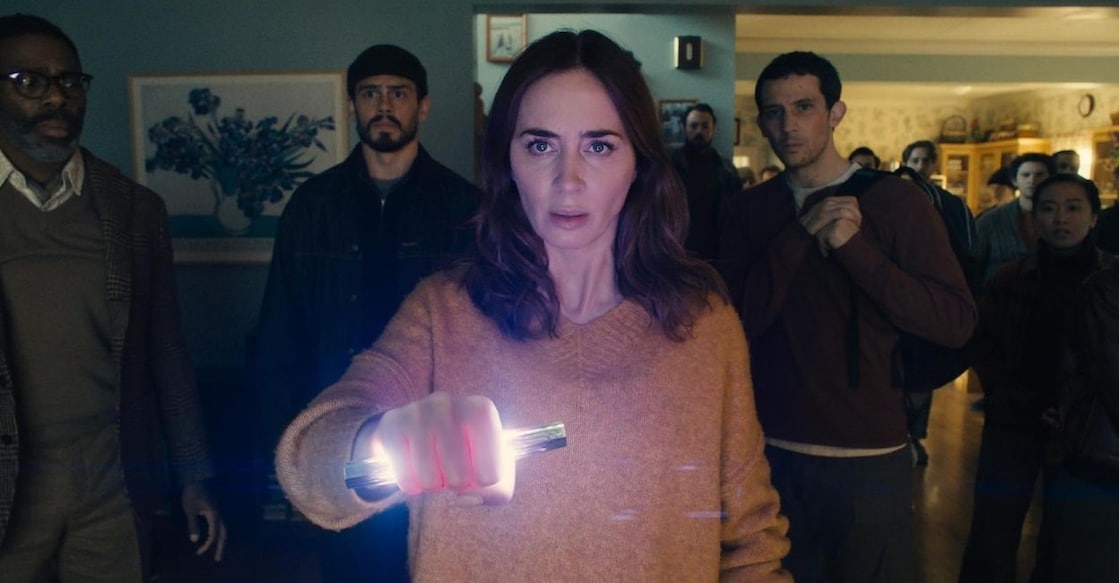
Running parallel is Margaret Fairchild (Emily Blunt), a television meteorologist who begins experiencing strange psychic episodes connected to the larger mystery. Blunt has the more difficult role because Margaret is required to be both a character and a conduit. She is often the audience's bridge to whatever lies beyond human understanding. It is a tricky role to pull off because Margaret often serves as the film's link to the unknown. Yet Blunt never lets her become merely a plot device, finding genuine emotion in even the film's most surreal moments.
What Spielberg understands better than most contemporary blockbuster filmmakers is that anticipation is often more powerful than revelation. Some of the film's most effective moments involve very little happening. A lingering look. A strange sound in the distance. A room falling silent. He has spent an entire career teaching audiences that wonder begins long before the spectacle arrives.
Working once again with Janusz Kaminski, Spielberg fills the film with images that feel unmistakably his. Light spills through windows, shadows stretch across rooms, and characters spend an awful lot of time staring at things just outside the frame. The visual language is familiar, but it remains effective because Spielberg never treats spectacle as the main attraction. He is still more interested in the people looking at the miracle than the miracle itself.
That approach works beautifully for much of the film. The mystery grows larger. Questions pile on top of questions. And then comes the problem.
The answers are not nearly as interesting as the mystery.
For a filmmaker who once revolutionised the alien genre with 'Close Encounters of the Third Kind', 'Disclosure Day' occasionally feels trapped by its own nostalgia. Spielberg's vision of extraterrestrial life remains rooted in the imagery he helped popularise decades ago. There is a warmth to that choice and even a certain optimism. Unlike many modern science-fiction filmmakers, Spielberg still believes the unknown can be approached with empathy rather than paranoia.
But cinema has changed. Audiences have changed. We've seen the linguistic puzzles of 'Arrival'. We've seen the cosmic abstractions of '3 Body Problem'. Modern science fiction increasingly imagines alien life as something so vast and incomprehensible that human beings struggle to process it. Against that backdrop, the extraterrestrials in 'Disclosure Day' feel strangely familiar.

The irony is that the film's most fascinating idea has nothing to do with the aliens themselves. Again and again, Spielberg returns to the question of communication. Not contact, but communication. Institutions hiding information. Scientists interpreting signals. Individuals struggling to explain experiences that defy language. Even the film's emotional core rests on people trying, and often failing, to understand one another.
Perhaps that is why the film works best when it stays grounded. For all its talk of UFOs and extraterrestrial life, 'Disclosure Day' is ultimately about human connection. The bond between Daniel and Margaret carries more weight than any cosmic revelation. Colman Domingo brings a welcome warmth to the film, while O'Connor's understated performance gives the story a necessary sense of vulnerability.
There is plenty to admire in 'Disclosure Day'. Technically, it is elegant and assured. Spielberg remains one of the few blockbuster directors capable of making a crowd lean forward simply by withholding information. Yet for all its craftsmanship, the film never quite achieves the sense of awe it is chasing.
Maybe that is because awe is harder to manufacture today than it was in 1977. Or maybe Spielberg already answered his own questions decades ago in 'Close Encounters of the Third Kind'.
What makes 'Disclosure Day' worth watching isn't the possibility that we are not alone in the universe. It is Spielberg's suggestion that even if humanity finally receives the answer it has spent centuries searching for, our greatest challenge will remain understanding each other.
 Add as a preferred source on Google