

Asha Bhosle's lone Malayalam song stemmed from a wish, it was fulfilled in Mumbai

Mail This Article


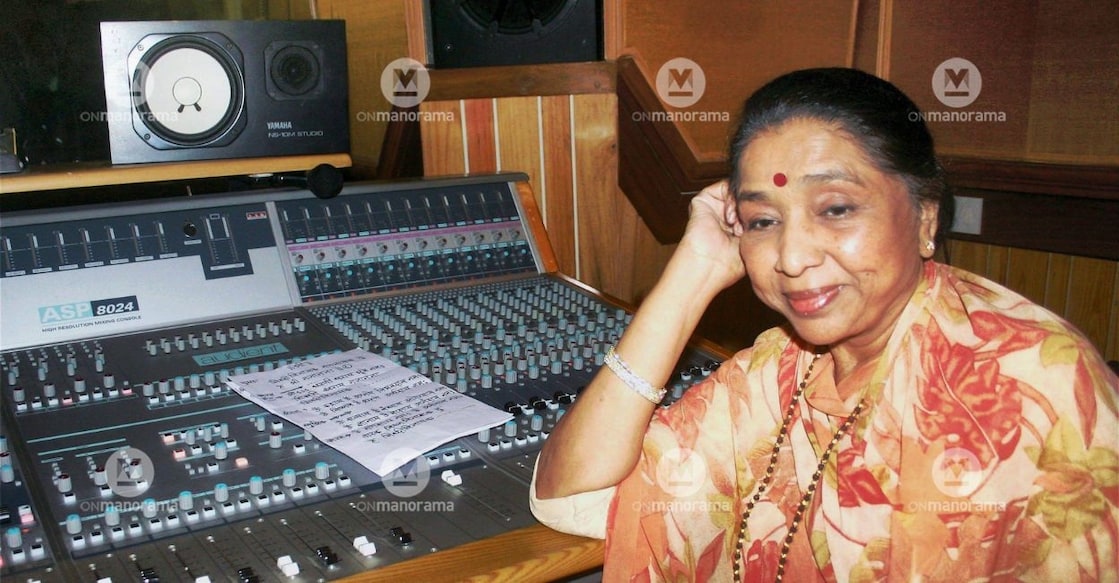
When Asha Bhosle passed away, tributes poured in for a singer who had defined Hindi film music for generations. Yet, beyond the staggering scale of her work in Bollywood, there exists a quieter, lesser-known footnote in her career. It is a single Malayalam song, recorded decades ago, that still lingers in memory. For many, that brief crossover says as much about her reach as the thousands of songs she recorded elsewhere.
Music critic Ravi Menon recalls how that rare moment came to be. The song, 'Swayamvara Subhadina Mangalangal' from the 1977 film Sujatha, was not part of any larger plan to enter Malayalam cinema. Instead, it was driven by a wish. “Producer P V Gangadharan and director Hariharan wanted her to sing for the film,” he says. “The recording happened in Bombay, and she agreed. That is how it came together.”
The film itself featured other non-Malayalam voices as well, including Hemlata, with music composed by Ravindra Jain. At the time, bringing in singers from outside Kerala created a certain curiosity among listeners. “It was unusual then,” Ravi points out. “And the song she sang became popular too.”
It remains her only Malayalam track, but the fact that it still finds mention decades later speaks to the kind of presence she carried. Even a single song, in a language she did not regularly perform in, managed to leave a mark.
To understand why, one has to step back into the scale of Asha Bhosle’s career. Born into the Mangeshkar family, she entered music at a time when playback singing itself was still evolving. She recorded her first song in 1943 and went on to build a body of work that crossed 12,000 recordings. Over the years, she moved effortlessly across styles, adapting to each new phase of cinema while retaining a distinct voice.

Her journey often ran parallel to that of her elder sister, Lata Mangeshkar. But where many singers of that era gravitated towards Lata’s style, Asha chose a different path. “She never tried to imitate her sister,” Ravi says. “Everyone else did, but Asha carved out her own identity.” That decision, he adds, is what eventually gave her a cult-like stature in Indian music.
Her collaborations played a crucial role in shaping that identity. With composer O P Nayyar, she found early success through rhythmic, energetic songs. Later, her work with R D Burman expanded her range even further, bringing together cabaret, romance, and experimental sounds. Songs like Dum Maro Dum, Piya Tu Ab To Aaja, and Yeh Mera Dil were not just hits but trendsetters that introduced new textures into Hindi film music.
At the same time, she was equally at ease with more nuanced forms. Her work in films like Umrao Jaan demonstrated a command over ghazals that stood apart from her more popular numbers. This ability to move between extremes became one of her defining strengths.
Singer Gayatri Asokan remembers encountering that versatility up close. She met Asha Bhosle twice, once in Thiruvananthapuram and later in Mumbai. One memory stands out clearly. “I had the chance to sing ‘Jaaneman Jaaneman’ in front of her,” she recalls. “We were backstage together, and it was a very special moment for me. She was warm, approachable, and incredibly gracious.”
For Gayatri, Asha Bhosle’s legacy goes beyond individual songs. “She is like a music university,” she says. “To leave a lasting mark over such a long career is not easy. She and Lata ji were among those who shaped playback singing in its early years. They made it possible for singers to explore different scales and styles.”
That sense of range is something Gayatri returns to repeatedly. In an industry where film music often defines success, Asha Bhosle moved comfortably between commercial and non-commercial spaces. “She could handle everything,” she says. “From cabaret numbers and rock and roll to bhajans and ghazals, she created a space for herself in every genre.”
Behind that ease was a level of discipline that is easy to overlook. Gayatri recalls hearing about her rigorous practice routines. “She would rehearse even late at night,” she says. “That kind of dedication is what made her who she was.” Balancing a demanding career with personal responsibilities only adds another layer to that story. “When you look at it that way, she was extraordinary,” Gayatri adds.
Ravi, too, points to the longevity of her career as one of its most remarkable aspects. She began at a time when recording technology was limited and studios were far from ideal. “Playback singing itself was still taking shape,” he says. “From those early conditions to the modern era, she adapted to every phase. She saw it all and evolved with it.”
In that sense, her Malayalam song becomes more than just a footnote. It reflects a larger truth about her career. She did not belong to one language or one style. Her work travelled across regions, often without the need for repetition. Even a single song in Malayalam could resonate because the voice behind it was already familiar, already trusted.
Ravi draws a comparison with another enduring figure. “There are very few artists from that era still with us,” he says, mentioning K J Yesudas as one of the rare names. The reference underlines the scale of what has been lost. These are voices that defined not just songs but entire periods of music.
For listeners, Asha Bhosle’s songs have always existed in fragments of memory. A dance number that plays at a celebration. A ghazal that surfaces in a quiet moment. A tune that crosses languages without losing its essence. Each one carries a trace of a voice that refused to be confined.
