

Mail This Article


A coconut is all it takes to unlock a full meal at Sreedharan’s tea shop, quite literally!
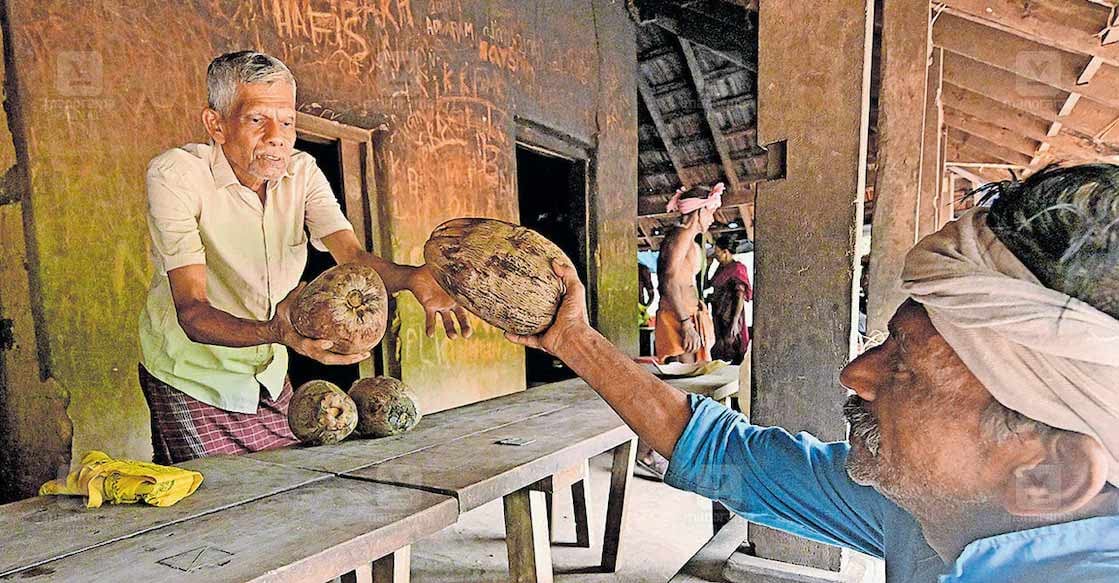
If you happen to have a coconut in hand, you can simply walk into Sreedharan’s tea shop in Kerala's Kannur district and enjoy a porotta and a cup of tea. With four coconuts, you could savour two porottas, a plate of steaming chicken curry, and tea and walk out with both your stomach and heart content.
There is no need to pause and wonder whether this is some unusual barter system where coconuts are exchanged for food. That, in fact, is the quiet charm of Kizhakkayil Sreedharan’s modest eatery at Thiruthy in ward four of Thriprangottur panchayat, Panoor.
Here, coconuts replace cash when it comes to paying for a meal and it's a rhythm that has remained unchanged for decades. Each coconut is valued at Rs. 20, while the food items are priced modestly to keep them easy on the pocket. A cup of tea costs Rs.10, a porotta Rs.10, chicken curry Rs.50, and kappa puzhukku (mashed tapioca) Rs. 20. The shop is run by Sreedharan and his wife Shobha. Their unassuming, nameless tea shop has gone viral on social media reels, drawing visitors from far and wide, all eager to experience the couple’s homely flavours. What makes it even more memorable is its unique system, food in exchange for coconuts.

Sreedharan was only 20 when he opened his tea shop. From the very beginning, he followed this distinctive practice of serving tea and snacks in exchange for coconuts. The coconuts he receives are dried and converted into ball copra (used to make coconut oil), which he later sells at the Vadakara market. At one point, he recalls, he would collect as many as 50,000 coconuts this way, with at least 200 arriving every day.
Even during times when cooking gas shortages left restaurant owners elsewhere struggling, Sreedharan has remained unaffected. His kitchen runs entirely on firewood, sourced from nearby plots. Above this hearth, coconuts are stacked on a loft, slowly drying and transforming into copra over three months. Tea, kanji, tapioca and porottas are all prepared over a traditional wood-fired hearth, which also lends the food a rustic warmth. He is assisted in the kitchen by his sister-in-law, Praseetha.
Let’s now step into Sreedharan’s homegrown eatery, a few coconuts in hand.
