

His Siberian husky is paralysed & Kochi man demands justice after alleged medical negligence

Mail This Article


Kochi: Akira cannot stand, lift her head or even wag her tail. The four-year-old Siberian Husky lies motionless on the floor of her home in Kaitharam near North Paravur in Kochi, watching her family with striking blue eyes. Her meals are now spoon-fed or hand-fed, with the dog having to eat while lying on her side.
Her owner, Vishnu Prasad A P, alleges that wrong diagnosis and treatment at a government veterinary facility contributed to the deterioration of her condition, leaving her completely paralysed. With Akira now diagnosed with advanced liver cancer, he is demanding accountability from the Animal Husbandry Department over what he describes as medical negligence and inadequate investigation of her symptoms.
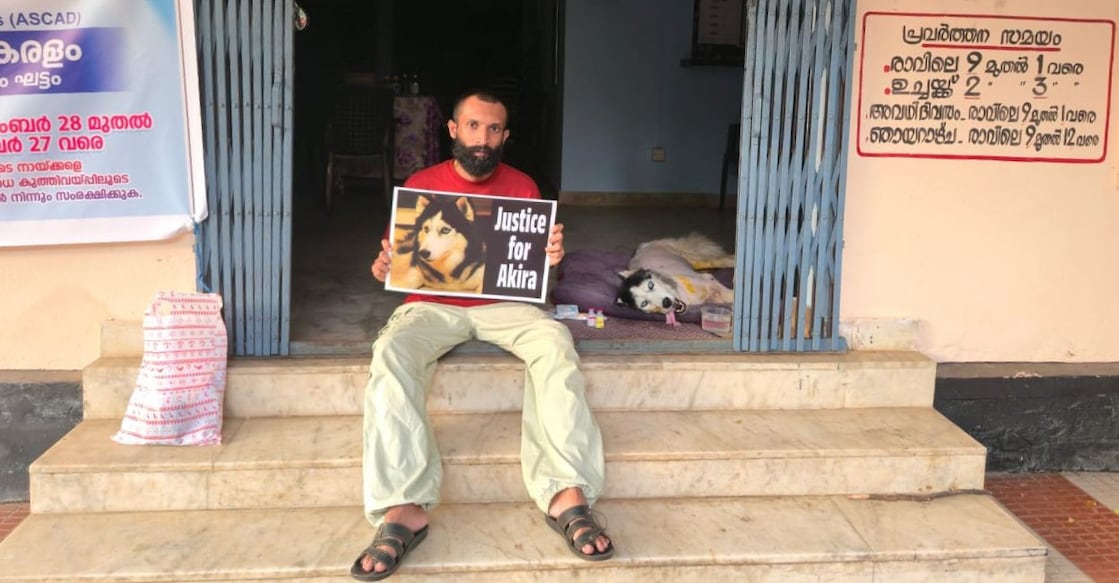
On Monday, Vishnu took Akira to the Government Veterinary Polyclinic in North Paravur and staged a protest outside, carrying her on a makeshift bed. Beside the helpless animal, he held up a placard reading: “Justice for Akira.”
“I brought her home when she was just 35 days old,” said Vishnu, an assistant manager at a private firm in Kochi. “I had waited one and a half years to bring a Husky into our lives, travelling all the way to Bengaluru and spending nearly ₹1.35 lakh. She is our family and my parents, my brother, my wife, and my little child all adore her. Now, watching her lie like this every single day is pushing me into complete depression.”
From suspected tick fever to paralysis
Akira’s health began deteriorating on September 2, when Vishnu noticed her dragging her front right paw, a condition known as knuckling. She was lethargic and had refused food for two days. He immediately took her to the North Paravur polyclinic.
He questioned the diagnosis of tick fever, alleging that the veterinarians did not conduct the requisite tests before beginning treatment.
“I grew up raising dogs; we’ve had 10 to 12 dogs at home over the years, and I know what tick fever looks like,” he said. “I pleaded with them, telling them there wasn’t a single clinical sign of tick fever. They didn’t even conduct a basic peripheral blood smear test, which is standard protocol before diagnosing tick-borne infections. Instead, they insisted on it and began shooting her with injections.”
Akira received daily injections for five days, followed by oral medication. However, the weakness spread from her front limbs to her hind legs. When Vishnu returned on September 10, further tests were conducted, but he alleges that the doctors continued to maintain that the results were normal.
By September 21, Akira had lost all motor function and was completely paralysed.
Advanced scans reveal liver cancer
Vishnu then approached a senior private veterinarian in Tripunithura. According to him, the veterinarian found no clear clinical indication of tick fever in Akira’s treatment records.
Vishnu, who says he spent more than ₹19,000 on treatment, filed a departmental grievance with the AHD on September 26. He submitted a petition to the North Paravur police station on September 29.
“When we went to the police station, the polyclinic doctors stood there and continued arguing that it was tick fever,” Vishnu recounted.
At the Kerala Veterinary and Animal Sciences University (KVASU) Veterinary College in Mannuthy, examinations and scans conducted between October 3 and 12 revealed hepatocellular carcinoma, an advanced form of liver cancer that had spread across the organ.
“We were preparing to drive 360 kilometres to the Namakkal Veterinary College in Tamil Nadu on Tuesday for better treatment. That was when the final abdominal scan in Mannuthy confirmed the tumour. The doctors told us there is virtually no hope left,” he said.
Department defends treatment
Dr Eldhose, the Ernakulam District Animal Husbandry Officer, told Onmanorama that a departmental inquiry had been conducted under the Chief Veterinary Officer of the Ernakulam District Veterinary Centre.
“The inquiry officer conducted a spot visit and the inquiry has concluded, though the formal written report is yet to be submitted,” he said.
“The dog has liver cancer, hepatocellular carcinoma. A local veterinary dispensary simply lacks the diagnostic machinery to detect internal cancer,” Dr Eldho said.
He added that tick fever was common and could become fatal if left untreated, explaining that veterinarians sometimes administer broad-spectrum antibiotics when the infection is suspected.
“Even if the diagnosis was incorrect, administering an antibiotic would not deteriorate her condition or trigger paralysis,” he said.
Dr Eldho suggested that stress caused by the undiagnosed tumour might have contributed to secondary complications.
“Tick fever can cause paralysis, and sometimes localised pain or weakness arises after injections, but cancer itself or the profound stress it induces complicates the picture. We can only deliver a conclusive statement once the inquiry report is formally reviewed,” he added.
Vishnu alleges that the polyclinic failed to maintain proper treatment records, conduct essential differential diagnostic tests and respond adequately to his concerns.
Akira is now receiving supportive treatment under a government veterinary surgeon stationed in Kodungallur.
Vishnu wants the department to accept accountability and bear Akira’s specialised treatment expenses. If recovery is no longer medically possible, he also seeks compassionate clearance for euthanasia to end her suffering.
