

How an artwork in Fort Kochi on shared legacy got embroiled in a hate video row
Mail This Article


An artwork by Riyas Komu that juxtaposes two leaders with a shared past has found itself at the centre of an unlikely controversy sparked by a North Indian influencer.
'What is Jinnah doing in Bharat?' asks North Indian influencer Amrit Singh Darren in a video questioning an artwork displayed at Kashi Art Cafe in Fort Kochi. He questions the display of Muhammad Ali Jinnah alongside Mahatma Gandhi before making claims about the neighbourhood’s Muslim population and food culture, warning that Kerala is in danger and calling to 'save' the state.
The video has triggered widespread criticism in Kerala, with many questioning its portrayal of Fort Kochi as a place divided along religious lines. The Kochi city police have registered a case against Darren over remarks allegedly promoting communal enmity.
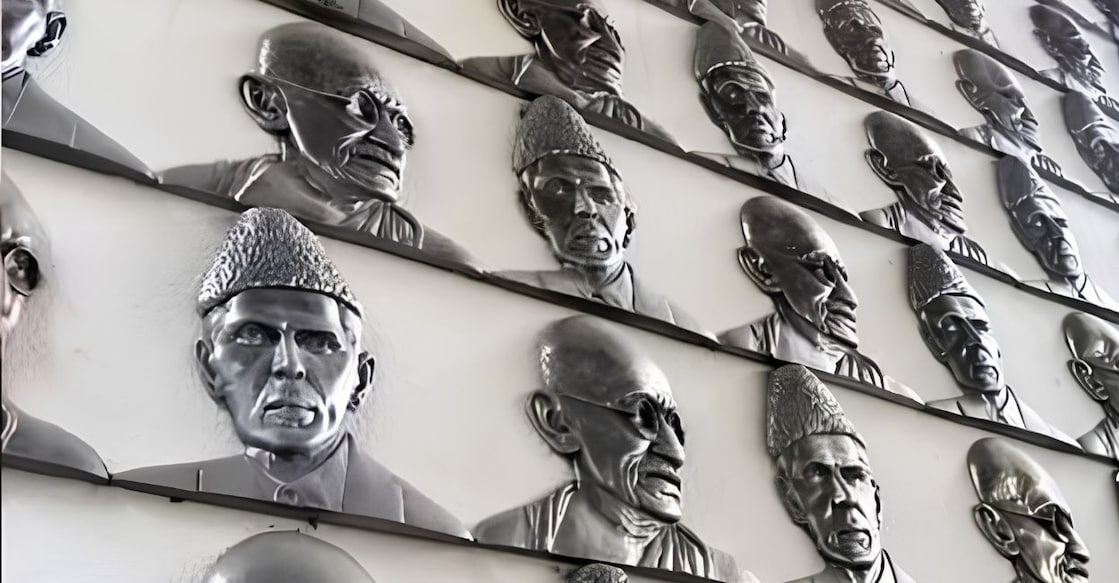
The artwork Darren questioned
Titled ‘Blood Brothers: Two Fathers from Gujarat’, the installation features repeated, alternating aluminium reliefs of Gandhi and Jinnah. The title draws attention to their shared Gujarati origins, while the juxtaposition invites viewers to consider their intertwined histories and the political divisions that culminated in Partition.
A 2012 report in The New Indian Express described Komu’s use of the two figures as a reflection on social divisions and how conflicts rooted in the past continue to shape the present. The installation places two leaders with complicated, intertwined legacies in a visual dialogue, rather than presenting their images as straightforward declarations of political allegiance.
The controversy over the artwork has also brought renewed attention to the place where it is displayed. For former Kochi mayor K J Sohan, the idea that Fort Kochi should be viewed through the lens of religious division overlooks the character of a neighbourhood he has known since childhood.
“Fort Kochi is a cultural mosaic, with its old settlements, architecture and traditions still intact. Communities from different backgrounds have lived here together for centuries. It is an inviting place where people coexist without bothering one another,” Sohan told Onmanorama.
Recalling his childhood, he said he had grown up among people from different communities, including Jews, Anglo-Indians and Konkanis. Their presence, he said, was part of the everyday life of Fort Kochi, where cultural differences were not necessarily barriers between people.
Sohan also pointed to the longstanding presence of Muslims in the area, particularly in Calvathy, which has a significant Muslim population and a history of Muslim traders. The neighbourhood is home to a historic mosque dating back to the 14th century.
“There are Muslim traders here, and their presence is visible. Perhaps that is what the influencer noticed,” Sohan said. “But in Fort Kochi, you cannot tell people apart by whether they are Gujarati, Marathi, Kutchi Memon, Jewish or Anglo-Indian. This is a place where people live freely together. It is shocking that someone could make such claims about it.”
For Sohan, the presence of a large Muslim community is part of Fort Kochi’s longstanding social and cultural fabric, not evidence of the area being taken over by any one group. Its identity, he said, cannot be reduced to the religious composition of its residents.
Writer and illustrator Bony Thomas said the claims made in the video misrepresented a neighbourhood whose defining feature is its cultural diversity.
“What he is saying is so bizarre that it does not even warrant a response. These are baseless allegations against a place like Fort Kochi,” he told Onmanorama.
Thomas described the Kochi-Mattancherry belt as one of the most culturally diverse parts of Kerala, pointing to the many languages, religious traditions and communities found within a relatively small area.
“People speak almost 16 languages. There are more than 40 gods,” he said.
To illustrate the diversity, Thomas pointed to the concentration of religious and cultural landmarks in the area, from Jewish Town and the former Cochin royal residence to temples associated with Konkani, Telugu, Marathi and Gujarati communities. Jain places of worship, mosques and Christian churches also form part of the landscape.
The proximity of these institutions, he said, reflects a neighbourhood where different communities have maintained their traditions while sharing the same streets and public spaces.
“If one community is celebrating a festival, another will be celebrating a different one. It is a beautiful place, not the kind of place being portrayed in this video,” Thomas said.
Riyas Komu didn’t respond to Onmanorama’s request for a comment.
