

How farmer from Muvattupuzha turned an abandoned quarry into a profitable cage fish farm
Mail This Article


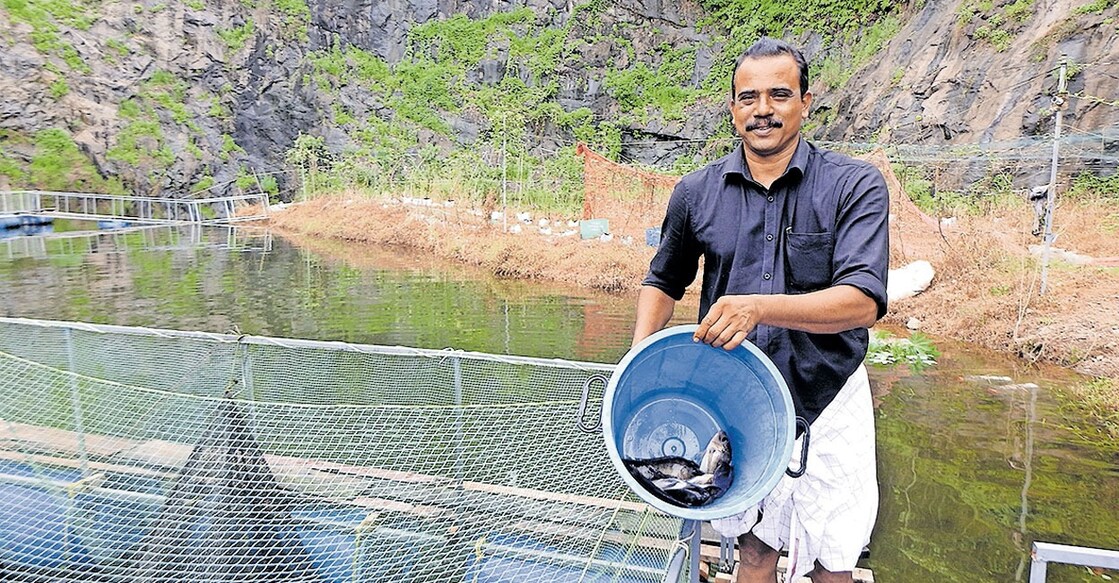
Across many regions, disused quarry pits lie abandoned, often turning into unsightly hazards or hubs for antisocial activities. However, with the right approach, these deep water bodies can be converted into highly productive aquaculture hubs. VP Naushad, a farmer and community worker from Kalamboor near Muvattupuzha in Ernakulam district, has proven this by running a flourishing cage fish farm in a leased two-acre quarry pit, harvesting nearly 12 tonnes of fish every year.
Naushad transitioned from poultry farming to pisciculture ten years ago. Initially, he raised carp varieties in the quarry, harvesting once or twice a year. Realising that cage culture could guarantee a steady, round-the-year income, he adopted the technique in 2021 with support from the Fisheries Department and the Central Marine Fisheries Research Institute (CMFRI).

Daily harvest and superior quality
Cage culture involves growing fish fingerlings in net enclosures suspended in open water bodies while feeding them floating commercial feeds. Naushad maintains 10 floating cages in the 150-foot-deep quarry pit. Inside the cages, he raises GIFT and Chitralada varieties of tilapia, while free-swimming species like Katla, Rohu, wallago catfish, and snakehead thrive outside the cages in the main water body.
Because the fish inside the deep cages remain suspended well above the muddy bottom of the quarry, they produce clean, high-quality meat without any muddy taste. This premium quality allows Naushad to sell his harvest directly to consumers at ₹200 per kg. Staggering the stocking batches across different cages enables him to harvest and sell fish almost every day.
Cage structure and operational setup
Each floating cage unit is built using a GI pipe frame resting on floating plastic drums, supporting a three-metre-deep nylon net. The cages measure four metres in length, three metres in width, and three metres in depth, with a half-inch mesh size. A secondary outer net protects the inner cage from external fish attacks and prevents feed loss. Naushad stocks around 2,500 fingerlings per cage, initially keeping them in fine-mesh hapa nets for three months before releasing them into the main cage environment.
Investment, subsidies, and farm economics
Fabricating a single cage setup costs around ₹1.25 lakh, including 12 floating drums, GI piping, and nylon netting (which costs approximately ₹20,000 per net). To assist farmers, the Fisheries Department provides a one-time subsidy of ₹1.20 lakh for a two-cage unit. Fingerlings cost around ₹7 each. From 2,500 stocked tilapia fingerlings, roughly 1,800 reach a market weight of 500g to 700g over an 8 to 10-month growth cycle, yielding 1,000 to 1,200 kg of fish per cage and generating around ₹2 lakh in gross revenue.
Daily operational costs are notable, with 10 cages consuming nearly 40 kg of feed per day, amounting to ₹2,400 daily at ₹60 per kg. Nevertheless, direct sales at fixed market prices keep the venture profitable. Free-swimming carp species in the open quarry, which feed naturally on algae and aquatic grass, serve as a bonus harvest, with fingerlings provided free by the Fisheries Department.
Integrated organic farming and future outlook
Naushad has also integrated vegetable and banana farming in grow bags along the quarry perimeter. He uses nutrient-rich water pumped directly from the fish pond to irrigate his crops organically, catering to customers who visit the farm to purchase both fresh fish and vegetables. Looking ahead, Naushad plans to introduce recreational angling facilities and on-site fish frying services for visitors.
