

Union Budget 2026: Kerala eyes AIIMS, Sabari Rail, special fiscal correction package
Mail This Article


New Delhi: Union Finance Minister Nirmala Sitharaman will present her ninth consecutive Union Budget in Parliament on Sunday at 11 am. Sitharaman, who completed six years and eight months in office on January 31, is the longest-serving finance minister to hold the post continuously.
The budget presentation will be live-streamed on the YouTube channels of Sansad TV and Doordarshan.
Ahead of the Budget session, Prime Minister Narendra Modi said that Sitharaman presenting the Union Budget for the ninth consecutive time “will be recorded as a matter of pride in India’s parliamentary history”.
Former prime minister Morarji Desai had presented the Union Budget on 10 occasions, while P Chidambaram presented the Budget nine times, though not in consecutive years.
For Kerala, this Union Budget will be crucial, as the state is pinning its hopes on several projects, including approval for the All India Institute of Medical Sciences (AIIMS), the Sabari Rail project, and Vizhinjam port development. Most importantly, the state is expecting a special fiscal correction package from the Centre to overcome its financial crisis.
Kerala Finance Minister K N Balagopal had raised these demands with the Union Finance Minister during a pre-Budget discussion in New Delhi last month. A special package for rehabilitating expatriates, a wage hike for scheme workers, fund allocation to mitigate human-wildlife conflicts, and support for the plantation sector are among the other major expectations of the state.
Like Kerala, other states also have high expectations from the Budget.
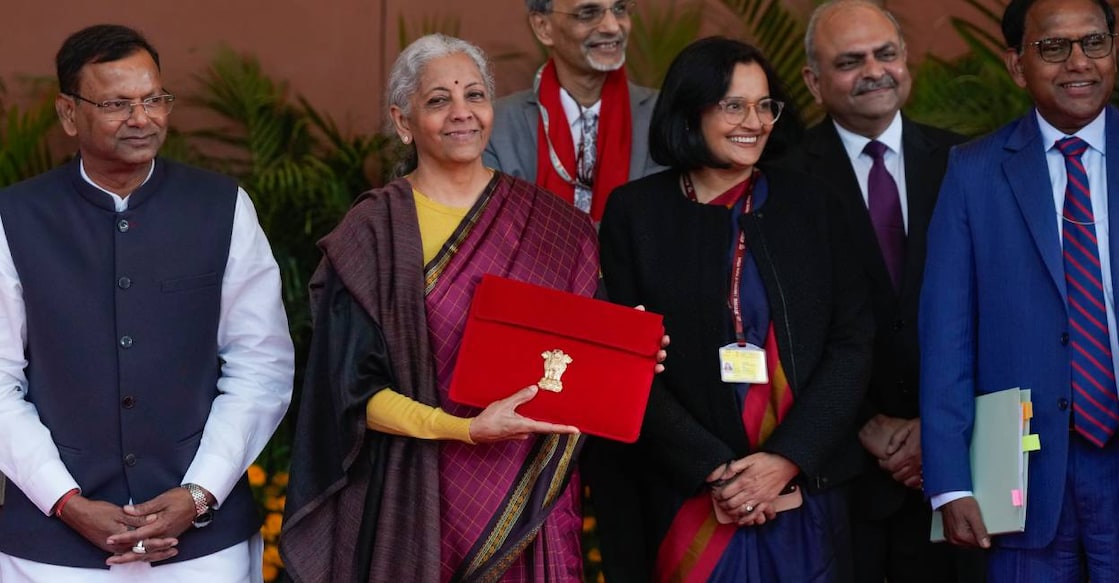
In her first Budget in 2019, Sitharaman replaced the leather briefcase—used for decades to carry Budget documents—with a traditional ‘bahi-khata’ wrapped in red cloth. This year’s Budget will once again be presented in a paperless format, as has been the practice for the last four years.
Here are the key numbers to watch out for in the Union Budget for 2025-26:
Fiscal Deficit: The budgeted fiscal deficit for the current fiscal year (April 2025 to March 2026, FY26) is estimated at 4.4 per cent of GDP.
Having achieved a fiscal consolidation roadmap with the deficit below 4.5 per cent of GDP in FY26, markets will watch for guidance on debt-to-GDP reduction in FY27 and whether the government announces a specific fiscal deficit target for the next financial year. There is an expectation that the fiscal deficit could be pegged at 4 per cent of GDP for FY27, reported PTI.
Capital Expenditure: The government’s planned capital expenditure for FY26 is budgeted at ₹11.2 lakh crore. The upcoming Budget is expected to continue its focus on capex, with a possible 10–15 per cent increase, as private sector investment remains cautious.
Capex could exceed ₹12 lakh crore, as pay revisions are due only in FY28, providing fiscal space.
Debt Roadmap:In the 2024–25 Budget speech, the finance minister stated that from 2026–27 onwards, fiscal policy would aim to keep the central government’s debt on a declining path as a percentage of GDP.
Markets will closely watch the debt consolidation roadmap from FY27 onwards, particularly timelines for reducing general government debt-to-GDP to the 60 per cent target. The ratio stood at 85 per cent in 2024, including central government debt of 57 per cent.
Borrowing: Gross market borrowing for FY26 was budgeted at ₹14.80 lakh crore. This figure will be closely tracked as it reflects fiscal health and revenue mobilisation.
Tax Revenue:Gross tax revenue for FY26 is pegged at ₹42.70 lakh crore, an 11 per cent increase over FY25. This includes ₹25.20 lakh crore from direct taxes and ₹17.5 lakh crore from indirect taxes.
GST: GST collections in FY26 are estimated to rise 11 per cent to ₹11.78 lakh crore. FY27 projections will be keenly watched, especially following rate reductions implemented since September 2025.
Nominal GDP: Nominal GDP growth for FY26 was initially estimated at 10.1 per cent, with real GDP growth at 7.4 per cent. However, nominal growth has been revised downward to 8 per cent due to lower-than-expected inflation.
FY27 nominal GDP projections, expected to be between 10.5 and 11 per cent, will offer insights into the inflation outlook.
Spending on key schemes such as GRAM G, along with allocations for health and education, will also remain in focus.
