

Onmanorama Explains | What changes does the new Transgender Bill bring?
Mail This Article


Parliament has passed a Bill to amend the law on the rights and protection of transgender persons, proposing to exclude social orientations from its scope. The Rajya Sabha passed the Bill by a voice vote, rejecting amendments proposed by the Opposition. It also turned down Opposition demands to send the Bill to a select committee for further review.
The Bill, which seeks to amend the Transgender Persons (Protection of Rights) Act, 2019, also proposes graded punishment based on the severity of offences against transgender persons.
What does the Bill propose?
The Bill aims to define who qualifies as 'transgender' and excludes different sexual orientations and self-identified sexual identities from its scope. It also proposes stricter punishments for offences such as forcing individuals to become transgender through coercion or physical harm.
In the 2019 Act, a transgender person has been defined as "whose gender does not match with the gender assigned to that person at birth and includes trans-man or trans-woman (whether or not such person has undergone Sex Reassignment Surgery or hormone therapy or laser therapy or such other therapy), person with intersex variations, genderqueer and person having such socio-cultural identities as kinner, hijra, aravani and jogta".
The definition has now been replaced with:
(i) a person having such socio-cultural identities as kinner, hijra, aravani and jogta, or eunuch, or a person with intersex variations specified below or a person who, at birth, has a congenital variation in one or more of the following sex characteristics as compared to male or female development:— (a) primary sexual characteristics; (b) external genitalia; (c) chromosomal patterns; (d) gonadal development; (e) endogenous hormone production or response, or such other medical conditions; or

(ii) any person or child who has been, by force, allurement, inducement, deceit or undue influence, either with or without consent, compelled to assume, adopt, or outwardly present a transgender identity, by mutilation, emasculation, castration, amputation, or any surgical, chemical, or hormonal procedure or otherwise:
Stricter certification process, new penal provisions introduced
Under Sections 5 and 6 of the 2019 Act, read with the Transgender Persons (Protection of Rights) Rules, 2020, a transgender person could apply for an identity certificate by submitting the prescribed form, as specified in the Act, along with an affidavit declaring their gender identity. Based on these documents, the District Magistrate was responsible for issuing the certificate of identity, and no medical or physical examination was required, as per Rule 4 of the 2020 Rules.
If the person has undergone a medical intervention for a gender-affirming procedure, then such a person may apply along with a certificate issued to that effect by a Medical Superintendent or Chief Medical Officer of the medical institution concerned. Based on this, the District Magistrate could issue a revised certificate of identity as per Section 7.
Now, the 2026 amendment requires that the District Magistrate can only issue a certificate after examining the recommendation of the "authority", which is a Medical Board, headed by a Chief Medical Officer or a Deputy Chief Medical Officer, as may be appointed either by the Central Government or the State Government of the UT administration.

Even after the recommendation of the Medical Board, if the District Magistrate considers it, he can take the assistance of other medical experts. Who these medical experts are has not been defined under the Amendment Act.
Amendments have also been made to Section 7, which makes it mandatory for a transgender person to make an application to the District Magistrate after a gender affirming surgery. It has also now become mandatory for the medical institution concerned to furnish details of such persons to the District Magistrate as per clause (1A), which has been inserted into Section 7.
Apart from this, Section 18 has also been amended, and various punishments have been added, such as if a person kidnaps or abducts any adult and causes him to undergo a hormonal or surgical procedure with the intent to impose a transgender identity against the will or consnet will be punished for a minimum of 10 years of imprisonment and a fine of ₹2 lakh.
What MPs said about the Bill
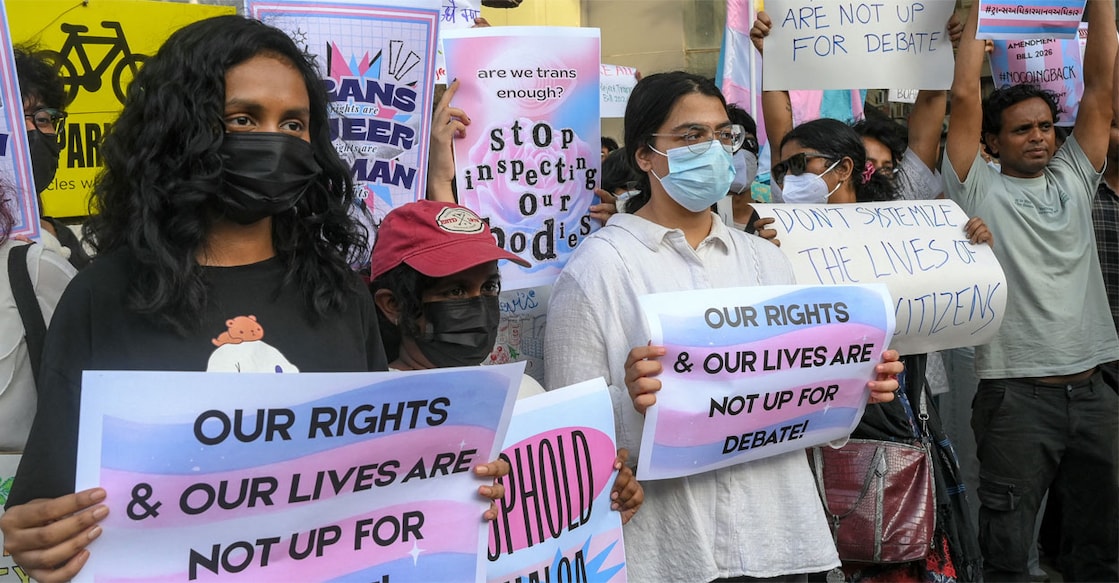
Opposition members raised concerns over the Bill's approach to gender identity, consultation, and rights. Congress's Rajya Sabha MP Renuka Chowdhury questioned why transgender persons should face scrutiny by medical boards when others self-declare their gender without such verification. She also flagged the lack of participation by Union government officials in consultations and asked whether transgender communities were meaningfully consulted.
TMC MP Saket Gokhale criticised the government for not engaging with affected communities, alleging the Bill was influenced by global political trends. He termed it "colonial" and highlighted concerns over underreporting, noting that only a fraction of the estimated transgender population has applied for identity cards due to fear and stigma.
Manoj Kumar Jha questioned the absence of a rights-based approach in the legislation and criticised the timing of the amendment, arguing that it undermines constitutional protections.
Shiv Sena's Priyanka Chaturvedi raised concerns about the lack of broad consultation and transparency, pointing out that several identity card applications have been rejected without explanation. She warned that allowing medical boards to determine identity could violate the dignity of transgender persons.
