

No injustice in delimitation, assures PM; Opposition cries foul ahead of crucial vote tomorrow
Mail This Article


A three-day special session of Parliament began on Thursday on a stormy note, as the government and the Opposition clashed over a Constitution amendment bill linking the implementation of the women’s reservation law to the contentious delimitation exercise.
The Lok Sabha introduced the Constitution (131st Amendment) Bill, 2026 after a division of votes, following a heated 40-minute debate in which the Opposition demanded voting on its introduction. The Bill was cleared for introduction with 251 members voting in favour and 185 against. Alongside it, two related legislations — the Delimitation Bill and the Union Territories Laws (Amendment) Bill — were also introduced to operationalise the proposed framework, including in Delhi, Puducherry and Jammu and Kashmir.
The three Bills together triggered an intense political confrontation, setting the tone for the special session as both sides dug in over the contentious link between women’s reservation and delimitation.
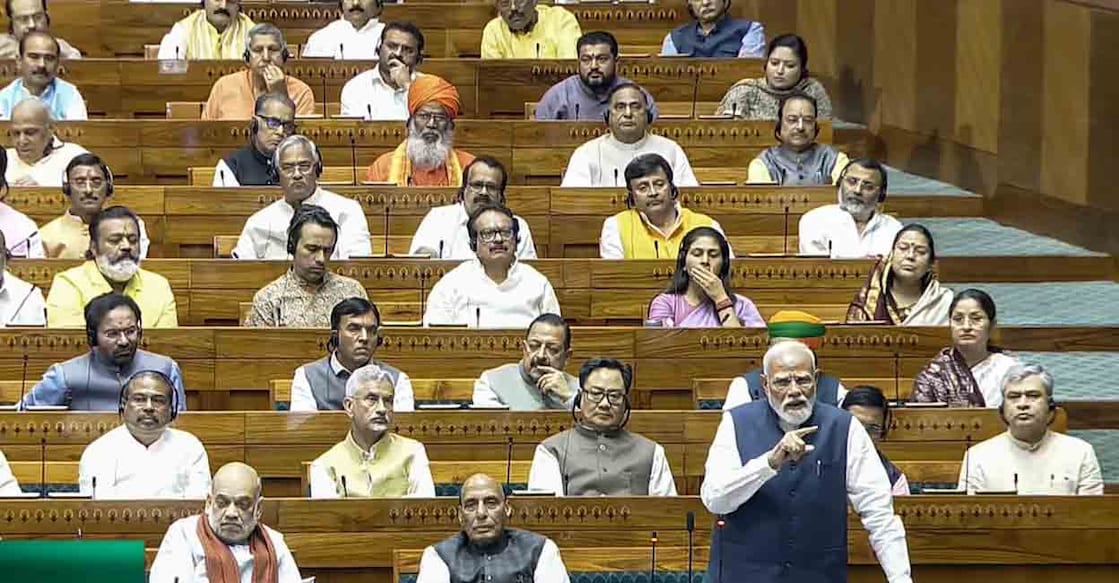
During the debate on the Bills, Prime Minister Narendra Modi urged the Opposition not to give a “political colour” to the legislation. “The three Bills, including the Constitution Amendment Bill, have been introduced as it is the logical end to implementing the Women’s Reservation Bill. Do not see this from a political lens, this is a decision in national interest,” he said.
Seeking to allay concerns over delimitation, Modi added, “No injustice will be done to any state — from east to west and north to south.” He also cautioned that those who had opposed women’s reservation in the past “were not forgiven by the women of the country and ended up badly in the elections that followed”.
However, Opposition parties strongly opposed the move, clarifying that they support women’s reservation but object to what they termed “politically motivated” delimitation provisions being tied to it. Congress MP Gaurav Gogoi, initiating the debate, alleged that the government was trying to “bulldoze” delimitation in the name of women’s reservation and termed the Bills “anti-women, anti-caste census, anti-Constitution and anti-federal structure”. He argued that if the Centre was serious about implementing the quota, it should do so within the existing strength of 543 seats without linking it to delimitation.
Samajwadi Party chief Akhilesh Yadav accused the BJP of turning “nari” into a “nara”, alleging that the amendments were being used to delay the Census. He questioned the representation of women within the BJP and its ideological ecosystem, and reiterated support for women’s reservation without conditionalities.

From Kerala, Congress leader K C Venugopal termed the delimitation provisions a “hidden trap” and an “attack on democracy”, while MP N K Premachandran echoed concerns over federal imbalance. They argued that while reservation for women was necessary, linking it with delimitation could disproportionately impact southern states. Venugopal said a Constitution amendment Bill could not be discussed together with other ordinary Bills, but Home Minister Amit Shah rejected the objection, saying it could be done. Speaker Om Birla cited precedents to state that the Constitution amendment Bill could be discussed alongside other Bills as they relate to the same subject.
A key proposal in the draft amendment is to increase the strength of the Lok Sabha from the current 543 seats to as high as 850 to facilitate 33 per cent reservation for women ahead of the 2029 general elections. The proposal also includes expanding seats in state assemblies and Union territory legislatures.
The proposed delimitation, likely to be based on the last published Census, has triggered concerns — particularly in southern states — that their political representation could shrink relative to states with higher population growth, despite better population control outcomes.
Ahead of the session, Opposition leaders met at the residence of Congress president Mallikarjun Kharge to chalk out a joint strategy. Leaders including Rahul Gandhi, T R Baalu, Tejashwi Yadav, Sagarika Ghosh, Sanjay Raut, Arvind Sawant and Supriya Sule participated, with Akhilesh Yadav joining virtually. They reiterated that women’s reservation should be implemented within the current House strength. Leader of Opposition Rahul Gandhi accused the government of attempting a “power grab” through delimitation and warned of possible gerrymandering, saying the Opposition would resist any move that undermines representation of southern and smaller states.
Numbers challenge the government
Passing the Constitution amendment will not be straightforward. It requires a special majority — more than 50 per cent of the total membership and a two-thirds majority of members present and voting.
If all 540 members participate, the two-thirds mark would be 360. The NDA currently has 292 MPs in the Lok Sabha, while the Opposition bloc has around 233, making cross-party support crucial.
States voice protest
Several states have also raised objections. Tamil Nadu’s ruling DMK announced a state-wide black flag protest, with Chief Minister M K Stalin terming the proposal a “massive, historic injustice”. TVK chief Vijay called for the withdrawal of the Bill, calling it a “biased action”.
Kerala Chief Minister Pinarayi Vijayan warned that delimitation could undermine the federal structure, while Trinamool Congress leader Derek O’Brien alleged a “devious plot” to push delimitation under the cover of women’s reservation.
Former Rajasthan Chief Minister Ashok Gehlot urged the Centre to address concerns of southern states, while Shiv Sena (UBT) leader Sanjay Raut said delimitation without a Census could face strong resistance, even as his party supports women’s reservation.
BJD chief Naveen Patnaik also called for a discussion in the Odisha Assembly to safeguard the state’s interests in the delimitation process, while backing the women’s quota law.
