

LDF govt’s pick for Waqf Board to keep Munambam simmering ahead of polls
Mail This Article


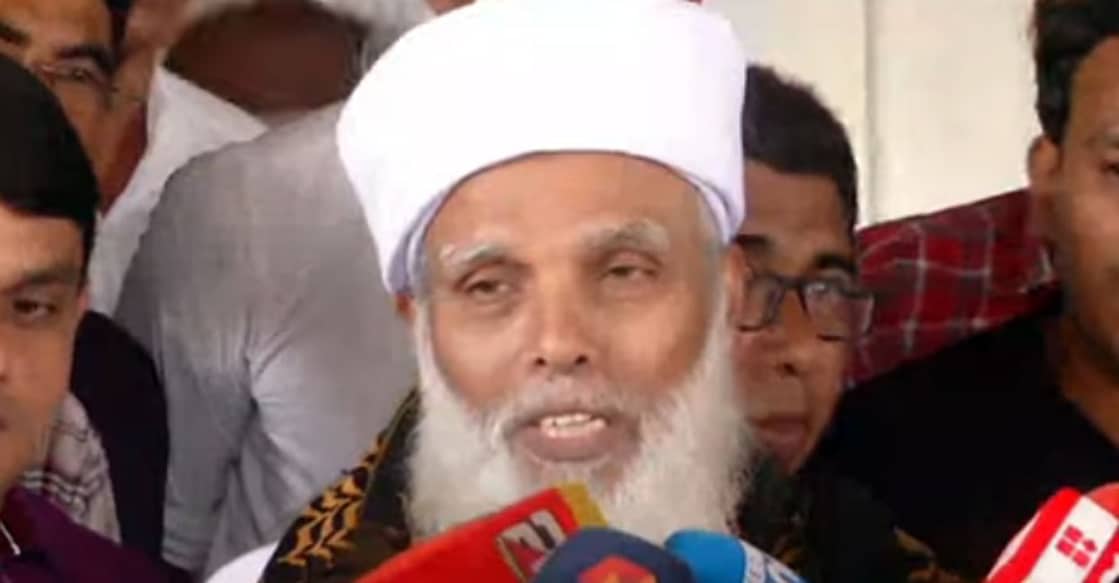
Kasaragod: One of the first reactions after the LDF government appointed K Ummer Faizy Mukkam -- joint secretary of the IUML-aligned Samastha Kerala Jem-iyyathul Ulama, the influential body of Islamic scholars -- to the Kerala State Waqf Board was his own expression of surprise. “I don’t know why I was picked,” he said.
But Faizy Mukkam was clear about how he views his role. “I am happy with the appointment because I can work for the protection of Waqf land and against encroachments, like what we saw in Munambam, and in cases of misuse of Waqf property. I see this as an opportunity to clearly articulate the position of religion in such matters, and to say it aloud.”
Faizy Mukkam, considered close to Samastha chief Sayyid Muhammed Jifri Muthu Koya Thangal, is also a member of the organisation’s Mushawara, its highest decision-making body. At the same time, he has long been seen as a sharp internal critic of the IUML’s leadership. In November 2024, he questioned Sayyid Sadik Ali Thangal’s credentials and authority as Qazi, triggering a sharp reaction from the party. IUML leader K M Shaji even called him CPM’s “sleeper cell”.
So IUML would see Faizy Mukkam’s appointment to the Wafq Board with scepticism because the party’s current political instinct is to see the Munambam issue de-escalated, without allowing it to rupture Kerala’s social fabric. Faizy Mukkam’s position, by contrast, is blunt and categorical.
“Faizy Mukkam can claim he doesn't know why he was picked. But the LDF government knows what it wants by appointing him to the Waqf Board. It wants to stir the already muddied waters of Munambam ahead of the Assembly election,” said a Samastha watcher. “There are several other IUML leaders who are also accused of giving away or selling Waqf land. Faizy would go after them, too,” he said.
Majority of the mosque committees in Kerala are under the influence of Samastha under Jifri Muthu Koya Thangal, and the organisation is broadly aligned with the IUML. Yet, Faizy Mukkam belongs to a strand within the organisation that has historically been closer to the Left. He is often referred to as “Comrade Ummer Faizy Mukkam”.
That political positioning lends added weight to his first statements as a Waqf Board member. “I see this appointment only as an opportunity to react to situations of encroachment,” he said. He was in Kasaragod as part of Samastha's centenary celebration event.
Reiterating his stand, Faizy Mukkam asserted that Munambam is Waqf land. “That is clear,” he said. “The land was given to Farook College, an educational institution set up for the educational uplift of the Muslim community, which has historically lagged in the education sector. The land was made a Waqf for educational purposes.
“It was later encroached upon, and the college committee itself sold portions of the remaining land. That was wrong, and under Islam, it cannot be accepted. I see my appointment as an opportunity to respond to such violations.”
The legal dispute over Munambam is now before the Supreme Court, which on December 12, 2025, stayed the Kerala High Court judgment holding that the 404 acres in the coastal village of Munambam in Ernakulam district is not Waqf property.
Political positions on the issue remain fractured. Congress leader and Leader of the Opposition V D Satheesan has publicly maintained that Munambam is not Waqf land. IUML supremo Sadik Ali Thangal, while asserting that the land is Waqf, has consistently opposed the eviction of families residing there.
Around 600-610 families, predominantly from the Christian fishing community, live on the land. Sadik Ali Thangal has personally reached out to Christian leaders, stressing that the dispute should not damage relations between the two communities.
The Left government, for its part, has repeatedly stated that no family in Munambam will be affected. Yet IUML leaders, including national general secretary P K Kunhalikutty, accuse the government of deliberately keeping the issue alive. “The government could have solved it in five minutes. They did not do it,” Kunhalikutty said, alleging that when the Waqf Tribunal was close to resolving the matter, fresh delays were introduced. He has accused the Left of attempting to create friction between Christians and Muslims, the two key pillars of the UDF, using Munambam as a wedge.
It is against this backdrop that the appointment of Ummer Faizy Mukkam to the reconstituted Waqf Board is being read in IUML circles.
To see through only Munambam's prism is a narrow reading of LDF's game plan. It wants to create a larger rift within Samastha by giving importance to Faizy, says an Islamic scholar.
The previous Waqf Board, headed by Left-leaning Adv M K Sakeer, had taken an unambiguous position before the High Court that Munambam is Waqf land. It argued that once a property is declared Waqf, the Board is statutorily bound to recover all such property.
The High Court verdict was challenged by the Kerala Waqf Samrakshana Vedhi (Kerala Waqf Protection Forum), which contended that the court had exceeded its jurisdiction, arguing that questions relating to the validity of a Waqf declaration fall exclusively within the domain of the Waqf Tribunal.
With the matter now before the Supreme Court, the new Waqf Board -- with the outspoken Ummer Faizy Mukkam as a member -- is expected to throw its weight firmly behind that position.
