

Samastha seeks redrawing of big districts; Malappuram CPM asks why tiny Kasaragod still lags behind
Mail This Article


Kasaragod: Samastha Kerala Jam'iyyathul Ulama (EK faction), an influential body of Sunni Islamic scholars, has passed a resolution calling for the reorganisation of districts in Kerala, citing the State's growing population and increasing challenges in governance.
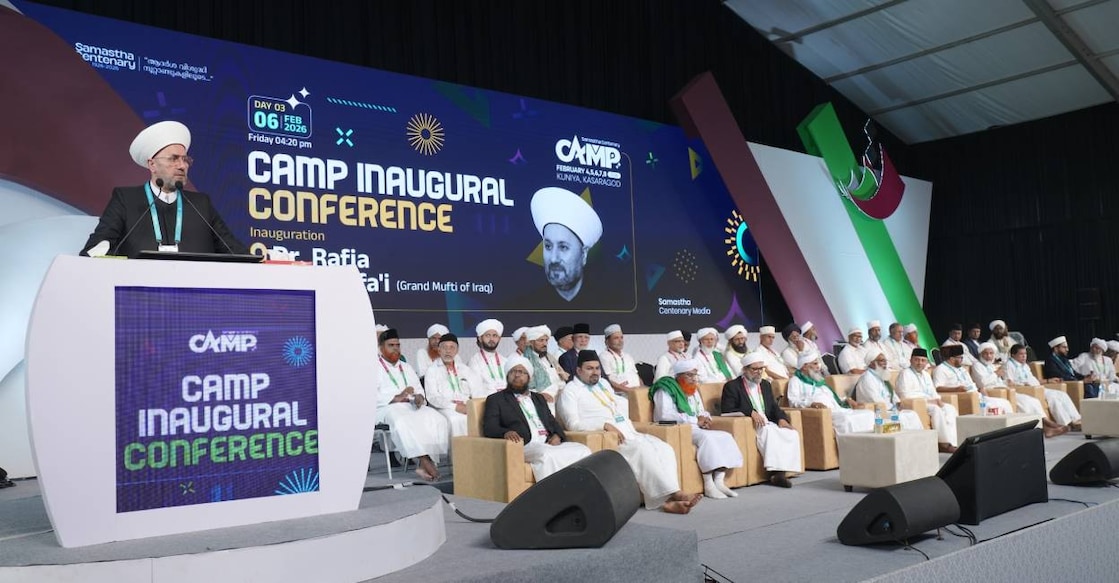
The resolution was adopted at the valedictory session of Samastha's year-long centenary celebrations, held in Kasaragod on Saturday.
Pointing to large districts such as Malappuram, which has a population exceeding 45 lakh, the resolution said the creation of new districts was essential for efficient administration and the equitable distribution of resources. It noted that similar difficulties -- arising from terrain and travel constraints -- are also evident in districts such as Idukki, Ernakulam, and Palakkad.
The resolution was proposed by K Umar Faizi Mukkam, who is considered close to the ruling CPM, even as Samastha is widely regarded as the spiritual and ideological backbone of the Indian Union Muslim League (IUML), which dominates Malappuram district politically.
Earlier in January, Samastha Kerala Jam'iyyathul Ulama (AP Kanthapuram faction), seen as close to the LDF, had also called for the reorganisation of Malappuram district on similar grounds. In December, the Kerala Muslim Jamat urged the government to bifurcate Malappuram to improve access to public facilities.
"It is high time Malappuram district was divided. This is the only way to ensure equal facilities for all, irrespective of caste or religion," Kerala Muslim Jamat district president Koottampara Abdurahman Darimi had said at a function in Vengara.
The demand for dividing Malappuram is decades old, but has gained renewed traction in recent years. Ahead of the local body elections in December, former LDF-backed MLA-turned-rebel P V Anvar proposed the formation of a new district by carving out areas from northern Malappuram and southern Kozhikode.
While the Samastha EK faction's resolution flagged governance issues across Kerala, Malappuram emerged as a key focus. The resolution suggested that Kerala look to Tamil Nadu as a model, noting that the neighbouring State has 38 districts within the boundaries of 39 parliamentary constituencies. "This can serve as a model for Kerala in addressing the issue," it said.
Kerala, by contrast, has 20 Lok Sabha constituencies spread across just 14 districts.
The creation of new districts, the resolution argued, would bring basic infrastructure -- such as civil stations and hospitals -- closer to people and accelerate economic growth in backward regions. "Rising above political interests, the Samastha Centenary Conference calls on both the ruling and opposition parties to work together to realise district reorganisation based on scientific studies," it said.
Commenting on the issue earlier in January, Congress state vice-president V T Balram wrote on Facebook that at least five new districts could be formed in Kerala. Stressing that it was his personal view, he suggested one district carved out of Thiruvananthapuram and Kollam, another by merging parts of Ernakulam and Thrissur, two by reorganising parts of Malappuram and Palakkad, and one from parts of Kozhikode and Kannur.
The CPM, however, struck a cautious note. Malappuram district secretary V P Anil pointed out that Samastha's resolution spoke of "reorganisation" rather than "bifurcation". "These are two different things," he said, drawing attention to Kasaragod district, which has a population of just 13 lakh. "Has Kasaragod surged ahead in development? Isn't it still lagging behind Malappuram? If population alone is the benchmark, shouldn't it be far ahead?"
Developmental challenges cannot be addressed merely by carving out smaller districts, Anil argued. "Policies matter. Centrally sponsored schemes matter. Effective intervention by district panchayats matters. What we need are job-oriented enterprises."
Malappuram district was formed in 1969 on geographical considerations, though the move triggered political controversy at the time, with both the Congress and the BJP accusing the then government of creating a district on religious lines. The government was led by E M S Namboodiripad, with support from a seven-party alliance that included the IUML.
V Abdurahiman, Minister for Sports, Wakf and Haj Pilgrimage and a CPM-backed independent MLA from Tanur, declined to comment, describing the issue as sensitive. "It is the government's call," he said.
IUML Tirur MLA Kurukkoli Moideen, however, has been vocal. In October 2025, he raised the demand for a new district with Tirur as headquarters at a Revenue Assembly held in Thiruvananthapuram, proposing that it include Tirur, Tirurangadi and Ponnani taluks -- coastal areas largely inhabited by fishing and other economically and socially backward communities.
The Social Democratic Party of India (SDPI), which first raised the demand as early as 2010, has proposed a similar reorganisation -- dividing Malappuram into coastal and hill regions -- citing inadequate access to schools, hospitals, beds and doctors. The party has run several campaigns to push the demand.
In June 2019, IUML leader K N A Khader moved a calling attention motion in the Assembly seeking a debate on Malappuram's reorganisation. Then, Industries Minister E P Jayarajan dismissed it as an "unscientific plan", saying the People's Plan campaign would address the concerns. Anil reiterated that effective intervention by MLAs and MPs could address development issues without altering district boundaries.
The IUML, meanwhile, has remained cautious, maintaining that any reorganisation, if it happens, must be rooted in governance needs and not framed along religious lines.
