

Ex-Army man learns Bharatanatyam, performs with daughter at Kerala temple fest, awes crowd

Mail This Article


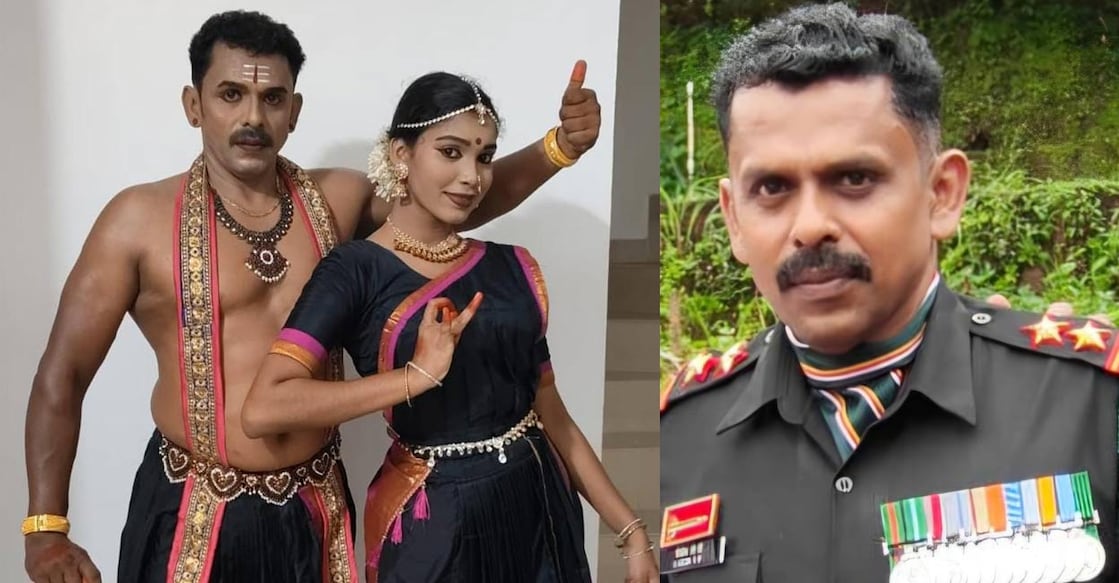
When Honorary Subedar Major Lijesh T P (rtd), a familiar figure at Kadachira, Kannur, stepped out of a car at a recent temple festival, onlookers paused—confused for a moment—before breaking into smiles of quiet awe. Often seen in his crisp civilian clothes, he appeared in classical dance attire for the annual festival at the Thrikkapalam Dakshinamoorthy Shiva Temple, Kadachira.
Many of them had expected the 50-year-old to be there only as a father accompanying his 17-year-old daughter, Vaidehi, who was scheduled to perform a semi-classical dance. What they did not expect was Lijesh himself stepping onto the stage alongside her. “Even the festival committee members were surprised,” Lijesh recalls. “They were expecting only my daughter’s performance.”
He explains that he had registered the programme under the names Vaidehi and Lijesh. However, the organisers assumed it referred to a single performer—Vaidehi Lijesh—mistaking Lijesh for her second name. “Once they realised the mix-up, everyone was extremely supportive. There were no objections, only warmth and encouragement. I was welcomed wholeheartedly and even felicitated,” he says.

Lijesh retired from the Indian Army in October 2024 after 28 years of service. Back home in Kadachira, retirement did not translate into rest. He first joined martial arts classes along with his son Avanindra, a Class 7 student who was learning kickboxing. Lijesh took up karate alongside him.
Around the same time, he thought of enrolling his daughter, Vaidehi—a Class 11 student and trained classical dancer—for karate classes as well. “She didn’t like it at all,” he laughs. “Within two weeks, she told me, ‘This is boys’ martial arts. I have nothing to do with this.’”
That was when Lijesh made a counteroffer: he would learn classical dance if she agreed to teach him. “We both took it seriously,” he says.
Vaidehi began training her father in December last year. Every morning before leaving for school, she would demonstrate steps and ask him to practise before she returned. “I behave like a naughty kid,” Lijesh admits with a grin. “I would roam around during the day, and when she came back, she would scold me and make me practise again.”
Their practice sessions stretched from evening till nearly 10 pm, with wife Santhini and son Avanindra in the audience. “They turn the volume up and practise in the drawing room,” says Santhini. “I record their sessions and point out mistakes.” Neighbours often questioned the loud music, she adds, only to be told that a dance rehearsal was in progress.
Avanindra, meanwhile, was the biggest sceptic. “He kept telling his father, ‘Acha, you can’t do this,’” Santhini recalls. “That only made Lijesh more determined. He wanted to prove he could. I am so proud of the duo.” Vaidehi has been learning Bharatanatyam since Class 4, though she stopped formal training by Class 10 and later continued practising on her own.
When temple authorities approached Lijesh to ask whether Vaidehi could perform during the festival, he submitted two entries - for himself and his daughter. The family informed relatives that father and daughter would perform together, and they also arrived to watch. The costumes and jewellery were bought by Vaidehi and Lijesh themselves, while Santhini did the makeup for her husband.
“I had done a beauty and makeup course when we were posted in Punjab,” Santhini says. “This felt like the perfect moment to use what I had learned.” Vaidehi did her own makeup.
The performance was scheduled for 8.30 pm. Until then, father and daughter waited inside the car, dressed in full costume. When Lijesh stepped out, it became clear to onlookers—and finally to the organisers—that this was not a solo recital. On stage, another ex-serviceman, Shaji, introduced the performance. “He gave me a mass introduction,” Lijesh says, smiling. “He said the dance was by a fierce Army man who once guarded India’s borders.”
As the curtain rose, Lijesh moved with calm precision. There was no trace of nervousness. “Compared to my 28 years in the Army, this wasn’t frightening,” he says. “I’ve witnessed war, death, and situations far more intense. Nothing scares me anymore.” The four-minute performance depicted Samudra Manthan from Hindu mythology. When it ended, the applause was instant and loud. “That meant everything to me,” Lijesh says. “The appreciation was overwhelming.”
Santhini, however, insists that it was Vaidehi who truly stole the show. “He’s stubborn and wants to learn more,” she says, smiling.
Lijesh reveals that dance had once interested him as a child. He briefly attended Bharatanatyam classes during school but dropped out, later focusing on athletics in college. After a short stint in carpentry, he joined the Indian Army in 1997 at the age of 20 as a Sepoy. His service took him to Jammu and Kashmir, Nagaland, Gujarat, and Sikkim, among other places, and included stints with the Special Task Force and as an instructor for multiple Agniveer batches.
Now, the retired soldier and his teenage daughter are already preparing for their next performance. "We will soon come up with another choreography," Lijesh says.
 Add as a preferred source on Google