

18% vs 0% tariffs show lack of reciprocity in Indo-US trade pact: Tharoor
Mail This Article


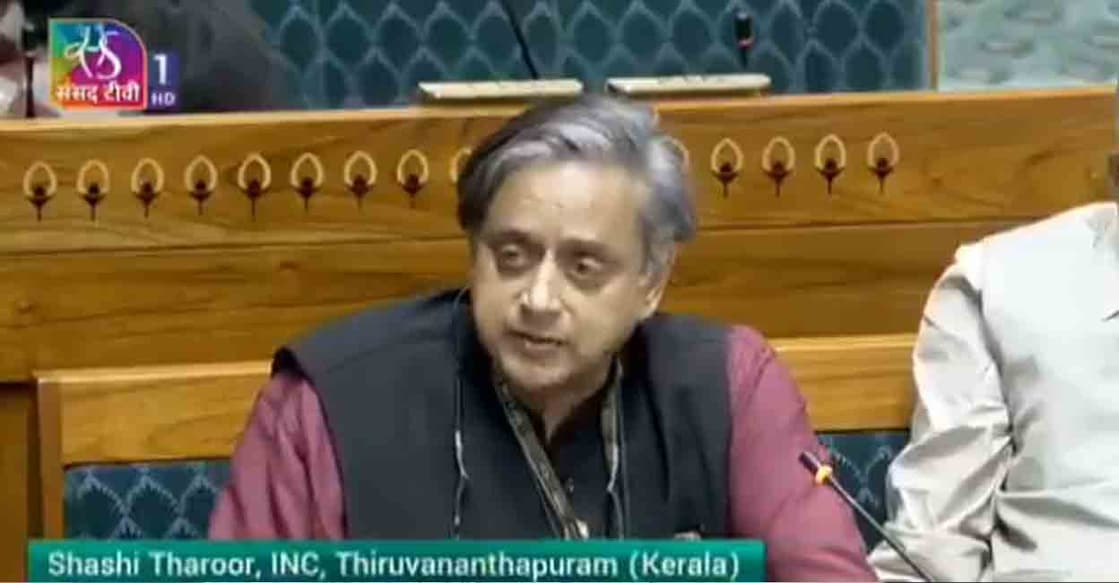
New Delhi: Questioning the logic of what the government has described as a reciprocal trade arrangement, Congress MP Shashi Tharoor on Tuesday asked how an 18 per cent tariff on one side and zero per cent on the other could be called reciprocal, saying the interim India-US trade pact resembled a “pre-committed purchase agreement” that overturns the very principle of reciprocity.
Initiating the debate on the Union Budget in the Lok Sabha, Tharoor accused the government of overstating the gains from the deal and said claims that India had secured a better agreement than China, Vietnam, or other Asian economies did not stand up to scrutiny. While India may have obtained tariff reductions of one or two percentage points, he said, no East Asian economy had agreed to deliberately dilute its trade surplus with the US through guaranteed purchase commitments.
At a time when India’s bilateral trade with the US stands at around $130 billion, with a surplus of nearly $45 billion, Tharoor said the government had committed to purchasing $500 billion worth of American goods over five years. This, he argued, would effectively convert a trade surplus into a long-term deficit through executive assurance rather than market demand.
He said no major economy had ever neutralised its own trade leverage in this manner. While the US continued to impose tariffs of up to 18 per cent on Indian exports, India had committed to near-zero tariffs, opening agriculture, diluting data localisation norms, softening intellectual property safeguards, and redirecting strategic energy imports, particularly away from Russia, to meet purchase targets.
“This is not strategic balancing; it is economic pre-emption,” Tharoor said.
He also criticised the government for failing to explain how farmers, MSMEs, and domestic industry would be protected, or why India had, in his words, voluntarily surrendered its negotiating power without securing proportional market access or policy space in return.
Tharoor said Parliament had not been informed about the scale, timeline, or fiscal implications of the commitments, even as key budgetary assumptions depended on them. When questioned, he alleged, the commerce and external affairs ministers passed responsibility between each other, creating a “ping pong” of accountability.
“A Budget framed amid such uncertainty is not just incomplete. It asks Parliament to approve numbers without knowing the obligations that may soon overtake them,” he said.
Last week, India and the US announced a framework for an interim trade agreement under which the US agreed to reduce reciprocal tariffs on Indian goods from 25 per cent to 18 per cent. The US has also removed the additional 25 per cent tariff imposed last year over India’s purchase of Russian crude.
The Congress has described the interim pact as a surrender of national interests, alleging it compromises India’s economic self-respect.

 Add as a preferred source on Google