

22-hours at the wheel: KSRTC driver's solo protest demanding work on bandh day raises safety alarm

Mail This Article


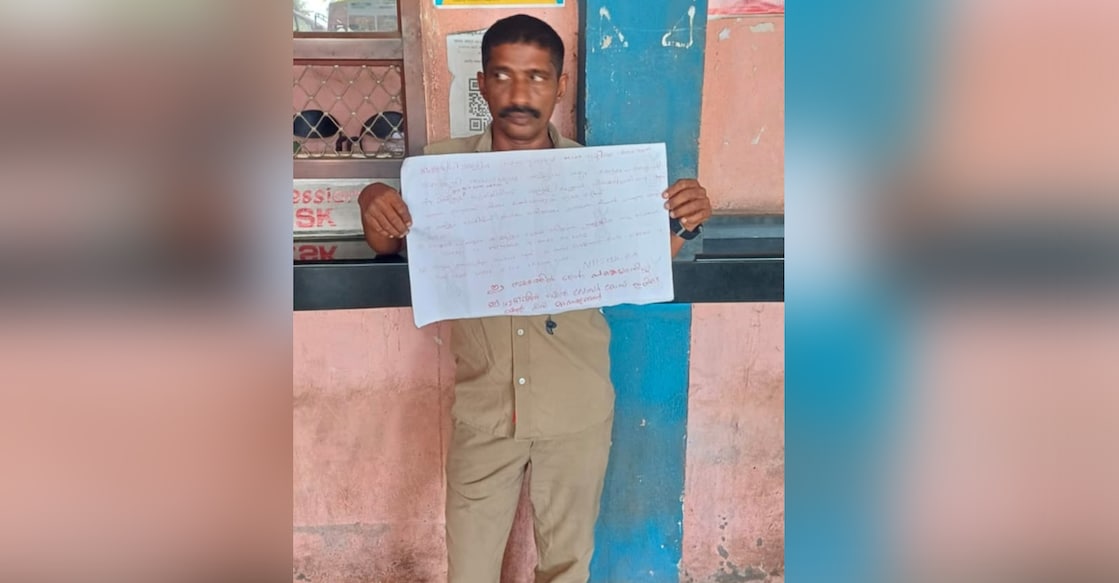
Kasaragod: On Thursday, as trade unionists across Kerala stayed away from work, 47-year-old KSRTC driver Naseer E A cocked a snook at them, staging a one-man protest outside the Kasaragod KSRTC Station Master’s office -- demanding to be put on duty.
Transferred to Kasaragod from Kottayam after he refused to drive for 22 continuous hours, Naseer chose the Bandh Day to question the "hypocrisy" of the trade unions of KSRTC. “Isn’t it hypocritical that unions and their leaders have no problem when KSRTC makes drivers work 18 to 22 hours at a stretch, but protest against a labour code that permits 12-hour shifts?” he said. The labour code allows flexibility of working for four days in a week, as it has retained weekly working hours at 48 hours.
Naseer, a native of Perumbavoor with 19 years of service and an accident-free record, said the trigger for his protest was an incident on January 18, 2025. After a 10-hour duty the previous day, he was assigned the 10 am duty on the Kottayam-Tenkasi route, a 310-km round trip that takes about 10 hours to complete. When he returned around 8.30 pm, he was told to head out again for another night trip without a second driver. "I was tired and sleepy. So I refused to put the lives of my passengers or mine on the line,” he said. KSRTC did not take the no, and Naseer landed up in Kasaragod, often described by employees as the government's favourite punishment destination.
There, he said, little has changed. He continues to be behind the wheel for 17 to 18 hours a day. He now plies the busy and profitable Kasaragod-Mangaluru route. The one-way journey takes about 90 minutes, but operations are governed by an alternating two-hour window system between Kerala SRTC and Karnataka SRTC.
If the 6 am to 8 am departure window from the Kasaragod depot is allotted to Kerala SRTC, Karnataka SRTC buses cannot leave until 8 am. By the time a Kerala SRTC bus reaches Mangaluru, the Kerala slot would have opened there, leaving little room for rest.
“Just the other day, I was having lunch at 3.40 pm in Mangaluru when the conductor said we had to leave immediately as the two-hour window was closing at 4 pm,” Naseer said. To avoid being stranded for two hours, they left immediately. "Giving us three days off after making us drive for nearly 20 hours at a stretch makes no sense. It is a public safety risk.”
Law vs practice
The Motor Transport Workers Act caps a driver’s working hours at eight a day and 48 a week. Overtime beyond eight hours must be voluntary and cannot push the total beyond 10 hours in a day. Drivers are also entitled to a 30-minute break after five hours of continuous driving. Wages for overtime are mandated at twice the regular rate, which KSRTC drivers are not given but adjusted on weekly days off.
In 2017, the unions took KSRTC to the high court over the long shift hours for drivers. After a nudge from the Division Bench, KSRTC held talks with the unions, and in December 2018, issued a "memorandum" stating that working hours would not exceed eight hours a day.
A memorandum from the Managing Director’s Office, dated December 6, 2018, noted that the number of accidents in KSRTC had been rising in recent years because drivers were being made to work beyond eight hours.
To cut “losses in terms of people and money” caused by accidents, the memo directed: “Drivers of all services, including long-distance services, should not be assigned duty for more than eight hours. Driver-cum-conductor crew changes should be implemented for services exceeding eight hours, according to their category.”
The ground reality, even today, remains different, said A S Boban (49), among the first batch of Volvo bus drivers in KSRTC. In 2014, when the premium Volvo service was introduced, Boban pulled over his bus at Coimbatore while returning from Bengaluru and took a short nap because he felt drowsy. He was suspended for bringing “bad repute” to KSRTC’s “prestigious” service. “Naseer has begun protesting now. I have been demanding two drivers for trips exceeding 10 hours for the past 12 years,” said Boban, who is now posted at the Pappanamcode depot in Thiruvananthapuram. He said long-distance buses become a risk not just for drivers but for passengers when fatigue sets in after six to eight hours of driving.
In June 2025, another driver, Somasundaran R (47), returned to Thiruvananthapuram after two exhausting trips to Nagarcoil. He began feeling dizzy and refused a third round trip. When he went to the Thiruvananthapuram Medical College Hospital, the doctors diagnosed him with vertigo, a condition that causes a spinning sensation and loss of balance, which can occur due to prolonged strain and lack of rest. The doctor advised him to take three days’ rest. Onmanorama has seen the medical certificate.
KSRTC, however, dismissed the diagnosis and suspended him, alleging a loss of Rs 6,200 for the cancelled trip. “If I had gone, I might have been dead, and so might my passengers,” Somasundaran told Onmanorama. His suspension was revoked three months ago; he is now posted at Palode.
The two-driver demand
Boban recalled his experience in the September 2014 trip on Volvo. He said he was the only driver on the 12-hour route. He reached Bengaluru at 6 am, but he had to return the same evening at 6 pm. "
When KSRTC sought his explanation for stopping the bus for taking a nap, he said in writing: "Even trucks carrying salt sacks have two drivers, why not passenger buses?" That reply did not go down well with the superiors, said Boban.
When KSRTC launched Swift, a private company for long trips, it deployed two drivers-cum-conductors. But regular KSRTC services still continue with a single driver for most of the long-distance journeys. The Kottayam-Thenkasi bus still has only one driver, said Boban. There is only one driver even on Minal buses on routes such as Thiruvananthapuram-Kozhikode and Thiruvananthapuram-Palakkad, which are eight to nine hours one way, they said.
Drivers allege that conductor posts are retained even when tickets are largely booked online for long-haul night buses. Though Swift has conductor-cum-driver posts, KSRTC has not yet created such a post. To be sure, Minal buses going beyond Kozhikode, say to Mananthavady and Kasaragod have two drivers, who double up as conductors, too. "But there is no such post yet," said Boban.
When fatigue turns fatal
Naseer said he sent an RTI query to Kottayam District Transport Office asking for KSRTC's official stance on driver's duty time. In a reply on November 10, 2025, the DTO replied that no information regarding the driver’s duty time, maximum working time, safety reforms undertaken by KSRTC, and steps taken and instruction given by the corporation to reduce accidents was available with the office. "I got that callous reply despite the CMD's memorandum dated December 18, 2018, was sent to all units," said Naseer.
Naseer points to a recent head-on collision between two KSRTC buses on the Thiruvananthapuram-Nagarcoil route -- the same route Somasundaran had refused to ply after 10-hour duty. “One driver lost both legs; the other lost one,” he said.
“KSRTC will blame the driver. But such accidents happen when drivers have logged more than 10 hours. That’s when fatigue kicks in,” Somasundaran added. Naseer, who is not part of any trade union, said he wanted to expose the double standards of the government and trade union. "That's why I demanded to work on bandh day."
 Add as a preferred source on Google