

Kerala English lecturer who loves swimming and ukulele strikes civil services gold
Mail This Article


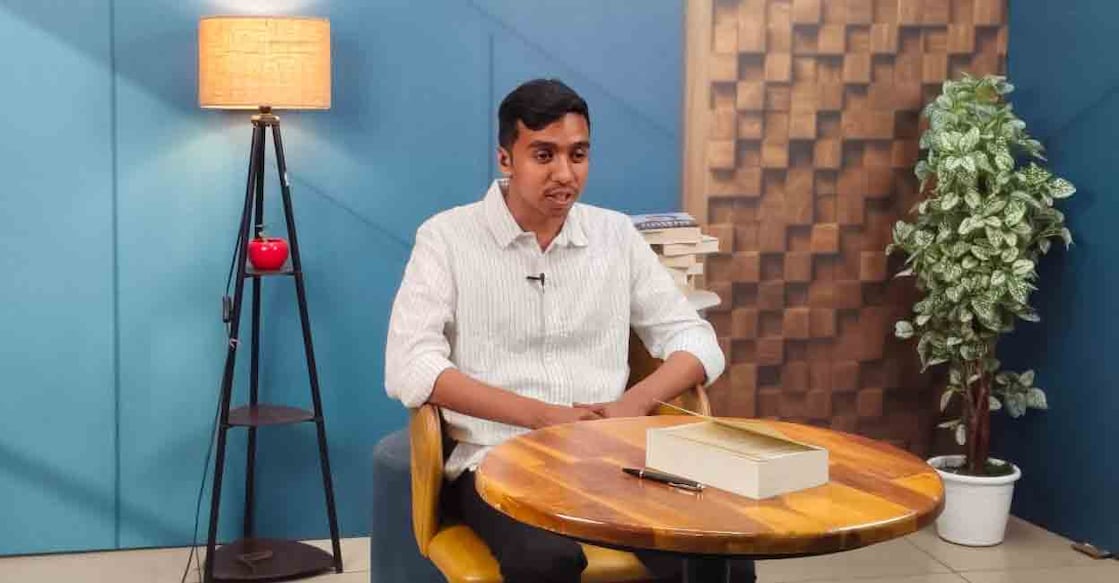
It is the warmth of his guileless smile that is felt first. So when 24-year-old Ajay R Raj suddenly adopts a stern manner, it can catch you off guard.
"I don't want to be asked anything about my disability," the 109th rank holder in the 2025 civil services exam, right away sets his only condition for talking with Onmanorama. "My constraint has nothing to do with what I have achieved now. It does not make it more glorious or less. If you ask anything on those lines, I will consider it an infringement on my privacy," Ajay said.
We quickly regain our composure and agree, and the child-like warmth is back. It could have been this endearingly honest quality about him that worked with the UPSC interview board.
When he entered the interview room, the chairperson greeted him with what Ajay described as a "casual type question". 'How are you Ajay? How are you feeling', the chairperson said.
The chairperson knew him from the last year's interview. Last time, he had secured the 730th rank, and was inducted into the Indian Railway Management Services.
This time he felt calmer. "I said, Sir I am feeling so grateful to come back to Dholpur House (headquarters of the UPSC) once again. He perked up at that, and others in the panel were also smiling. I also laughed and for a moment it felt like a very intimate get-together of friends. I had the feeling that I had made some impression. I could give the panel the sense that I was not lost, that I was in the moment," Ajay said.
The interview questions were largely from his personal information, which is given in what IAS aspirants call the 'Detailed Application Form' or DAF. In the DAF, the candidates fill in their background details, hobbies, and interests.
The interrogation began with literature, the subject he taught in Christ College, Irinjalakkuda. Cultural studies was his domain, and so he was prepared to take questions from there. But the interview board was more curious about translations. "The chairperson kept hurling questions about the translation trends in contemporary Indian writing," Ajay said.
Then it moved on to leadership because he had attended a leadership conference at Harvard Business School. "Since I was posted in Indian Railway Management Services last year, there were questions on Indian Railways," he said.
But there was a "bouncer" that nearly took his wicket. One of the Board members asked him to compare military and corporate leaderships. "Neither did I have a military background nor had any corporate connections. From the way he was speaking I sensed that the member was from a military background. Although it was a bouncer, I somehow managed," Ajay said. Questions that can catch the interviewee by surprise are 'bouncers' in the lexicon of IAS aspirants.
When he explained interview techniques, Ajay again tied it up with cricket. Should the answers be long or short? "There are different types of questions," Ajay said.
"Some, for instance, are very casual, and these are largely prompted by the personal information in our DAF. In my case, swimming was mentioned as a hobby. If I am asked why I have picked up swimming, it is a subject very close to my heart. My answer would come straight from the heart, and I can go on and on, take two to three minutes. This particularly happens when you feel that the Board is also enjoying this conversation. But there are some hard academic questions that require you to be very brief and to the point, and then you have to play differently. So like in cricket, we have different shots, and we play according to the situation," Ajay said.
There was one question that would have been music to his ears. His DAF had mentioned about his interest in ukulele (a guitar-like string instrument). His students at Irinjalakkuda had inspired Ajay to take up the instrument. He balanced ukulele training with his IAS preparation. The interview board but left the ukulele untouched.
Though his post graduation was in English, Sociology was his optional subject for the mains. "There is this conventional belief that English is just about Shakespeare and T S Elliot. But contemporary English is also about interdisciplinarity where sociology, political science and many other subjects merge. The entire domain of cultural studies aligns closely with sociology," he said.
We are at LeadIAS Academy, a civil services coaching institute in Thiruvananthapuram. Earlier, while waiting to meet Ajay at the Academy, one of his teachers, Unnikrishnan, marvelled at Raj's focus and determination.
"He so much wanted to make it big in life that he came all the way from a village in Kozhikode (Thottilpalam that borders Wayanad district) to do his higher secondary in humanities in an elite English medium school in Thiruvananthapuram," Unnikrishnan said. He was all India eighth rank holder in CBSE Class 12.
"And from there he went straight to Delhi and then secured admission in St Stephen's College for post graduation in English. It is no small thing for a village lad to even aspire to take such a leap," Unnikrishnan said.
It was at St Stephen's that the IAS dream was born. "My graduation was in St Stephen's, which itself had produced a crowd of civil servants. I got my primary exposure from them," Ajay said.
But his motivator-in-chief is elder brother Renoj N K. "Whenever I am nervous or worried, I go to him for clarity. It was he who asked me to give civil services a try," Ajay said. Renoj is an assistant professor of Political Science at Kerala University.
Dr Adeela Abdullah, the first Muslim woman to crack the IAS from Malabar, is his other inspiration. "It is from her that I learned the value of being anonymous but effective," Ajay said.
But there is one reason why this achievement means the world to him. "I called up my parents (N K Raj and Radha) in Kozhikode and they sounded happy. There is nothing more that I want," he said.
 Add as a preferred source on Google