

Middle East war a signal to India to resurrect 'Swadeshi' movement: Chief Economic Advisor
Mail This Article


With the war raging in the Middle East, Chief Economic Advisor to the Government of India V Anantha Nageshwaran said on Monday that it was high time India revisited what he called the "heretical" idea of 'Swadeshi' that the country had once tried, failed, and then discarded.
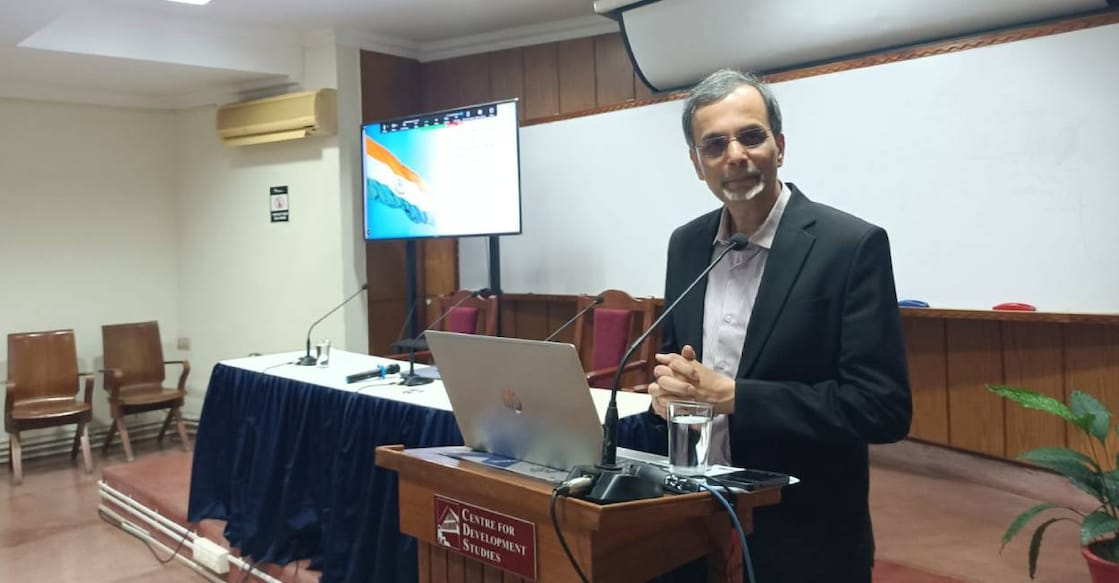
"We may have given it a go-by between 1990 and 2020. From the 1980s we have abandoned 'Swadeshi' but now it will have to come back with hopefully some modifications so that it wouldn't lead us to the same outcomes that we experienced earlier with policies like import substitution," Nageshwaran said while delivering the 15th Dr P K Gopalakrishnan Memorial Lecture organised by Centre for Development Studies in Thiruvananthapuram on the topic 'Building Strategic Leverage in the Emerging World Order: Challenges and Opportunities for India'.
Nageshwaran gave four reasons why 'Swadeshi' mattered now. One, he said: "The nature of the global system has changed." He said the world was now "strategically competitive".
Two, he said: "Trade is not reciprocal." "It is one-sided. Basically, it is a 'big fish small fish' situation," he said.
Three, he said: "Markets are not neutral." "Governments are beginning to take stakes in strategic enterprises. Once they do so, the markets will not be neutral anymore," he said.
And four, he said: "Supply chains are becoming instruments of state power." He gave the example of the United States imposing extensive export controls on advanced semiconductors and associated manufacturing equipment to constrain China's access to next-generation AI and chip technologies. China, in turn, has tightened export licensing and controls on key rare earth elements and permanent magnet materials essential for defence, electronics, and energy transitions.
In this backdrop, he said "indigenisation matters". Again, he gave the example of the United States, and how in a globalised world, it was ceding space to its rival China.
"Back in the Second World War time, the US produced more than a million pounds per day of RDX and HMX, the explosives. Today, the concern is whether America or Israel will run out of interceptors to deal with the missiles and drones of Iran, but the fact is, before they run out of interceptors, they will run out of the chemicals used in these interceptors," Nageshwaran said.
The US's Holston Army Ammunition Plant was the world's largest producer of RDX and HMX, the explosive component inside all US warheads. In 1944, Holston shipped over a million pounds of explosives per day across ten production lines. Today, it runs only two. The output doubled recently, but it is still nowhere near what it was in the forties.
Meanwhile, China has been mass-producing next-generation explosives since 2011. "It is a very strange situation to be dependent on your strategic rival for your own protection and defence. China can turn off its tap any time. These just remind you of the vulnerabilities that you have got into by accepting this ideal notion of global village," Nageshwaran said.
The country's Chief Economic Advisor said such a condition was applicable to India, too. "We are dependent on our rivals or not-so-friendly countries for everything from pharma, to solar panels, to fertilisers, to batteries, to battery chemical and so on and so forth," he said.
Reality strikes only in moments of crisis. "When we see the kind of problems we run into with the Gulf conflict in terms of oil and gas, we immediately say that we should have done much more in solar and wind. We have done a lot, far better than developed countries in terms of integrating renewable energy into our power generation mix," Nageshwaran said.
But there is a problem. Solar and wind power are so energy-intensive that India has to import materials like copper, silicon and aluminium that go into the making of solar and wind power.
Wind energy, for instance, requires 2866 tonnes of copper to generate one gigawatt of wind power. But India is not self-sufficient in copper. "We are dependent on other countries for these raw materials," he said. Recently, he said the negotiations Reliance held with a Chinese company to manufacture batteries in India had broken down.
He then gave a list of products that India should indigenise to achieve what he called "strategic resilience". What we need to indigenise. There are "high urgency" products that are 'high' feasible and 'low-medium' feasible.
The 'high' feasible products are: Oils & pulses, Fertiliser inputs, application programming interface (APIs), power electronics, industrial chemicals, telecom equipment. The 'low-medium' feasible products that should be indigenised with high urgency are: magnets, battery cells & cathodes, solar wafers & cells.
Then there are 'low-medium urgency' products whose indigenisation, too, can be categorised as 'high' feasible and 'low-medium' feasible. The 'high' feasible ones are: cranes, industrial machinery, EV drivetrains, and medical devices (non-critical).
The 'low-medium' feasible ones are: rail signalling, defence electronics, and electrolysers.
