

Kerala's women candidates battle not just elections but dirty campaign over body & gender
Mail This Article


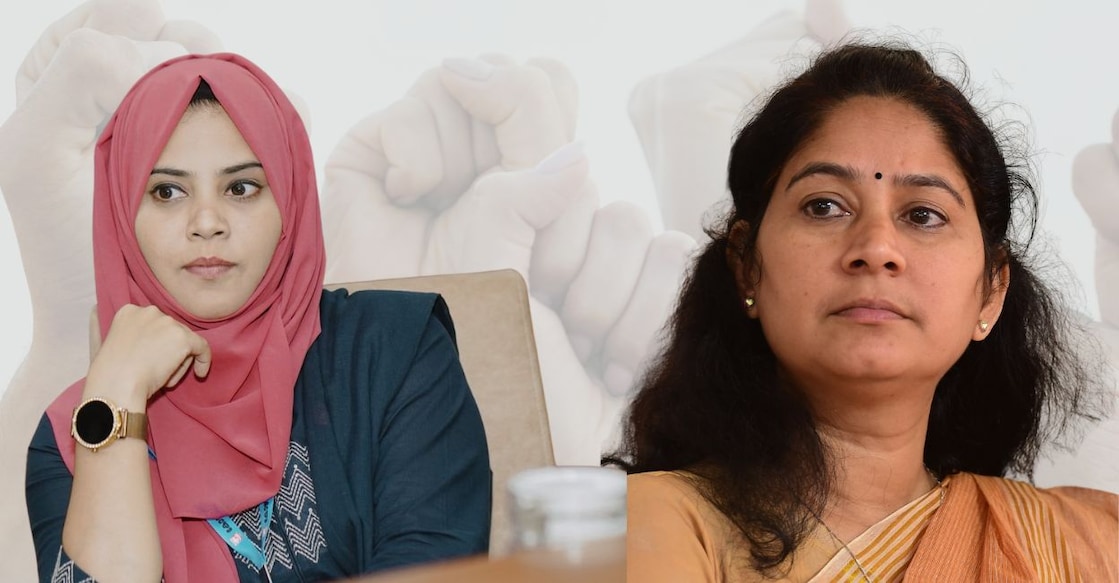
Kozhikode: When a teary-eyed U Prathibha MLA met the media after an IUML leader hurled an outrageous comment at her during a campaign speech, it revealed the deep hurt she felt inside. Always known to put up a bold face, Prathibha just couldn't hold back her tears. The moment was not an isolated one. In North Kerala, Muslim League's Perambra candidate Fathima Thahiliya has been the target of vicious comments online.
From sexually charged remarks to cyber abuse targeting women candidates, the election season has become an ugly theatre of male aggression.
The recent incidents underscore a troubling truth: patriarchal attitudes remain deeply entrenched, and women continue to face harassment, neglect, and suppression in the political space.
The remarks made by IUML leader A Irshad against Prathibha- suggesting she was seeking electoral success by "selling her eloquence and beauty"- became a flashpoint in the ongoing campaign. The comment, which reduced a sitting MLA's political work to her appearance, drew widespread criticism and reportedly left her deeply distressed. Though Irshad later expressed regret, Prathibha made it clear that an apology alone was insufficient, signalling her intent to pursue legal action as a means to challenge entrenched misogyny.
The incident also triggered responses from women leaders cutting across party affiliations. Youth Congress leader Aritha Babu, who had faced similar personal attacks and cyber harassment during the 2021 Assembly elections in Kayamkulam, expressed solidarity with Prathibha. She emphasised that political contests should be rooted in ideology and development, not personal or gender-based attacks.
Aritha pointed out that reactions to such incidents are often limited to party lines, with leaders defending only their own members. She argued that misogyny in politics must be collectively resisted, rather than treated as an issue affecting individual parties.
Recalling her own experience, Aritha said she was mocked at for her livelihood- raising cows and selling milk- during her election campaign. She noted that despite formally complaining to the Chief Minister about the cyber abuse she faced, there was little response at the time. She also criticised what she described as selective outrage, observing that leaders who remained silent earlier are now vocal about protecting women. Her position, she said, remains consistent: any insult targeting women, regardless of political affiliation, must be unequivocally opposed, and a culture of dignity in political engagement must be upheld.
The targeting of IUML candidate Fathima Thahiliya further illustrates how women candidates are subjected to sustained online scrutiny and abuse. Much of the criticism directed at her on social media stems from her support for Haritha, the women's wing of her party, especially during internal disputes over alleged discrimination by sections of the leadership. What could have remained a political or organisational issue has instead been amplified into personal attacks, often questioning her autonomy and right to take independent positions.
Leaders within the Muslim League have also acknowledged the severity of these attacks. Najma Thabsheera, president of the Perinthalmanna Block Panchayat, noted that the nature of criticism against Thahiliya has become increasingly vile since the announcement of the election. She criticised the broader political silence surrounding such incidents, arguing that opportunistic responses, based on political convenience, do little to address the structural issue of violence and harassment against women in public life.
Such incidents are neither new nor isolated. Kerala has witnessed multiple instances where women in politics have been subjected to sexist remarks, character assassination, and public humiliation. Many such episodes go unnoticed, while others conclude with brief expressions of regret that rarely translate into meaningful accountability.
In 2024, senior CPM leader K K Shailaja was targeted by Revolutionary Marxist Party (RMP) leader K K Hariharan, who made an offensive reference during a public rally in Vatakara. The comment, widely criticised, was seen as a stark example of reducing a senior woman leader to objectification and public ridicule.

Following a local body election victory celebration in Thennala, a CPM local leader, Saidali Majeed, made remarks suggesting that women should not be "shown to other men" but remain confined to their husbands, drawing sharp backlash from various quarters.
Earlier episodes also reflect a consistent pattern. During the 2019 Lok Sabha elections, Congress leader Ramya Haridas faced disparaging remarks from CPM politburo member A Vijayaraghavan, which she said caused her significant mental distress and amounted to character assassination. She subsequently approached the police, though the case did not lead to major legal consequences.
In another instance, CPM leader and Lok Sabha candidate K J Shine filed a complaint over defamatory social media campaigns alleging illicit relationships, which she described as politically motivated attempts to discredit her.
The pattern extends further back. During the 2011 Assembly elections, then Chief Minister V S Achuthanandan made controversial remarks about his opponent Lathika Subhash, implying notoriety without substantiation. Though the issue drew attention and a complaint was filed, it did not result in substantial action.
Likewise, remarks by CPM leader M M Mani against women activists of the Pembilai Orumai movement led to prolonged legal battles, including proceedings in the Supreme Court.
Observers point out that such rhetoric is not confined to election periods alone but tends to intensify when women gain greater visibility in public and political spaces. Public meetings, rallies, and even celebratory events have at times become platforms for remarks that objectify or undermine women.
Women's rights activists argue that these patterns reflect deeper structural resistance to women's leadership.
V P Suhara of the NISA Movement noted that male-dominated power structures across political parties often perceive the rise of women as a threat. According to her, women who assert themselves in leadership roles are frequently subjected to abuse, including cyber attacks, aimed at discouraging their participation. She stressed that such tendencies cut across political ideologies and must be collectively challenged.
While welcoming the IUML's decision to field a woman candidate like Fathima Thahiliya as a progressive step, Suhara pointed out that increased representation has also led to intensified scrutiny and attacks. She observed that women candidates are often judged on appearance and personal attributes rather than political capability.
At the same time, she expressed optimism that structural changes, such as 50 per cent reservation for women in local self-government institutions, have encouraged greater participation and will gradually reshape higher levels of governance. Attempts to undermine women through intimidation or insult, she said, reflect insecurity within existing power structures and are unlikely to succeed in the face of a more aware and assertive new generation.
 Add as a preferred source on Google