

Idukki native turns beekeeping into business earning monthly income of more than ₹1 lakh
Mail This Article


A farmer managing thirty honey bee boxes can earn an impressive annual income of around one and a half lakh rupees. With an average yield of 15 kg of honey per box, total production reaches 450 kg. Even at a conservative selling price of ₹300 per kilogram, this translates to an income of ₹1,35,000. On top of that, about 2,000 rupees’ worth of beeswax can be sold each year. By trading at least 30 live bee colonies annually, a minimum income of ₹20,000 is guaranteed and gradually increasing the number of colonies can significantly boost earnings over time.
Robin George, a beekeeper and entrepreneur, speaks enthusiastically about the exciting new opportunities emerging from the business of beekeeping. “Those producing up to one ton of honey annually can gradually expand their operations and sell directly through their own retail channels,” he adds.
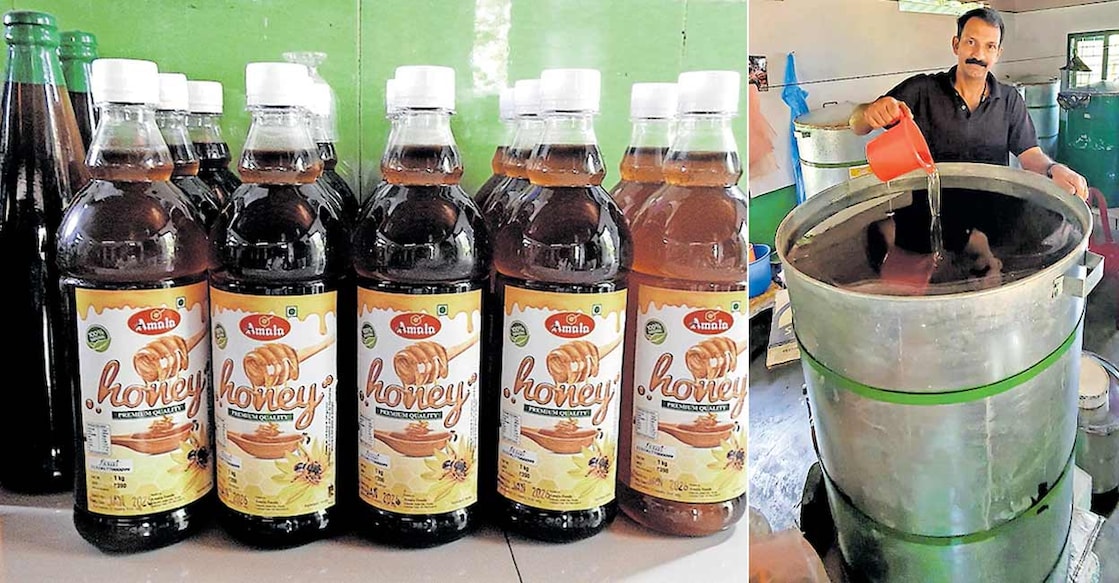
When Robin, a native of Arakkulam near Moolamattom in Idukki, first turned to beekeeping as a means of livelihood, he could hardly have imagined selling even 500 kg of honey in a single year. At that time, honey consumption was generally low. However, by combining his own production with honey sourced from other farmers, he now manages an annual trade of 25–30 tons. Under his brand, Amala Honey, Robin sells honey through retail channels and also supplies it to pharmaceutical companies and other bulk buyers.

Patience is key
Robin emphasises that small-scale farmers need patience when selling honey. Those who harvest honey must develop the habit of carefully processing and preserving it before putting it on the market. “Honey should be double-boiled and properly stored before attempting retail sales,” he advises. To boost retail opportunities, farmers should also be open to experimenting with new approaches. Robin, on his part, has successfully tapped into the market for honey in medical stores, supplying it in 200 ml bottles arranged prominently at pharmacy counters. Many customers who come to buy medicines are also eager to purchase pure, locally produced honey.
In Robin’s method, the first step is to carefully store honey, sourced from both his own hives and other farmers, in steel or zinc containers for 60 days, allowing its flavour to fully develop. To further preserve the honey, he uses a method called double boiling to reduce its moisture content. The honey is transferred from one steel container to another containing warm water, maintaining a temperature of around 60 degrees Celsius for 45 minutes. After heating, the honey is cooled in steel containers, covered with mesh, and left open for 48 hours before being sealed. According to Robin, honey treated this way can remain fresh and unspoiled for several weeks.
The appeal of Kerala's pure honey
Honey from Kerala is increasingly sought after in the North Indian market, where South Indian varieties are highly valued. The honey produced here is naturally low in water content and has a thick, jam-like consistency. For this reason, it is stored and sold in wide-mouthed jars, making it easier to handle. It is precisely because of its pleasant taste and rich aroma that Kerala honey enjoys high demand among North Indian consumers, Robin George notes.
In addition, North Indian traders often purchase Kerala honey in large quantities to blend with their own stocks, which also helps reduce the moisture content of their product. In short, Kerala honey commands a premium in the national market, benefiting local farmers, an opportunity Robin emphasises we must fully capitalize on.
Concerns over moisture content
At the same time, Robin points out that the Food Safety Department’s requirement to reduce moisture content below 20 percent poses a major challenge for small-scale farmers branding their honey. Honey harvested from other states, where rainfall is comparatively low, naturally has lower moisture, but in Kerala’s climate, it typically reaches 24–25 percent. Even using the double boiling method, moisture can only be reduced by about three percent. Achieving the ideal moisture level would require modern processing facilities costing ₹15–20 lakh, an expense beyond the reach of most small-scale farmers. In this context, Robin notes that farmers can sell their honey under a brand only if the moisture level is maintained around 21 percent.
Turning rubber fields into honey harvests
In Kerala, the primary source of honey is large-scale rubber cultivation. The highest yields are found in areas where rubber trees produce honey and coconut palms supply pollen. However, Robin George notes that newer rubber varieties, such as 414 and 430, produce less honey, possibly due to issues like leaf curling.
According to Robin, the highest honey yield comes from plantations growing the 105 rubber variety. While many believe that younger plantations with saplings produce more honey, he points out that mature plantations actually provide a higher yield. Taking all these factors into account, honey farmers from Marthaandam in Tamil Nadu place their bee boxes in Kerala’s plantations during the season to maximise production, Robin explains.
