

Taking the aroma of Nilgiri Tea to Africa, Indian entrepreneur promotes zero budget natural farming

Mail This Article


From the misty hills of the Nilgiris to the heart of Central Africa, a remarkable story of sustainable agriculture is unfolding. Carrying the aroma and ethos of green tea cultivated through Zero Budget Natural Farming (ZBNF), a young entrepreneur from India has successfully replicated this model nearly 8,000 kilometres away in Cameroon.
Dhaneesh Kumaran, a native of Mangode, a quiet hamlet on the fringes of Nilgiris district in Tamil Nadu, bordering Kerala’s Wayanad, is carrying forward a legacy rooted in nature-centric farming. As heir to PK Green Tea, a micro tea production unit, Dhaneesh represents a new generation committed to sustainability and innovation in tea cultivation.
His father P Kumaran, a disciple of legendary Subhash Palekar, the master propagator of ZNBF, started the experiment in 2013, and the production unit was started in 2017.
A global journey rooted in Natural Farming
Dhaneesh told Onmanorama that the journey began when a French tea connoisseur visiting India purchased hand-rolled PK Green Tea from India and later gifted it to a friend in Cameroon, who owned an abandoned tea estate. “Captivated by the tea’s quality, Sofi, the head of a foundation in Cameroon, envisioned reviving the neglected plantation using similar bio-farming methods,” he said.
Tracing the source through the tea packaging, the foundation contacted Dhaneesh Kumaran. An agreement was signed in 2025 to transform the abandoned estate into a productive, organic tea plantation based on natural farming principles. There was also a provision for converting the tea leaf into hand-rolled green tea.

Mission Cameroon: Reviving an Abandoned Tea Plantation
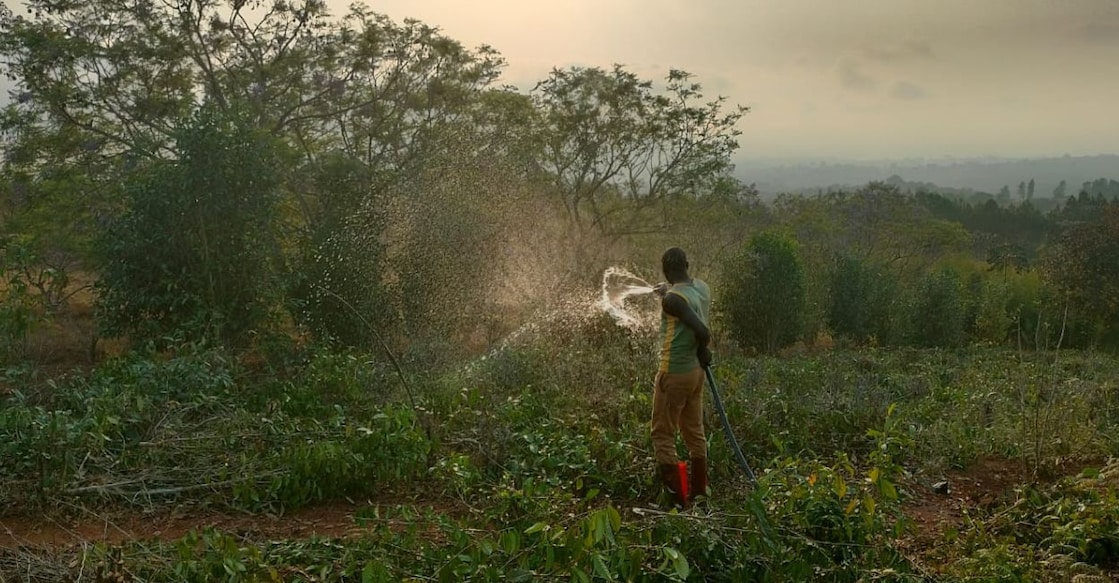
Dhaneesh arrived in Cameroon in January and completed the first phase of the project by March. What he encountered was a plantation left unattended for nearly eight years. Starting from scratch, he initiated rejuvenation by pruning sections of the tea bushes to restore plant health.
“Within the first week, approximately 2.5 hectares were pruned and revival initiated,” he said, adding that he also conducted hands-on training sessions for local workers, teaching them pruning techniques, irrigation practices for dry seasons, and methods to improve overall plant vitality.
A key focus was introducing Zero Budget Natural Farming practices. Workers were trained in preparing and applying traditional organic formulations such as Jeevamrutham (a mixture of cow dung, cow urine, gram flour, and jaggery) and Dashaparnika (a botanical extract made from the leaves of ten plants). These inputs significantly enhanced microbial activity in the soil and were integrated into daily plantation management practices.
Establishing a micro-unit in Cameroon
Initially, the plan was to produce entirely hand-rolled green tea. However, Dhaneesh soon realized the limitations due to labour shortages and the labour-intensive nature of the process. He recommended a more practical approach: establishing a micro tea factory based on the successful model developed by his father in India.
This marked a strategic shift from purely artisanal production to a hybrid model combining traditional knowledge with modern processing techniques.
A second phase of the agreement was signed to set up a mini tea factory in Cameroon with a processing capacity of 500 kilograms of green leaf per day. This phase includes, procurement, installation, and commissioning of machinery, training local personnel in green tea processing techniques and continued advisory support in natural farming and plantation management, said Dhaneesh.
The foundation will handle logistics such as travel, accommodation, and operational support, along with a monthly consultancy fee.
The Cameroon Context
The tea cultivation in Cameroon remains limited, with around 3,890 acres under cultivation and an annual production of approximately 5,000 tonnes, far below its domestic consumption needs, says the tea production experts.
The major tea cultivation zone in Cameroon is located near Mount Cameroon, which benefits from fertile volcanic soil. But the plantation of the Cameroon foundation has no nearby plantations and processing infrastructure.
The estate, once ornamental and partially used for vegetable cultivation, is now being transformed into a commercially viable tea unit, introducing the concept of micro tea factories to the region for the first time.
PK Green Tea: A micro production unit in The Nilgiris enchanting global tea lovers
The foundation of this success lies in the pioneering work of Dhaneesh’s father, P K Kumaran, popular as Kumarettan. Beginning his journey with a frying pan in 2013 by experimenting with tea production in his kitchen, Kumaran developed a low-cost, scalable model for micro tea processing.
Despite financial constraints and skepticism from others, his persistence led to the creation of a unique production unit costing under ₹20 lakh, with a capacity to process up to 500 kilograms of green leaf per day. This was the smallest form ever developed in the tea industry and also for a shoestring budget when other industrial units in tea cost more than ₹50 lakh scaling up to crores. His model has since been recognized and certified by the Tea Board of India.
Today, PK Green Tea exports to multiple countries, including the United States, the United Kingdom, Germany, Turkey, and several Gulf nations.
Tea Board recognition helps in easy brand promotion
According to Tea Board of India Executive Director Bharani Kumaar, the initiative represents a significant milestone in taking the principles of Zero Budget Natural Farming in tea cultivation to a global stage. Tea Board India also played a crucial role in upgrading the PK Green Tea unit from manual operations to a modern, technically equipped facility. The unit is now a certified Micro Tea Factory, equipped with specialized machinery such as a panner, orthodox roller, and dryer.
