

Analysis | Why 50% delimitation formula is unconstitutional, possibly a ruse to deceive southern states

Mail This Article


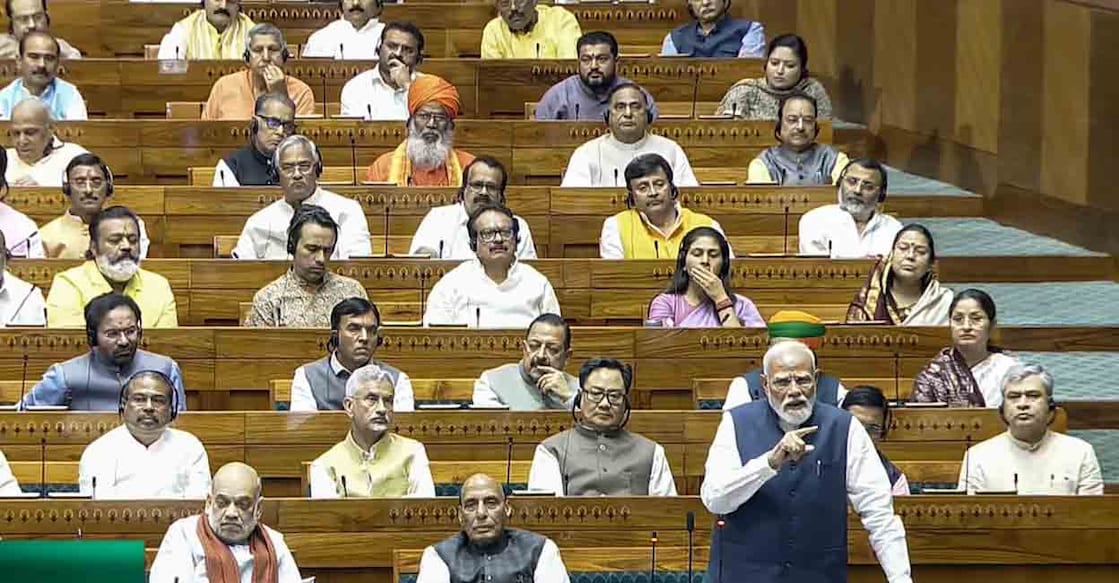
Prime Minister Narendra Modi was categorical in the Lok Sabha on Thursday that no states will be left out after the delimitation process.
"No injustice will be done to any state -- from east to west and north to south," the PM said during the discussion on the Constitution (131st Amendment) Bill, 2026, which would pave the way for both women's reservation and the redrawing of Lok Sabha constituencies before the completion of the 2027 census.
The basis for this assurance is the 50 per cent uniform increase in Lok Sabha seats for all states and union territories. Home Minister Amit Shah said in Parliament that a 50 per cent increase in seats would give "more seats to every state in South India". He said Tamil Nadu, which has 39 seats, will get 20 more. Kerala will get 10 more, he said.
50% delusion
BJP's young Karnataka MP Tejaswi Surya was the most spirited. He called the 50 per cent formula a "genius" concept. Before Shah, it was he who gave the numbers. He said Tamil Nadu's Lok Sabha seats will go up from 39 to 59, Karnataka's from 28 to 42, Andhra Pradesh's from 25 to 38, Telangana's from 17 to 26, and Kerala's from 20 to 30.
"The five southern states together gain 66 additional, while their collective share (in the Lok Sabha) remains exactly 23.7 per cent," Surya told the Lok Sabha.
Kollam MP N K Premachandran, who was in the Chair, asked Surya on what basis was he making the 50 per cent claim. "There is nothing in the proposed amendment Bill that speaks of this 50 per cent increase," Premachandran said.
Surya, who looked rattled for a moment, quickly took cover under Article 81(2)(a) of the Constitution, which essentially states that the ratio of the number of Lok Sabha seats allotted to a state and the population of the state should be the same "so far as practicable". In other words, an MP, whether in Kashmir or Kerala, should serve almost the same number of people.
Perhaps to wriggle out of Premachandran's poser that he himself termed "pertinent", Surya said the 50 per cent formula was derived from Article 81(2)(a). This was a faulty claim as the Constitutional mandate of uniform ratio for all MPs cannot be achieved under the 50% formula.
Magic million
As it stands, the Lok Sabha seats of states are based on the 1971 census.
Article 81(2)(a) says that the number of individuals represented by an MP across India should be almost the same. Based on the 1971 census, this uniform number was approximately 10.5 lakh (1.05 million) individuals.
For instance, Kerala's population was 2,13,47,375 (2.13 crore) as per the 1971 census. Each of its 20 seats on an average served 10,67,369 (10.67 lakh) people. Take Uttar Pradesh. Its 1971 population was 8,38,49,905 (8.39 crore). Each of its 80 Lok Sabha seats served 10,48,124 (10.48 lakh), almost similar to Kerala.
Each of Tamil Nadu's 39 seats catered to 10.56 lakh people, and each of Maharashtra's 48 MPs took care of 10.50 lakh people. More or less, the value of an individual vote was the same.
How a UP vote lost its value
However, with the increase in population over the years, this Constitutional ideal of 'One Person, One Vote, One Value' inherent in Article 81 has been jeopardised.
By 2011, Kerala's population rose to 3,34,06,061 (3.34 crore) from 2.13 crore. At this number, each of Kerala's 20 MPs on an average serves 16.7 lakh people.
Uttar Pradesh's population by this time shot up to 19,98,12,341 (19.98 crore), up from 8.38 crore in 1971. Since the 2011 census is kept as the base, each of its 80 MPs serve 25 lakh people. Each of Tamil Nadu's 39 MPs (based on its 2011 population of 7.24 crore) serve 19 lakh people, and each of Maharashtra's 48 lakh people (11.24 crore in 2011) serve 23 lakh.
Clearly, the uniform MP-population ratio has been wrecked. While a Kerala MP serves 16-17 lakh people, an MP from UP has to serve 25 lakh. More the number less the value of a vote.
New uniform number
So to restore the Constitutional ideal of 'One Person, One Vote, One Value' across India, delimitation has to be carried out. States like Uttar Pradesh and Bihar, though they have failed to control population through sound social and development measures, require more Lok Sabha seats.
Between 1971 and 2011, there has been a 120 per cent increase in the country's population; from 54.8 crore in 1971 it rose to 121 crore in 2011. So if the same jump is applied to the 'uniform number' a Lok Sabha MP has to serve, it will rise from 10.5 lakh to approximately 13 lakh.
If so, with the 2011 census as the base, Kerala would require 26 MPs (3.34 crore divided by 13 lakh). Uttar Pradesh, with a population of 19.98 crore, will need 154 MPs. Maharashtra, 86. Tamil Nadu, 56. Bihar, which now has 40 MPs, will then need 80. Only then will a single MP represent on an average 13 lakh people.
Yogendra's 'uniform number'
Political analyst Yogendra Yadav, instead of 13 lakh, has pegged the 'equal value' number at 14.5 lakh.
Then, Kerala will need slightly less, only 23 MPs. Uttar Pradesh, 138. Tamil Nadu, 50. Karnataka, which now has 28, will get 42. Telangana, which now has 17, will get 24. Andhra Pradesh, which has 25, will get 34. Maharashtra, 78. And Bihar, 72.
If the Yogendra Yadav 'One Vote One Value' model is applied, then the additional number of seats the five southern states will together get is 54.
The BJP's 50 per cent formula, however, will give the five southern states 66 additional seats.
Anomaly of 50%
This is seemingly beneficial for southern states. Problem is, this formula does not satisfy the 'One Person One Vote One Value' ideal, and therefore unconstitutional.
Under the 50 per cent formula, Kerala will get 30 seats. So each of its 30 MPs will serve approximately 11 lakh people. The 50 per cent formula will give Uttar Pradesh 120 seats. Each of its MPs will then serve nearly 17 lakh, at least six lakh more than an MP in Kerala.
Bihar will get 60, and each of its MP will serve 17.5 lakh. Maharashtra will get 72, and each of its MPs will serve 15.5 lakh. Tamil Nadu will get 59. Then, as per the 2011 census, each of its MPs will serve 12 lakh persons. Karnataka will get 42 MPs, and each of them will serve 14.5 lakh citizens.
In the process, what is lost is the uniformity the Constitution guarantees through delimitation. So even if the 50% rule is applied, it is not clear whether it will stand the test of law.
 Add as a preferred source on Google