

Parched border belt in TVM struggles as drinking water sources dry up
Mail This Article


Parassala: With summer tightening its grip over the region, Parassala and neighbouring panchayats along the state border are sliding into a severe drinking water crisis, as traditional sources dry up and piped supply systems struggle to cope with demand.
The shortage of potable water has reached alarming levels in the border panchayats of Karode, Kulathoor, Chengal and Parassala, which are already reeling under an intense heat wave. Wells and ponds across the region have dried up rapidly, while streams and canals have all but stopped flowing. In many areas, drinking water pipelines have turned defunct, leaving residents without a reliable supply even after making payments.
In Kulathoor and Karode panchayats, which include the coastal stretches of Pozhiyoor, residents are increasingly dependent on private suppliers to meet their drinking water needs. In the six coastal wards of Pozhiyoor under Kulathoor panchayat, drinking water has been supplied through tankers for over a week under the initiative of the local body.
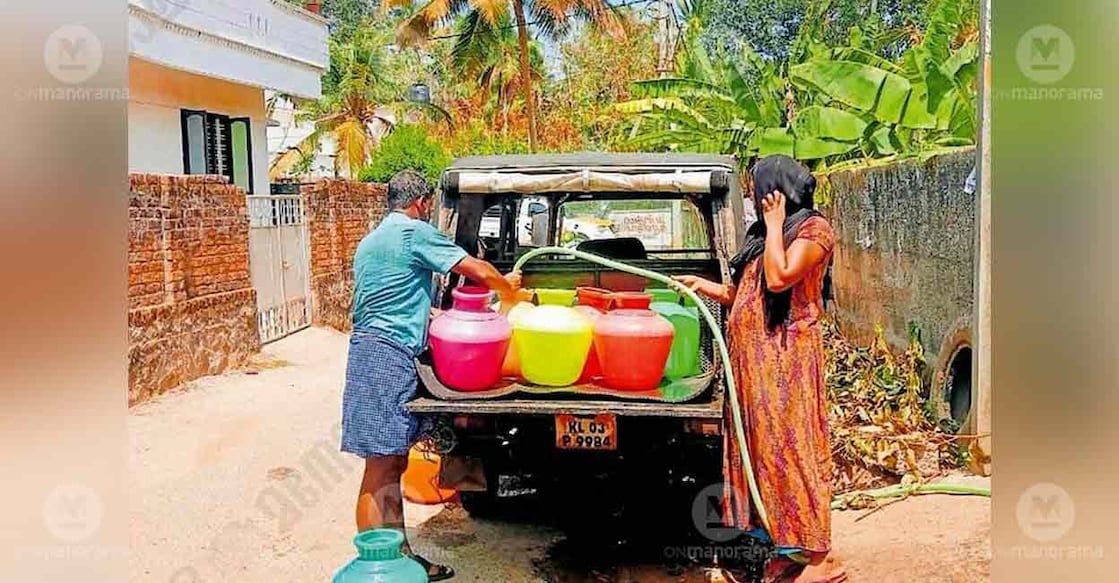
Being a coastal region, wells are already scarce here and those that exist are often brackish, making the water unfit for domestic use. Even the tanker supply is strictly rationed, with each household receiving only two or three pots of water.
Although the Kerala Water Authority has laid pipelines in the region, supply during the peak summer is limited to just twice a week and even then, for barely an hour each time. Long queues form at public taps as residents jostle to collect drinking water. With no assured supply, people are now forced to organise themselves and transport water from distant sources in small vehicles such as goods carrier auto-rickshaws, carrying filled pots back to their homes.
In Kulathoor panchayat, the lift irrigation system at Ooramvila offers some relief, enabling water to be channelled through the Neyyar canal to areas such as Mudippura. Water drawn from Mavilakkadavu in Neyyar is lifted and carried to the Neyyar sub-canal at Ooramvila, providing partial respite to residents in these pockets.
However, several areas in Karode panchayat, including Kadalikulam, Kunniyodu, Puthussery and Uchakkada, continue to reel under an acute drinking water crisis. Here, the Kollengode left bank canal of the Neyyar Dam remains the only major source of water. But a major pipeline near Venkulam, through which canal water is meant to flow into Karode, has remained non-functional for years, cutting off supply to these regions.
Though the Karode panchayat is willing to repair the pipeline, authorities say they are unable to proceed due to technical hurdles in fund utilisation. Locals have been demanding a solution similar to Kulathoor’s lift irrigation model, drawing water from a nearby source and diverting it into the Neyyar canal system, but the proposal remains unimplemented.
Drought cuts flow from Neyyar
Meanwhile, water flow in the Neyyar has dropped sharply, worsening the crisis for local bodies that depend heavily on the Neyyar Irrigation left bank canal during summer. A minimum discharge of 200 cusecs from the Neyyar Dam is required to feed the Kollengode, Chengal and Kollayil sub-canals through the system.
However, due to severe drought conditions, the Tathiyur shutter has been closed, reducing inflow to below 150 cusecs. As a result, even when water is released, it fails to travel through the entire canal network.

Adding to the strain, people at the upper reaches of the canal are reportedly diverting water for private use, which further disrupts downstream flow. According to Sajeev, Assistant Engineer of the Parassala Minor Irrigation Department, this is why water has not reached the final one-kilometre stretch of the Chengal canal, including parts of Kulathoor, despite releases over the past week. He added that strict action would be taken against such unauthorised diversion of canal water.
 Add as a preferred source on Google