

Hidden in plain sight: How a schoolgirl discovered 86 bird species on her 94-year-old campus

Mail This Article


On most mornings, long before the school bell rings and classrooms fill with chatter, Neharika D walks into the campus, spread across 10 acres, that, as she sees it, is already awake.
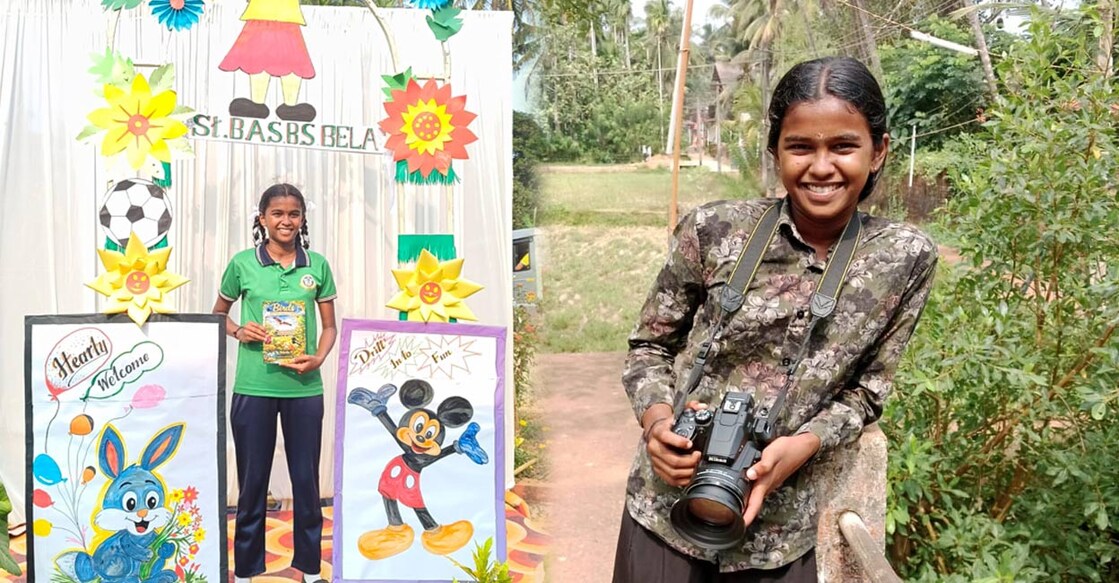
After seven years at St Bartholomea's Aided Senior Basic School, she left behind something that surprised even veteran teachers: a 45-page coffee table book documenting 86 species of birds she spotted and photographed on the campus.
“Our campus is a mixed habitat. It has rubber plantations, coconut groves, mango orchards, paddy fields, arecanut gardens and two laterite grounds,” said Neharika, with the ease of a seasoned birdwatcher. She is just 12, and has completed Class 7 at the primary school in Kasaragod’s Bela village in Badiadka. She named her book: 'Birds: The Hidden World on Our Campus'.
Her mentor, Raju Kidoor, does not hesitate to call her an expert. “Kasaragod has around 340 bird species. Neharika can identify at least 180 of them just by sound, sight or flight. So why not? She is a young expert,” said Kidoor, a teacher at Holy Family School.
Neharika, who will now join a new school in Class VIII, began her journey as a birdwatcher four years ago in Class 4. A chapter on birds of Kerala stayed with her longer than most lessons do. “At first, I noticed only a few familiar birds,” she said. “But as I kept watching, I realised the campus is full of birds… hiding, singing, feeding, playing, things we don’t see unless we stop.”
That “stopping” became a habit. And then, a discipline.
Her mother, Asha Kirana D, a botany teacher in a government higher secondary school, recognised the shift early. When Neharika was in Class 5, she bought her a camera -- a Nikon Coolpix P950 with a powerful zoom. It helped. But she prefers to be a birdwatcher rather than a photographer. “I am more interested in watching birds than clicking their photos,” Neharika said. "Photography is a very small part of birdwatching. I want to become an ornithologist," she says.
But her aunt, Usha Kirana, who often accompanies her on night stakeouts at the school, says Neharika has grown steadily as a photographer over the years. All the photographs in her book are Neharika’s own. Usha’s WhatsApp profile picture is an Indian pitta or the Navrang, clicked by her favourite niece.
Stopping to see, learn
For her book, Neharika followed a routine that many adults would struggle to keep. On the first and third Saturdays of every month, she arrived on campus between 7 am and 9 am, when bird activity was at its peak. On the fourth Saturday, she returned at night.
At each habitat, coconut grove, paddy field, orchard, she spent about 30 minutes, standing still, watching. Over a year, from November 2024 to October 2025, she didn’t just list birds. She watched how they lived.
She noticed that coconut groves drew the most life. “Birds love the coconut grove. They sunbathe there and find most of their food,” she said.
She found patterns across seasons: winter mornings that carried sound more clearly, summer days that shortened activity, monsoon months that brought a sudden surge of movement, with juvenile birds learning to fly and parents constantly feeding them. By March and April, activity dipped, only to rise again with the rains.
“Observing regularly helped me understand how weather, food, and human activity change bird behaviour,” she said. The bird she spotted only once on the campus was the greater spotted eagle. "It was circling overhead, and I thought it was a vulture," she said.

The campus is quiet at night. “The only bird I hear is the Jerdon’s nightjar. I haven’t seen it yet, but I know it’s there from its sound," she said. It’s like someone gently tapping a piece of wood again and again, each note ending with a slight tremble. The book does not have its photo.
Among the many birds she recorded, some stayed with her more than others. The red-whiskered bulbul is one of them.
“They’re active all seasons. They get along with other birds,” she said. “Once, when I was watching one, it wiggled its head at me and flew away. I felt like it noticed me.”
Then there are the drongos. “They’re like the police of the bird world,” she said. “If there’s a predator around, like a cat or a shikra, they alert other birds. Sometimes, they even mimic the predator’s sound to warn everyone.”
Not alone in the journey
What began as a solitary habit slowly became shared.
Prithvi M S, Drishya, Aradhya P Alva, Yukthi, Vaishnavi, Aral Niya D’Souza and Asher Neil D’Souza started accompanying her. “Initially, not many were interested,” Neharika said. “But when they kept coming, they started noticing more.”
Yukthi, in particular, surprised her. “She wasn’t very interested at first. Now she can recognise around 30 birds by sound and sight.”
What makes her different
There are a few young birders in Kasaragod district, but few are as persistent and disciplined as Neharika, says Raju Kidoor. "She is consistent. When not on the campus, she would be in her backyard watching the birds."
She also regularly attends bird camps, nature walks, and counts. Over time, she began mentoring other young birders as well, sometimes even guiding those older than her.
Birdwatching, she says, has taught her patience, the art of waiting without expecting. It taught her that even familiar places can become new if you stay calm and pay attention. “The sounds humans create disturb birds the most,” she says.
She is not just a birdwatcher. She is also a discus thrower who has competed at the state school games. Every day, she heads to the ground for practice, but she uses even that time to grow into the ornithologist she hopes to become. “I spend time watching birds when I go for practice and while coming back,” she says.
 Add as a preferred source on Google