

When a terrace turns tropical: A family’s journey in sustainable living
Mail This Article


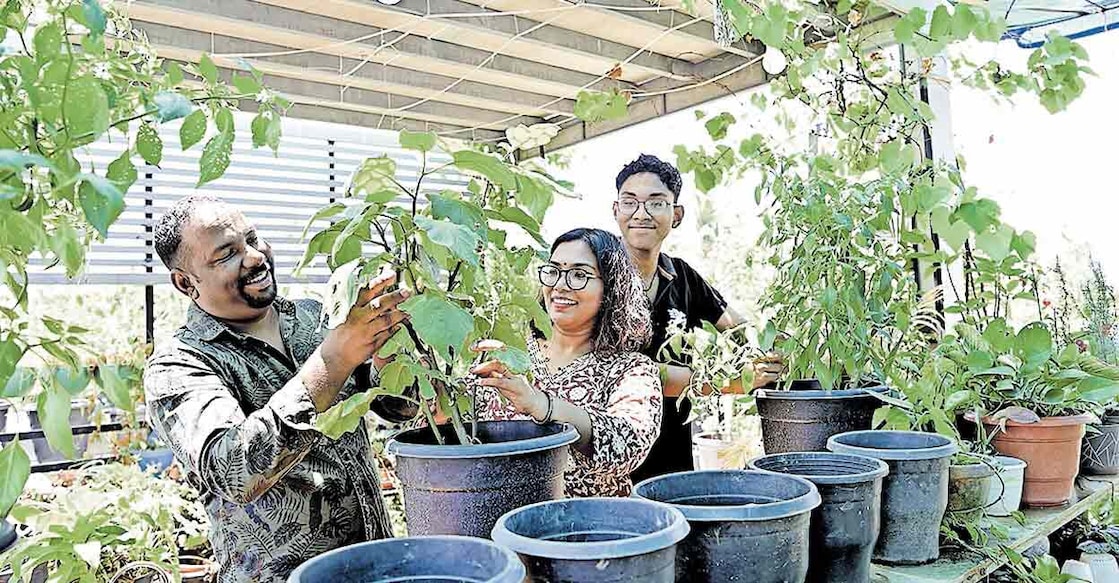
If a lush fruit forest suddenly rises above a third-floor terrace as you pass through Sanchaarimukku in Kollam, you are looking at the home of Dr K Mohanlal and Dr Devi Raj, a couple who have embraced sustainable living as a way of life.
Both psychologists, they run institutions such as Prana Holistic Healthcare and the Prana Institute of Brain Science and Rehabilitation in Kollam. Their work in mental health has given them a clear understanding of how nurturing the soil can in turn nurture both mind and body. Guided by this belief, they have transformed their three-storey home into a thriving expanse of fruits and vegetables, where every corner breathes life.
The greenery is not confined to the terrace alone. Balconies on the second and third floors overflow with plants, while even the narrow strip between the house and compound wall has been converted into a productive growing space. Walk past the terrace swimming pool, and it opens into what feels like an Eden in the sky. On the balconies, a four-inch layer of soil supports this elevated garden.

At the very top, the terrace unfolds into a dense canopy of around 40 trees, turning the rooftop into a thriving orchard in the sky. A remarkable variety flourishes here, including guava, papaya, star fruit, ambazham, gooseberry, jackfruit, mango, jamun, Indian jujube, agathi, peanut butter fruit, rambutan, sweet lime, multiple varieties of rose apple, small oranges, pomegranate, mangosteen, two kinds of sapota, different varieties of cherry and sarvasugandhi or allspice, among many others. Interwoven among them are three clumps of banana, bush pepper vines, and creepers of grape and passion fruit trained to spread across the space.
The idea, Dr Devi recalls, took root after watching terrace farming initiatives on television. When plans for their home began three years ago, they had already decided that the terrace would become a fruit garden. Within two weeks of the housewarming, the first saplings were planted on the rooftop. They used containers made from cut plastic barrels, deep enough to allow roots to spread and strengthen, which soon led to abundant flowering.
Most of the trees, especially guava, papaya, sapota, jujube, miracle fruit, cherry, and star fruit, have been yielding generously in these containers. Star fruit in particular has produced up to four kilos at a time, without a strict seasonal cycle. The mango trees on the terrace are now entering their second harvest season. “The joy of being able to share such a rich variety of fruits with our neighbours is beyond words,” says Dr Devi.
Vegetable cultivation is equally vibrant here. Green and red spinach are among their favourites, along with ladies finger, three varieties of brinjal, two types of tomatoes, several kinds of chilli, bush pepper, arrowroot, and curry leaves. From this rooftop itself, a wide range of edible greens is harvested regularly. Dr Devi notes that leafy vegetables form a key part of their daily diet, with almost all commonly used varieties now grown on the terrace. At regular intervals, they also cultivate microgreens, which are included in everyday meals.
Although the couple had originally dreamed of extensive farming, the reality of a six-cent plot, with most of it occupied by the house, forced them to think differently. The vegetable growing area was created by laying a fibre sheet base and spreading a mix of soil, cow dung compost and coconut husk to a depth of about four inches. Since most vegetables do not require deep root systems, this method transformed the limited space into a thriving sky garden.
Recognising the health benefits of fruits and vegetables grown without chemical exposure and with their freshness intact, the family has developed a strong affinity for terrace farming, says Dr Devi. She also points out that it serves as an effective way to unwind after the pressures of daily work. “Those working in mental health must prioritise their own well-being as well,” she adds.
The couple’s green way of life has also left a strong imprint on the next generation of the family. Their son, Alain Eric Lal, a Class 9 student at Delhi Public School, Meeyannoor in Kollam, has already planted and nurtured more than a thousand banyan trees across various parts of Kerala. He says a formative experience at the age of eight sparked this environmental commitment.

What profoundly affected Alain was the felling of a massive banyan tree in Kollam for the development of Kollam Thodu (canal). The sight of the tree, once a shelter for countless birds and squirrels, being brought down left a lasting mark on his young mind. From that moment, he began planting banyan saplings. When saplings were not easily available, Alain started propagating them on his own. After developing a successful method of raising saplings through branch cuttings, his efforts quickly gathered momentum.
Out of nearly 3,000 cuttings planted, around 1,000 saplings successfully took root. The journey, however, was not without setbacks. Nearly 300 saplings nurtured by Alain were later cleared for national highway development. Following his complaint, authorities assured him that once the highway expansion is completed, he would be allowed to replant saplings in the area.
Alain is also the author of Lost World of Moms and Covid Diary. He has received several honours, including the Ujjwal Balya Puraskaram, Green Hero Award 2021, Dr A P J Abdul Kalam Bhoomimitra Award and the Sundarlal Bahuguna Environment Award. The youngster was also invited and felicitated as a guest at the official residence of former Kerala Governor Arif Mohammad Khan.
 Add as a preferred source on Google