
Kannur man died after rare infection in Bengaluru; body exhumed 4 months later amid negligence probe
Mail This Article


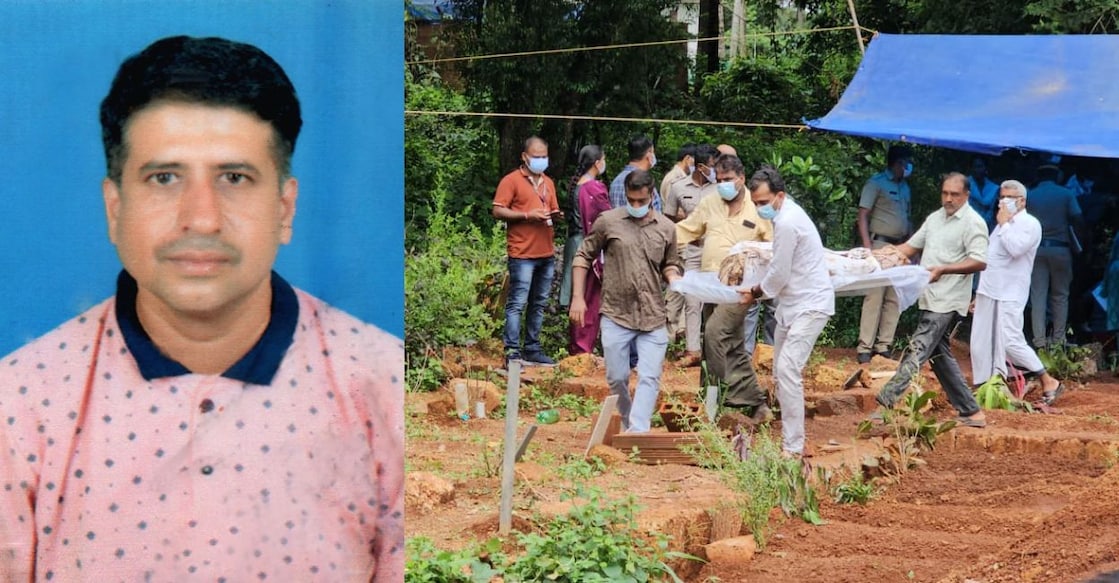
Kannur: Four months after a 45-year-old Dunzo delivery worker was buried in his native village in Kannur, his body was exhumed on Tuesday, July 7, after the Taliparamba Sub-Divisional Magistrate ordered an autopsy to determine whether he died solely from a rare, "flesh-eating" bacterial infection, or whether there were lapses in his treatment in Bengaluru.
For Sharly D (35), the Tamil-speaking widow of Shanavas C V, the order is a small victory in her relentless fight against Victoria Hospital, Bengaluru's largest government hospital, and also against the city police.
Shanavas's body was exhumed from the Iriveri Juma Masjid graveyard in Kannur's Chembilode panchayat around 10 am in the presence of Kannur Tahsildar N K Manoj Kumar and Chakkarakkal Police.

The autopsy was conducted at the graveyard by a three-member forensic team led by Dr Priyatha T of Government Medical College Hospital, Pariyaram. The entire procedure was videographed. “The autopsy team recovered mummified (dried and hardened) tissue from the genital region. They also found soft tissue there which will help us determine whether infection was still present at the time of death,” said Dr Prajith T M, Forensic and Police Surgeon at Kannur Government Medical College, Pariyaram.
Shanavas was treated at Victoria Hospital, the biggest government hospital in Bengaluru. After referring to the medical records, Dr Prajith said the hospital had correctly diagnosed Fournier's gangrene, a condition that requires emergency surgical removal of dead and infected tissue. However, he questioned the manner in which the procedure was allegedly carried out. "The treatment initiated was appropriate. But based on the history available to us, the surgery was allegedly performed in the ward instead of an operating theatre, under the light of a mobile phone flashlight, and the patient was made to lie on the floor. Those are not aseptic conditions," he said. Also, he was discharged without proper healing, said the forensic surgeon. “All that points towards medical negligence,” said Dr Prajith, an associate professor at the Kannur Medical College.
The autopsy has been video-recorded, and Chakkarakkal police would hand over the sealed CD to Bengaluru City's Vishveshwarapuram police investigating Shanavas's death.
Shanavas died at his rented home in Bengaluru's Bommanahalli on March 15. On March 16, Sharly travelled with their four children — the youngest just two-and-a-half months old — and an ambulance carrying his body to Iriveri in Chembilode panchayat, where he was buried according to Islamic rites.
Flesh-eating bacterial infection
Sharly alleges that her husband died because of medical negligence during treatment at Victoria Hospital. Hospital records show that Shanavas had been diagnosed with Fournier's gangrene, a rare and life-threatening bacterial infection that rapidly destroys the soft tissue around the genitals and the area between the genitals and the anus. Often described as a "flesh-eating" infection, it is a medical emergency requiring immediate surgery. According to the Cleveland Clinic, fewer than two people in every 1 lakh develop the condition in the US.
Doctors believe the infection usually begins when bacteria enter the body through a small cut, boil, surgical wound, insect bite or even a tiny tear in the skin. The bacteria then spread rapidly beneath the skin, killing tissue and, if left untreated, can lead to life-threatening sepsis.
Surgery under mobile lights?
Shanavas was admitted to Victoria Hospital on February 19 after suffering severe pain and swelling in the scrotal region for two days and developing a wound between the scrotum and the anus a day earlier. According to the hospital records accessed by Onmanorama, doctors at Victoria diagnosed him with Fournier's gangrene on the first day of admission.
-
1 HOUR 14 MINUTES AGO
Wayanad landslip: CM, Minister blame 'unscientific accumulation of mud'

Sharly, however, alleges that the emergency surgery was carried out by four postgraduate resident doctors in the ward rather than in an operating theatre. According to her, the students carried out three procedures through the night, each about one to two hours apart. "My father was asked to hold up a mobile phone with its flashlight switched on. I have videos of the students huddled over my husband, performing the surgery under the mobile phone light," she told Onmanorama. She also alleged that no nurses were present to assist the resident doctors during the procedure.
A 15-year love story cut short
Sharly met Shanavas while she was pursuing a diploma in nursing at Raja Rajeswari College of Nursing in Kambipura, on the outskirts of Bengaluru. Shanavas worked in a bakery opposite the college. They fell in love, married and built a life in Bengaluru.
As their family grew, Sharly never took up a job. Today she is the mother of four children aged six, five, two-and-a-half years and five months.
The family lived in a rented house in Hongasandra, paying ₹3,700 a month. Shanavas worked as a Dunzo delivery executive, delivering medicines and groceries across Bengaluru and earning around ₹30,000 a month.
Videos on Sharly's phone show Shanavas playfully tossing his two-month-old son into the air and catching him as the baby bursts into laughter. The next day, he complained of severe pain. Neither of them knew that he had developed one of the most dangerous bacterial infections.
A disease that spreads by the hour
The standard treatment for Fournier’s gangrene is emergency surgical debridement, the removal of dead and infected tissue, along with powerful antibiotics. Delaying the surgery can be fatal, as in severe cases, the infection can spread as fast as 1-2 cm an hour, said Dr Prajith.
Hospital records show that doctors explained the diagnosis and its risks to Sharly before obtaining consent for surgery.
After the surgery, Shanavas remained in the hospital for 12 days before being sent home on March 3. Another 12 days later, he was dead.
Sharly alleged the discharge was forced and done to cover up their failings. "He bled to death at home. I kept changing bedsheet after bedsheet to soak up the blood," she said.
'₹20,000 for autopsy'
Sharly said that after Shanavas died, she took the body to Victoria Hospital for an autopsy. "But the hospital officials told me that it would cost ₹20,000 or take the body elsewhere," she alleged.
Unable to arrange the money, she brought her husband's body by ambulance to Kannur. She wanted to give him a burial according to his faith.
After returning to Bengaluru, she approached the Vishveshwarapuram police, alleging medical negligence. "But the police told me that they could not proceed without a postmortem report," she alleged.
With no progress in the investigation, she approached the media in Bengaluru. Only after the case received widespread media attention, she said, did the Vishveshwarapuram police seek permission from the Taliparamba Sub-Divisional Magistrate to exhume the body for a postmortem examination.
SDM Vandana S promptly allowed the request, directing that the exhumation and postmortem be done on July 7. Her order directs Vishveshwarapuram Police to bear the cost of the autopsy.
Despite hospital records showing that they informed Sharly about the disease and the risk it carried, she did not know that her husband contracted Fournier’s gangrene. In fact, several media covering the case reported the disease as piles. But Sharly's questions remain focused not on the diagnosis but on the manner in which the surgery was carried out and the decision to discharge Shanavas before his wound had healed.
 Add as a preferred source on Google