
How to plant coconut, banana, and tubers for a bumper harvest
Mail This Article


Success in farming begins with selecting the right planting material and mastering the art of soil preparation. Whether you are planting coconut palms, Nendran bananas, or nutrient-rich tubers like elephant foot yam, taro, and greater yam, following systematic agricultural practices can significantly boost your yield. Here is a comprehensive guide to getting your planting methods right this season.
Selecting and planting the perfect coconut seedling
Regardless of the variety you choose, selecting healthy, high-quality seedlings is paramount. Look for one-year-old seedlings that feature at least six leaves and a sturdy collar girth of 10 to 12 cm. Ideally, the seedling should have one or two split leaves. If you are planting tall varieties such as the West Coast Tall (WCT), ensure the seedling is at least one metre tall; for dwarf varieties, a minimum height of 75 cm is recommended.
To facilitate profitable intercropping, maintain a spacing of 7.5 metres between individual coconut palms. The dimensions of the planting pit depend on your soil type. Dig pits of 1.25 m depth, width, and length in hard laterite soil. For deep red or black soil, a one-metre pit is ideal, while a 0.75-metre pit suffices in sandy soil. In waterlogged regions, construct mounds that are 1.5 metres in diameter and height to elevate the young plants.
Prepare the pits by filling three-quarters of the space with a mix of topsoil and one kilogram of dolomite or agricultural lime. Water this mixture for 10 to 15 days to effectively reduce soil acidity before applying any basal fertilisers. Once the soil is treated, mix in three to four kilograms of organic compost, and one kilogram each of bone meal (or Rajphos) and neem cake. Scoop out a small central planting hole inside the main pit, toss in a handful of rock salt, and add 20 grams of an approved chemical pesticide to ward off termites and rhinoceros beetles. Gently lower the seedling into this central hole, firm the soil around it, and provide light shade. Apply light doses of ammonium phosphate-sulphate (Factamfos) and potash every three months to accelerate growth.
Pre-planting preparation for banana and tubers
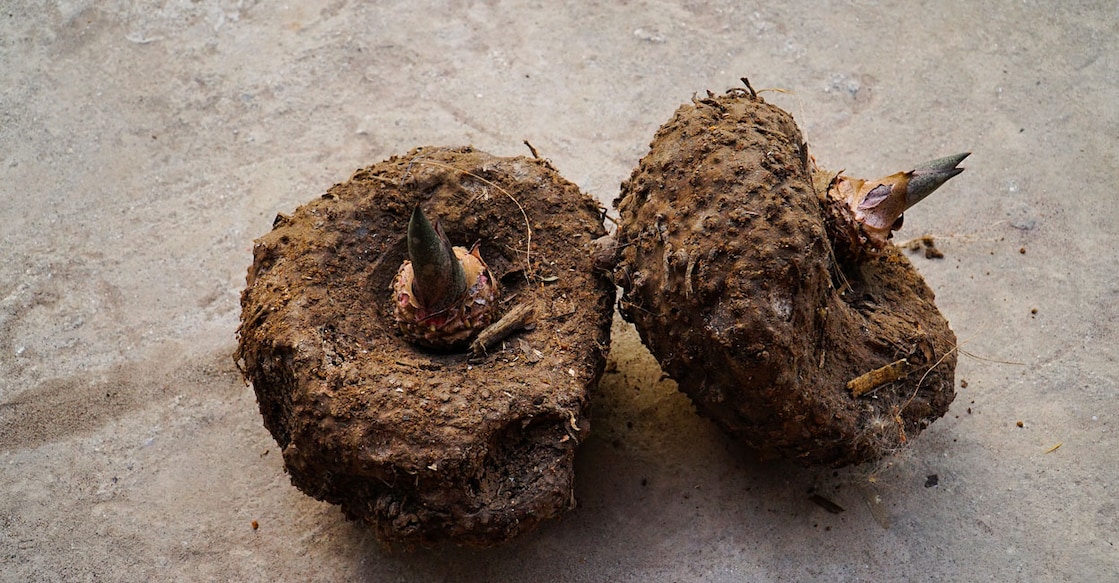
For Nendran bananas, elephant foot yam (chena), taro (chembu), and greater yam (kachil), selecting pest-free, disease-resistant seed stock of medium size is critical. Before planting, trim away old roots and outer pseudostem sheaths from the banana suckers. For the tuber crops, slice the seed tubers into planting sets or pieces. Ensure each piece has exactly one healthy, prominent bud (eye) and carefully scoop out any excess buds—a process traditionally known as de-eyeing. It is worth noting that larger seed sets of elephant foot yam yield larger tubers, while smaller sets produce smaller ones. For greater yam, avoid giant varieties as they have lower commercial demand; opt for the popular small, round varieties instead. Dip the prepared tuber sets in a thick slurry of fresh cow dung and wood ash before planting.
Sun-drying and soil de-acidification
To eliminate pathogens and stimulate uniform sprouting, sun-dry the treated banana suckers for four days, followed by three days of drying in the shade. Prepare all planting beds and pits at least ten days in prior. For Nendran bananas, dig pits of 0.5 m depth, width, and length. Fill three-quarters of the pit with topsoil mixed with half a kilogram of dolomite or lime, and water it thoroughly.
For elephant foot yam and taro, dig circular pits to a depth of 0.5 metres, mix in 100 grams of lime, and water well. For greater yam, prepare pits with a minimum width of 1.5 feet, incorporating topsoil with 200 grams of lime or dolomite. Let these treated pits sit watered for ten days to lower the soil's acid content.
Final planting and mulching
After ten days of soil preparation, it is time to add the basal fertilisers. For banana pits, mix three to four kilograms of compost, half a kilogram of Rajphos or bone meal, and half a kilogram of neem cake with the treated soil. Apply a similar ratio of organic and chemical fertilisers to the pits of the tuber crops. Place the dried banana suckers or tuber sets into their respective pits, cover them gently with soil, and apply a thick mulch of dry leaves. Top with another light layer of soil to lock in moisture and encourage rapid root development.
