
Former teacher swaps classroom for the farm, tastes success with rare rainbow corn
Mail This Article


For nearly 15 years, Reshma Angelin from Amaravila in Thiruvananthapuram led a busy life as a private school teacher. Today, she has traded her lesson plans for farming tools, dedicating her time entirely to cultivating fresh, organic produce. What began as an effort to secure safe, pesticide-free fruits and vegetables for her family has blossomed into a highly profitable agricultural enterprise.
Reshma manages her green sanctuary, named Edens Field, on her compact five-cent home plot. Every available space, from the balcony to the terrace, is draped in lush greenery. To scale up her passion, she leased an adjacent 20 cents of fallow land, converting it into a thriving farm and plant nursery. By retailing plants online and in person, she has successfully unlocked a steady stream of income.

The magic of glass gem corn
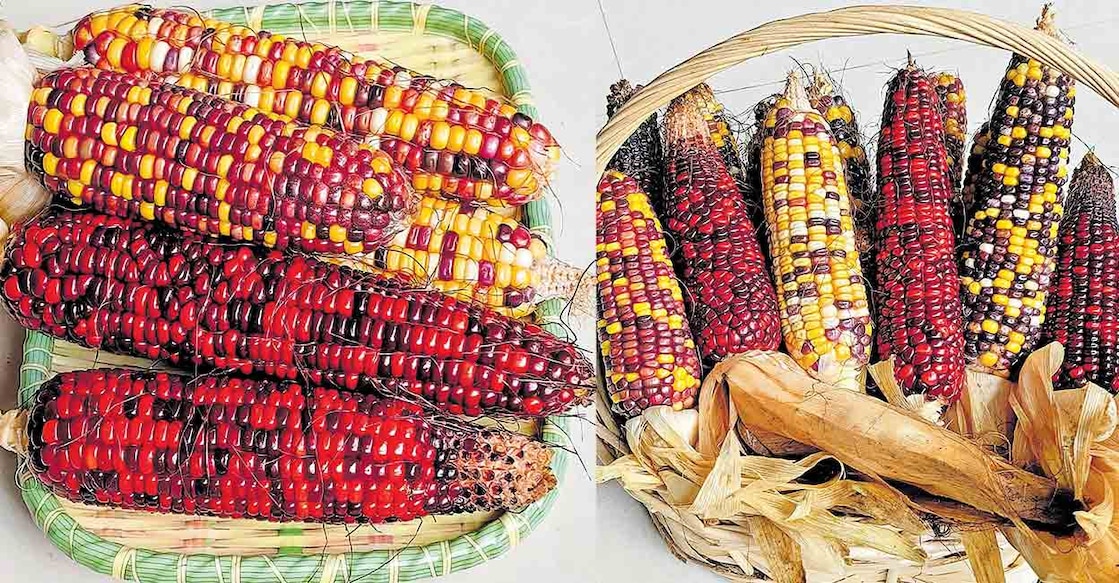
Among the many crops in her garden, the showstopper is undoubtedly the rainbow corn, also known as glass gem corn. This striking variety boasts translucent, multi-coloured kernels that glisten in shades of yellow, orange, pink, black, and red, resembling a cluster of precious gemstones. Developed by American farmer Carl Barnes, this vibrant heirloom variety has captured global attention for its decorative appeal and excellent culinary qualities, making it ideal for popping into popcorn or grinding into high-quality meal.
Sourcing the seeds and planting
Reshma’s journey with this exotic crop began when she heard of a homemaker in Malappuram cultivating it successfully. She reached out, learned the farming techniques, and sourced her first batch of seeds. Planting rainbow corn requires a structured approach. The seeds are sown 2 to 3 cm deep, maintaining a spacing of 25 to 30 cm between plants, and 60 to 75 cm between rows. The soil must be watered thoroughly right after sowing and kept consistently moist until germination, which usually takes five to ten days.
Nurturing the crop
Around 20 to 25 days after germination, Reshma applies organic fertiliser or compost to boost growth. As the plants grow larger, soil must be carefully piled around the base to provide strong support. Because corn is wind-pollinated, planting them in blocks of four to five rows rather than a single row ensures optimal pollination and well-formed ears.
The road to harvest
The growth timeline of rainbow corn is a fascinating process. About 45 to 60 days after sowing, male flowers bloom at the very top of the plant. Within three to seven days, the delicate silk of the female flowers emerges from the developing ears. Wind and insects facilitate pollination, and by day 20 to 25 post-pollination, green ears of corn begin to form. The kernels start hardening over the next 15 to 20 days. Finally, after another two to three weeks, the vibrant, translucent rainbow colours reveal themselves, signalling that the crop is ready for harvest.
Seed preservation tips
To preserve seeds for the next season, choose fully matured ears from the harvest. These should be dried thoroughly for two to three weeks. Once completely dry, carefully separate the kernels from the cob and let them dry in the shade for another two to three days. These well-dried seeds can then be stored in airtight glass jars or zip-lock bags to keep them fresh for future planting.
